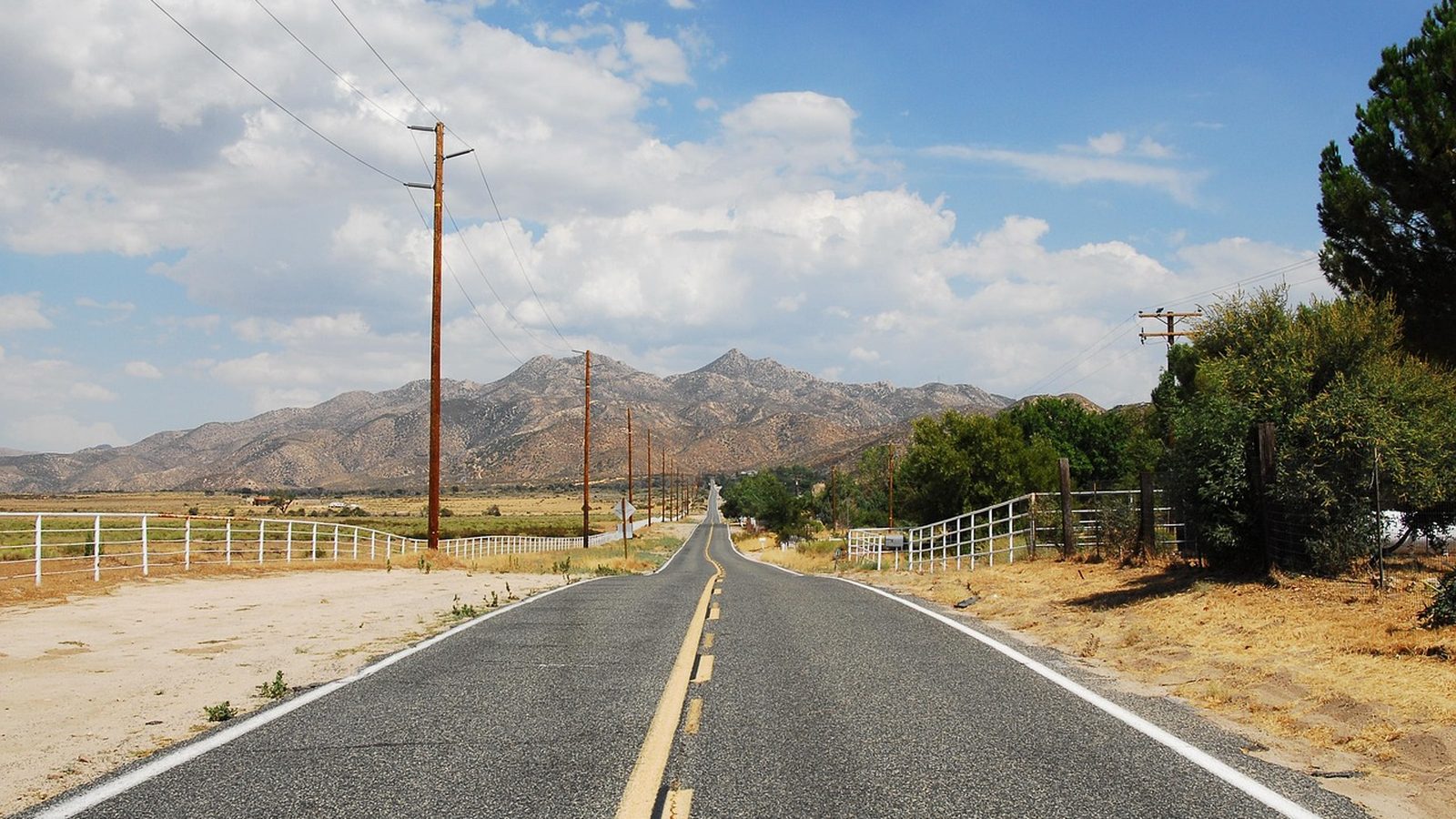
Photo: 2855717, via Pixabay
California · Hesperia
Hesperia solar: the fee is high, the sun is higher
Written by the Solar Learning Lab research deskUpdated August 26, 202612 min read
Start with the number the sales decks skip. Hesperia's fee schedule, effective December 1, 2025, prices a residential photovoltaic permit at $486, or $429 with a stock plan, and then stacks a 10 percent technology fee on every permit. State law caps that base fee at $450 for systems up to 15 kW. Hold those two figures side by side for a moment, because almost nobody writing about High Desert solar does.
Then the compensation: this is one of the best places in California to point a panel at the sky. An independent European Commission PVGIS run models 1,741 kWh per year for every kW installed on a Hesperia roof, the strongest and steadiest yield of any city we researched this week. High fee, exceptional fuel. The rest of this page is about not fumbling the details in between.
Check the yield against your bill
A Hesperia kilowatt out-produces most of the state. See what that means at your usage level before talking to anyone.
Open the calculator$486, $429, and the $450 line in state law
The FY 2025-26 fee schedule lists "Windmills and Photovoltaic Systems (Residential)" at $486 for plan review and inspection. Submit a stock plan and it drops to $429. Non-residential runs $845 per structure. Riding on top of every permit: a Technology Fee of 10 percent, a General Plan update fee of 7 percent of the building permit per equivalent dwelling unit, and a credit card processing charge at whatever rate Stripe, the SolarAPP+ payment processor, currently takes.
Now the statute. Government Code 66015 caps residential photovoltaic permit fees at $450 up to and including 15 kW, and exceeding the cap requires a written finding, an adopted resolution or ordinance, and substantial evidence of the reasonable cost of issuing the permit. Hesperia's $486 base sits above that line before the 10 percent add-on, and we could not locate a written finding on the City site during our research session. We are not a court, so we present the two documents side by side and let you draw the inference. What a homeowner can do about it is concrete: the stock plan option is the one lever that pulls the base fee to $429, under the cap.
Also in the schedule, for when an inspection goes sideways: the building re-inspection fee is listed at $103, while a separate section of the same document says no charge for the initial re-inspection, $75 for the second, and $100 for the third. Yes, both entries exist. Get your inspector's expectations in writing before the visit.
The High Desert advantage, quantified
Hesperia sits at roughly 3,200 to 4,000 feet in the Mojave's Victor Valley, with cold desert air, thin cloud cover, and 6.19 inches of rain in an average year, per the city's climate record. That geography is why the European Commission PVGIS v5.3 run at a 20 degree tilt models 1,741.28 kWh per kWp with a year to year standard deviation of just 26.29 kWh. Both numbers beat Rialto and El Cajon, the other two cities in this research batch. Steadier output means tighter payback forecasts, which is worth more than most people credit.
Our own PVGIS v5.2 model, run at a steeper 30 degree tilt for consistency across every city we cover, comes in higher still at 1,930.4 kWh per kW annually. The gap between the two runs is tilt and model vintage, not a contradiction. Either way, the chart below is the shape that matters.
May models as the peak month at 184.0 kWh per kW, and the curve dips through July before a small August rebound. Midsummer is not automatically the top of the year here.
PVGIS v5.2 model run by Solar Learning Lab on August 26, 2026, NSRDB radiation database. Fixed south facing mount, 30 degree tilt, 14 percent losses, downtown Hesperia coordinates. Your roof will differ. Run details live at the PVGIS tool. One local caution: summer means 99 degree July and August afternoons and monsoon thunderstorms, and December nights average 31 degrees. Equipment here works harder than a spec sheet at room temperature suggests, so ask bidders about temperature ratings, not just wattage.
SolarAPP+, with three Hesperia-only rules
Hesperia runs its residential solar permitting through SolarAPP+, as tracked in the CEC's SB 379 program file, and the state statute behind it, Government Code 65850.52, contemplates real time permit issuance up to 38.4 kW AC. The City's own promise is more modest: submit in SolarAPP+, pay the platform fee plus City fees, and a City permit in the AEXX-XXXXX format arrives within two business days of approval. Two days, not two minutes. Plan schedules accordingly.
Rule one, the one that stalls out-of-area quotes: the installer must hold a City of Hesperia Business License on top of a California contractor license. A cheaper bid from a crew that has never worked the Victor Valley often dies right here. Ask for the license number before you sign, not after.
Rule two: systems over 15 kW need an additional roof mount inspection before any panels go on, which forces the crew to sequence around a City visit. Under 15 kW skips it, and 15 kW happens to be the same break point where the state fee cap steps up. There is a quiet argument for right-sizing at or below that threshold.
Rule three: the fast lane is narrower than it looks. The eligibility list requires under 38 kW, rooftop residential only, no ground mounts, no ballasted systems, a legal permitted structure that is not historic, and, the sleeper, no existing photovoltaic system or battery on the property. A battery retrofit on an older array does not qualify. Keep the SolarAPP+ plans, the Hesperia permit, and the job card on site, request inspections at 760-947-1300 with 24 hours notice, and use the City's contracted hauler, Advance Disposal, for construction debris, because the City says permitting can be halted if you do not.
One city, two baseline regions, zero CCAs
Electricity comes from Southern California Edison, and SCE's filed community index lists Hesperia under baseline regions 14 and 16, plural. Baseline allocation, and with it the value of the 10 cent per kWh baseline credit, depends on the specific address, so any citywide savings example is already fudging. SCE's territory-wide 2024 residential average was about 32.4 cents per kWh in EIA's sales data. And despite Apple Valley Choice Energy operating literally next door, SCE's CCA list shows it serves Apple Valley only. Hesperia has no community choice option; generation is SCE bundled service, full stop.
| Energy source | Type | Average price | What that means |
|---|---|---|---|
| SCE TOU-D-5-8PM | summer weekday pricing | 34¢ to 74¢ per kWh | The 5 to 8 p.m. peak hits 74¢, or 64¢ after the baseline credit. That is the widest spread on the menu. |
| SCE TOU-D-4-9PM | summer weekday pricing | 34¢ to 58¢ per kWh | On peak 4 to 9 p.m. at 58¢ before the credit; off peak 34¢. October to May midday drops to 33¢. |
| SCE TOU-D-5-8PM | October to May pricing | 32¢ to 60¢ per kWh | Super off peak 32¢, off peak 38¢, mid peak 60¢ before the baseline credit. |
| Onsite solar | self-consumed energy | retail avoided cost not a fixed tariff | Production used behind the meter offsets these prices hour by hour. Exports are credited at lower avoided-cost values. |
SCE time of use plan postings, August 2026. Posted prices, not a simulation of your account.
For new solar customers the governing framework is the Net Billing Tariff, and Decision 22-12-056 adds an ACC Plus export adder of $0.040 per kWh for SCE residential customers, $0.093 with CARE, on the eligible import rate, which is TOU-D-PRIME, the plan SCE requires for Solar Billing Plan customers and reserves for households with an electric vehicle, a battery, or an electric heat pump. It carries the same $0.79 daily charge with no baseline credit, and a plan switch locks you in for 12 months. The nine year legacy protection follows the customer, not the house. None of this changes the core Hesperia physics: with a 74 cent evening peak available on one plan and 33 cent winter middays on another, the money is in consuming your own production when SCE is expensive.
When SCE turns the power off on purpose
Hesperia maintains its own Public Safety Power Shutoff page, which tells you something. SCE de-energizes lines in high fire risk areas during dangerous weather, residents get notified by SCE directly, and the City's advice for the aftermath is cooling centers and dialing 211. Pair that with the local climate, 99 degree average July and August highs and monsoon storms that can knock out power on their own, and the resilience case for a battery here is not marketing. It is the difference between a shutoff being an inconvenience and being a health problem.
The wildfire maps have teeth now too. The City's Information Bulletin IB-25-002 applies Wildland-Urban Interface construction standards to new construction in Very High fire severity zones from July 22, 2025 and High zones from January 1, 2026: Class A roof assemblies, ember-resistant vents with metal mesh between 1/16 and 1/8 inch, protected eaves. Additions and remodels to buildings constructed before July 1, 2008 are exempt, which covers most of Hesperia's stock, but if your solar project includes a new-construction reroof in a mapped zone, price the WUI requirements in from the start.
Remember the SolarAPP+ exclusion above when planning: solar plus battery together on a clean roof rides the fast lane; adding a battery later to an existing array does not. Sequencing the storage decision up front is worth real money and real weeks in this specific city.
What incentive money still exists in 2026
The federal 25D homeowner credit is gone for new installs: P.L. 119-21 ends it for expenditures after December 31, 2025, with the expenditure counted at installation completion, per the CRS explainer. Carryforward from earlier installs survives. That leaves state programs with income gates. SGIP's Residential Solar and Storage Equity budget pays $3,100 per kW of solar and $1,100 per kWh of storage for qualifying low income households, with reservations open since June 2, 2025 and a demand response enrollment requirement. DAC-SASH serves CARE or FERA eligible households in CalEnviroScreen's most disadvantaged quartile through 2030. With Hesperia's median household income at $68,971 on 2023 estimates, a meaningful share of the city can actually clear those gates.
The property tax side is quietly favorable: a qualifying active solar system is excluded from new construction assessment, though the exclusion sunsets January 1, 2027 as currently scheduled. The City itself offers no rebate, and its $80,000 CalAPP award from February 2023 in the CEC tracker funded permitting software, not homeowner checks.
Who actually installs in the Victor Valley
The snapshot below leans local: Apple Valley, Victorville, and Oak Hills companies rather than coastal brands with a satellite truck. Given the business license rule, that local weighting is rational. Whoever you pick, two questions sort the field fast: what is your Hesperia Business License number, and how do you handle the roof mount inspection if the design crosses 15 kW.
Socal Energy Group, Llc
Victorville, CA
4.9(292 Google reviews)
Nippon Energy
Victorville, CA
4.6(31 Google reviews)
Solar and Patio Pros
3.9(21 Google reviews)
Cinran Electrical Solutions Inc.
Apple Valley, CA
4.8(18 Google reviews)
Guasti Solar
Oak Hills, CA
4.6(14 Google reviews)
Ratings snapshot: Google Maps, August 2026, via the DataForSEO SERP feed. Zero companies paid us and none are endorsed by us.
Review counts up here are smaller than down the Cajon Pass. A 14 review company is not automatically worse than a 374 review company, but the thinner the record, the more weight belongs on license verification, workmanship warranty terms, and a job-site address you can drive past.
Run the Hesperia numbers
The calculator applies the statewide average rate to our downtown Hesperia production run. It does not know which of the two baseline regions your address falls in, and it cannot price a Public Safety Power Shutoff. What it shows well is scale: at this production level, modest systems cover serious usage, and oversizing past your load buys export credits worth far less than the retail power you already offset.
The high end of the slider is our downtown Hesperia PVGIS run, the strongest of any city we have modeled in this batch. The low end is 85 percent of it, a discount for an imperfect roof, not a forecast.
Cash quotes in Hesperia cluster near $2.46 per watt, against a $3.50 national 2024 median (LBNL). Use your quote.
Assumptions you can change
Use the rate on your actual lease or PPA quote. There is no published statewide average we trust enough to hardcode.
Cash purchase
$7,380 after state credit
- Year 1 benefit
- $160/mo
- Payback
- 4 years
- 20 year net position
- $39,348
This estimate uses the statewide average rate. Hesperia is SCE territory split across baseline regions 14 and 16, so the 10 cent per kWh baseline credit depends on the specific address, and exports under the Net Billing Tariff pay hourly avoided cost. The output is a starting point, not a bill.
Solar loan
$99/mo 15 yr payment
- Year 1 net
- $62/mo
- Upfront
- $0
- 20 year net position
- $28,964
Loan pricing here includes the state calculator's documented loan-over-cash spread. In Hesperia, ask the lender to break out cash price, financed price, and dealer fee, and add the $486 permit, or $429 on a stock plan, plus the City's 10 percent technology fee to the project budget.
Lease / PPA
$0 down you buy the power
- Year 1 net
- $45/mo
- Upfront
- $0
- 20 year net position
- $14,621
The 25D homeowner credit does not apply to systems completed after December 31, 2025, and this page makes no claim about credits a third party owner might take. A High Desert lease or PPA stands or falls on its rate against your SCE bill and its behavior during an outage.
Estimates, not quotes. Inputs are the California average retail rate, a downtown Hesperia PVGIS production run, and statewide cost data. The tool cannot model SCE baseline regions, time of use windows, or hourly export credits. We are a solar installer and we also partner with other solar companies. See our disclosures.
We are a solar installer and we also partner with other solar companies.
Hesperia questions we keep hearing
Why is Hesperia's solar permit $486 when state law says $450?
How long does a Hesperia permit take after SolarAPP+ approval?
Does my out-of-town installer need anything special to work here?
Is Hesperia really sunnier than cities down the hill?
Can I add a battery to my existing solar through the fast permit?
Can I join a community choice energy program in Hesperia?
Documents behind this page
Reviewed August 26, 2026. If a claim above is not in one of these, we should not have written it.
- City of Hesperia SolarApp page, permit process, and Public Safety Power Shutoffs
- Hesperia FY 2025-26 fee schedule and Information Bulletin IB-25-002
- Government Code 66015, Government Code 65850.52, and the CEC residential solar permitting tracker
- SCE communities and baseline regions, SCE time of use rates, SCE CCA list, and EIA Table 6
- CPUC Net Billing Tariff, Decision 22-12-056, SGIP, and DAC-SASH
- CRS note on the 25D sunset and BOE active solar exclusion
- PVGIS v5.3 Hesperia run, PVGIS tool, DOF E-5 estimates, and Hesperia background
Get a Hesperia estimate grounded in High Desert output
Your bill, your roof, your payment preference. Three inputs, and you leave with sharper questions for every bidder.
What does your monthly electric bill look like?
Hesperia average is $161 per month (EIA, 2024).