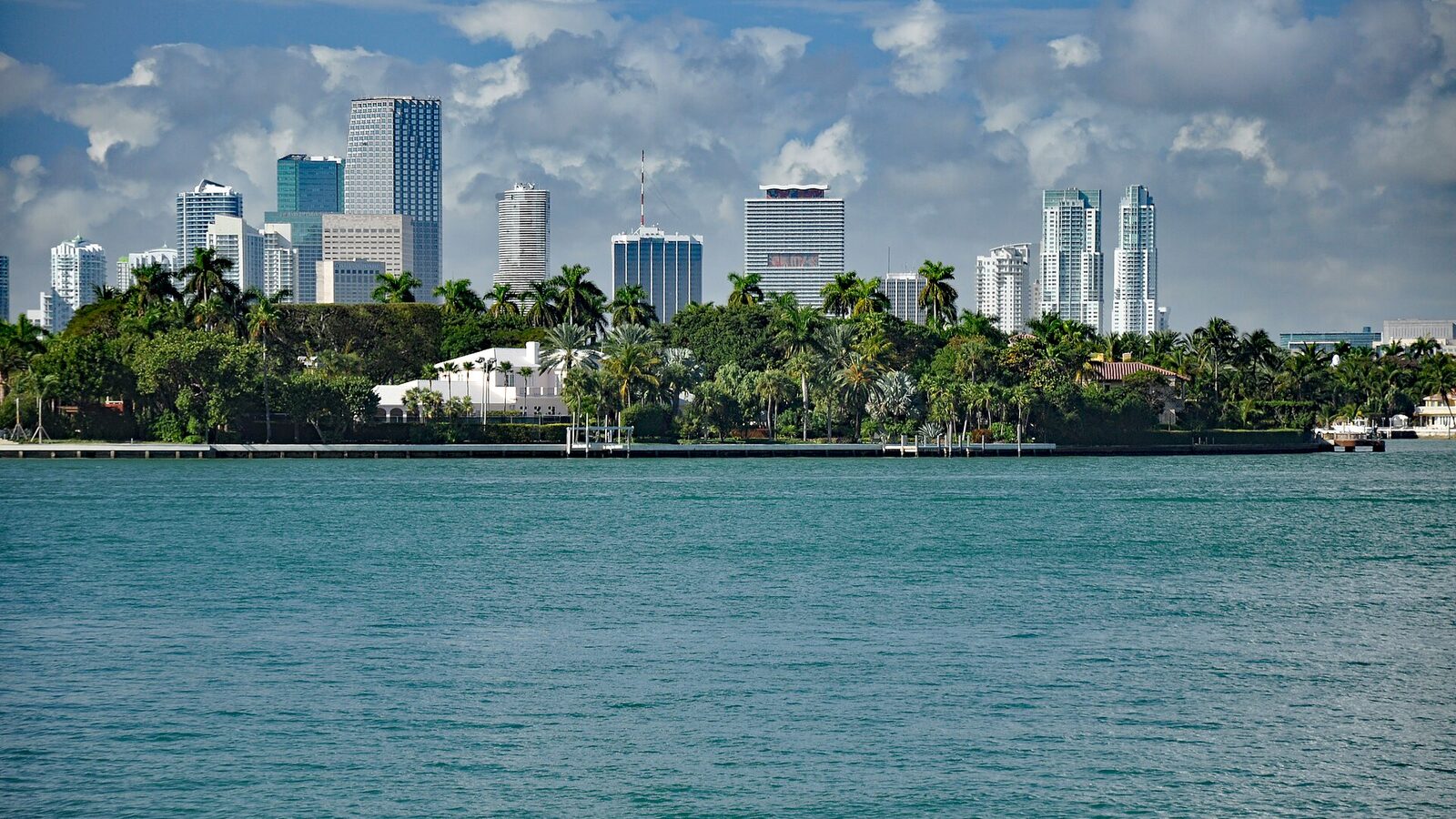
Photo: P. Hughes, CC BY 4.0, via Wikimedia Commons
Florida · Miami
Miami solar in 2026
Written by the Solar Learning Lab research deskUpdated August 17, 20269 min read
Miami quietly built the cheapest solar bureaucracy of any big American city. The city fully waives its own building permit fees for solar, residential and commercial, and requires itself to process those applications within three business days. No other city in our five-city study comes close. Pair that with Florida's intact full retail net metering and some of the cheapest install prices in the country, and the paperwork side of Miami solar is genuinely solved. The engineering side, hurricanes, is where the real scrutiny belongs.
$0
City of Miami solar permit fee, waived April 2026
$2.17/W
Average cash price in Florida, so a 7 kW system runs about $15,190
1,553 kWh
Annual output per kW installed, from our PVGIS run for Miami
See what a Miami roof pencils out to
Four questions, priced against FPL's actual RS-1 tariff and our Miami production data. No phone number required to see the math.
Get my Miami estimateThe $0 permit, and the fine print that survives it
Two systems run side by side here, and your folio number decides which one you deal with. If your parcel's folio starts with "-01" you are in the City of Miami and permit through the city's iBuild portal. Everyone else in the metro permits through Miami-Dade County, which charges real money.
| Jurisdiction and permit path | Fee per system |
|---|---|
| City of Miami, any solar installation | $0.00, fully waived |
| Miami-Dade County, prescribed mount details (G137) | $250.00 |
| Miami-Dade County, standard roof mounted (G127) | $365.63 |
| Miami-Dade County, ground mounted (G126) | $325.00 |
Sources: City of Miami fee schedule, Resolution R-26-0200, April 23, 2026; Miami-Dade electrical fee sheet, verified August 17, 2026. The city waiver excludes State of Florida and Miami-Dade County surcharges, so $0 city fee does not mean a $0 closing line.
What the waiver does not waive: engineering. City rules still require plans signed and sealed by a professional engineer, plus a PE letter addressing hurricane wind loads, and the installing contractor must hold an EC or CVC license. In a wind zone like this, that letter is not red tape. It is the difference between an array that sheds a Category 4 and one that becomes debris (City of Miami permit page).
What FPL charges, component by component
FPL's residential RS-1 tariff, effective January 2026, is a base charge plus a stack of per-kWh riders. On the first 1,000 kWh, the volumetric pieces sum to about 12.26 cents: base energy 7.865, fuel 2.893, storm protection 0.995, environmental 0.345, conservation 0.148, capacity 0.052, minus a 0.040 transition credit. Add the $10.52 base charge and a typical 1,000 kWh bill lands at $136.64, dropping to $128.45 in September on a one-month storm true-up refund.
Sources: FPL residential tariff, January 2026; FPL rates page; Rule 25-6.065. FPL filed proposed 2027 increases; those columns are labeled proposed, not approved, so we do not publish them as fact.
Electricity, gas, and solar, priced side by side
Most Miami households buy energy from two companies: FPL for electricity and, for the minority with gas service, Florida City Gas. Here is what each one actually charges, next to what electricity from an owned rooftop system works out to over its life. The units differ because the products differ, so read the notes.
| Energy source | Type | Average price | What that means |
|---|---|---|---|
| FPL | Electricity | 12.26¢ per kWh | Volumetric rate on the first 1,000 kWh, January 2026 RS-1 tariff. A 1,000 kWh month lands near $136.64 with the base charge. |
| Florida City Gas | Natural gas | $23.62 per Mcf | Florida residential average, December 2025, the latest month EIA reports. Per unit of raw heat that is roughly 7.8 cents per kWh equivalent. |
| Rooftop solar, owned | Electricity | ~5.6¢ per kWh | Our estimate: $2.17 per watt cash spread across 25 years of PVGIS production. Excludes financing and maintenance. |
Electricity: FPL RS-1 tariff. Gas: EIA Florida residential natural gas price, state average shown because Florida City Gas tariff riders change monthly. Solar is our own calculation, not a quoted price; method on our methodology page. Gas heat conversion: 1 Mcf is about 304 kWh of thermal energy.
A Miami roof, month by month
Miami's production curve is the flattest of our five cities, and its peak lands in March. Dry season sun beats wet season sun: June, the cloudiest and wettest month, produces less than February. The upside of that flat curve is steadiness; there is no winter cliff like New York's, and December still clears 119 kWh per kW. Annual total: 1553 kWh per kW.
March, highlighted, is Miami's best month at 151.4 kWh per kW. The June dip is the rainy season doing exactly what it does every year. A quote built on a smooth national production curve misses both.
Method: PVGIS v5.2, NSRDB radiation database. PVGIS v5.2 model run by Solar Learning Lab on August 17, 2026, NSRDB radiation database. Fixed south facing mount, 30 degree tilt, 14 percent losses, downtown Miami coordinates. Your roof will differ.
What solar costs in Miami by system size
These are estimates built from one price, EnergySage's August 2026 Florida cash average of $2.17 per watt, scaled linearly. Real quotes bend that line: complex roofs, premium panels, and hurricane attachment hardware all push the per-watt figure up, larger systems pull it down. Year one savings assume every kWh offsets FPL's 12.26 cent rate under full retail net metering.
| System size | Estimated cash price | Year one output (PVGIS) | Year one bill savings |
|---|---|---|---|
| 5 kW | $10,850 | 7,765 kWh | ~$952 |
| 7 kW | $15,190 | 10,871 kWh | ~$1,333 |
| 8 kW | $17,360 | 12,424 kWh | ~$1,523 |
| 10 kW | $21,700 | 15,530 kWh | ~$1,904 |
Our calculations from the EnergySage Florida cash average, August 2026, our Miami PVGIS run of 1553 kWh per kW, and FPL's January 2026 RS-1 rate. Estimates, not quotes. No federal credit applies to cash purchases in 2026.
Want these numbers for your actual roof?
The calculator below uses your bill and your system size instead of averages.
Jump to the calculatorThe highest rated solar installers in Miami
We pulled Google Maps results for Miami solar installers and kept companies with a 4.4 rating or better and a meaningful review base. A high rating with 600 reviews and a high rating with 15 reviews are not the same signal, which is why the review count sits next to every score.


Ratings and review counts are Google Maps ratings for Miami local results, retrieved August 17, 2026 via the DataForSEO SERP API. We list the highest rated established companies we found. No company paid to appear here, and appearing here is not an endorsement. Check current reviews and licensing before you sign anything.
The renter reality check
Here is the number most Miami solar marketing skips: only 31.8 percent of the city's housing units are single family and just 30.7 percent of households own their home, per Census ACS data. This is a condo and apartment city. If you own a detached roof inside city limits, you hold a scarcer asset than the install volume suggests, and the $0 permit plus retail net metering apply to you in full. If you rent or sit under a condo association, your realistic path runs through the association board, not this page's calculator.
Source: US Census Bureau, ACS 5-year estimates, 2023, Miami city. 190,282 households, median income $59,390, 91.2 percent heat with electricity, the highest share of our five cities.
Run your own numbers
Preloaded with FPL's RS-1 volumetric rate and our Miami PVGIS production run.
The top of the slider is our south facing PVGIS run for Miami. The lower bound approximates an east or west facing roof, which typically gives up 10 to 15 percent.
Cash quotes in Miami cluster near $2.17 per watt, against a $3.50 national 2024 median (LBNL). Use your quote.
Assumptions you can change
Use the rate on your actual lease or PPA quote. There is no published statewide average we trust enough to hardcode.
Cash purchase
$18,662 after state credit
- Year 1 benefit
- $136/mo
- Payback
- 11 years
- 20 year net position
- $21,074
No federal credit for cash purchases in 2026, no Florida income tax to credit against, and no FPL cash rebate. What Miami offers instead: full retail net metering under Rule 25-6.065 and a city that waives its own solar permit fees.
Solar loan
$260/mo 15 yr payment
- Year 1 net
- -$124/mo
- Upfront
- $0
- 20 year net position
- -$7,154
We price loans at $3.37 per watt: the EnergySage Florida cash figure plus the $1.20 national loan-over-cash spread LBNL documents, since dealer fees get built into loan pricing.
Lease / PPA
$0 down you buy the power
- Year 1 net
- -$131/mo
- Upfront
- $0
- 20 year net position
- -$34,312
The provider keeps the federal 48E business credit and prices some of it into your rate. In 2026 this is the only path that captures any federal incentive.
Estimates, not quotes. The rate input sums FPL's RS-1 volumetric charges on the first 1,000 kWh from the January 2026 tariff (base energy, fuel, storm protection, environmental, conservation, capacity, transition credit); the $10.52 base charge and the $30 minimum bill sit outside the per kWh math. Production comes from our PVGIS run for Miami, cost from EnergySage Florida data, August 2026. We are a solar installer and we also partner with other solar companies. See our disclosures.
Miami solar questions, answered from the data
Every answer below comes from the sources already cited on this page, not from a national FAQ template.
Is net metering still available in Miami?
How much does solar cost in Miami in 2026?
Does Miami really charge nothing for solar permits?
Do I need hurricane engineering for rooftop solar here?
Is solar worth it when FPL power is this cheap?
What we could not verify
As of August 17, 2026: no FPL cash rebate for residential rooftop solar exists on any page we reviewed. The effective date of the current version of Rule 25-6.065 as applied to new 2026 interconnections is not stated on FPL's copy. FPL's January 2027 rates exist only as proposed figures, so we exclude them. And the City of Miami SAVE program's 50 percent fee reduction, separate from the solar waiver, sunsets February 12, 2027.
Get your Miami estimate
Four questions, answered against this page's FPL tariff and PVGIS data. We are a solar installer and we also partner with other solar companies. Details in our disclosures.
What does your monthly electric bill look like?
Florida average is $167 per month (EIA, 2024).