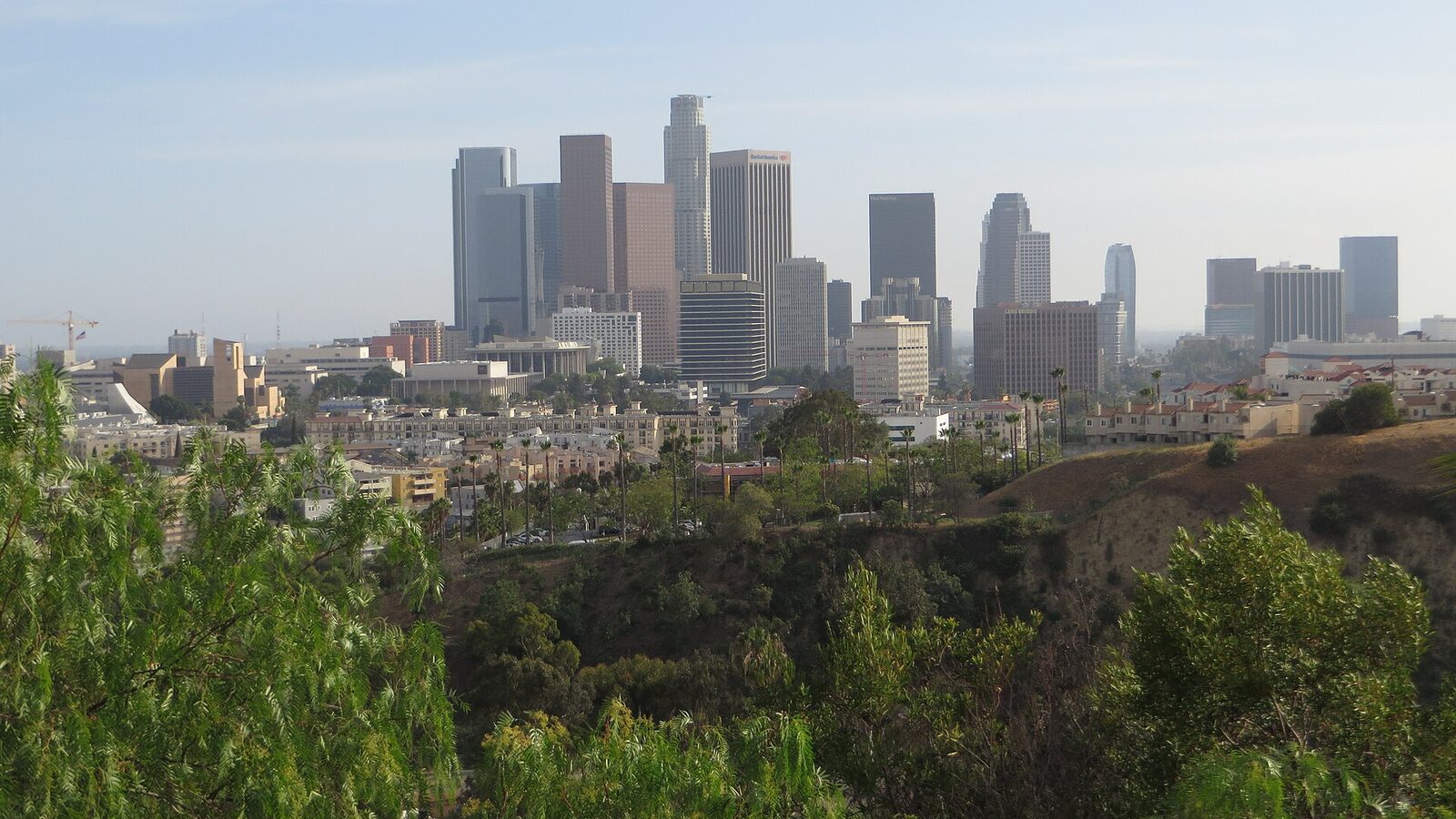
Photo: Ken Lund, CC BY-SA 2.0, via Wikimedia Commons
California · Los Angeles
Los Angeles solar in 2026
Written by the Solar Learning Lab research deskUpdated August 17, 202610 min read
Most of California lost retail net metering in 2023. Los Angeles did not, because Los Angeles does not buy power from the companies that lost it. The city runs on LADWP, a municipal utility with its own rates, its own solar rules and its own paperwork. If you have been reading about the Net Billing Tariff and shrinking export credits, most of that coverage describes Edison and PG&E territory. It does not describe this city.
26.4¢
LADWP Tier 1 summer rate per kWh, and solar exports earn it back at full retail
$2.46/W
Average cash price in California, so a 7 kW system runs about $17,220
1,705 kWh
Annual output per kW installed, from our PVGIS run for Los Angeles
Price a roof against LADWP's real tiers
Four questions, run against the R-1A rate table and our Los Angeles production model. You see the math before anyone sees your name.
Get my Los Angeles estimateWhat LADWP actually charges
LADWP's standard residential rate, Schedule R-1A, is tiered and seasonal. The numbers below are the total consumption charge with adjustment factors included, which is the number your bill actually reflects. Adjustment factors reset each January, April, July and October, so the fourth quarter column does not exist yet.
| 2026 period | Tier 1 | Tier 2 | Tier 3 |
|---|---|---|---|
| January to March | $0.24771 | $0.30630 | $0.30630 |
| April to May | $0.24362 | $0.30221 | $0.30221 |
| June | $0.24362 | $0.30221 | $0.38922 |
| July to September | $0.26408 | $0.32267 | $0.40968 |
| October to December | Not yet published | ||
Source: LADWP residential electric rates, per kWh, verified August 17, 2026. On top of energy: a monthly Power Access Charge of $2.30, $7.90 or $22.70 by tier and a $10.00 minimum. An optional time of use schedule, R-1B, prices July through September at $0.35124 high peak, $0.29284 low peak and $0.26540 base, plus a $12.00 monthly service charge.
Why this table matters for solar: the more of your usage that lands in Tier 3 summer pricing, the more each solar kWh is worth. A big air conditioned house in the Valley hitting 41 cent power in August is the best case for panels in this city. A small coastal apartment sitting in Tier 1 is the worst.
The last big-city retail net metering in California
LADWP's net energy metering works the way the whole state's used to. You are billed for net energy at your own rate. If your panels make more than your house uses in a billing period, the excess becomes a credit that rolls to your next bill. Compare that to Edison territory next door, where exports earn an hourly wholesale-ish value that usually sits far below retail.
Source: LADWP Amended Net Energy Metering Guidelines, revised November 23, 2020, verified in force August 17, 2026. Interconnection starts at ladwp.com/nem; systems under 10 kW AC without a battery or service upgrade qualify for fast track review. LADBS signs off on the building permit first, then LADWP inspects and sets the net meter.
LADWP power, SoCalGas heat, and solar, on one table
An energy bill in this city usually splits two ways: LADWP for electricity, SoCalGas for the furnace and water heater. Here is what each charges today, lined up against what a kWh from an owned rooftop system works out to across its life. The units differ because the products differ, so lean on the notes.
| Energy source | Type | Average price | What that means |
|---|---|---|---|
| LADWP | Electricity | 26.41¢ per kWh | Tier 1 summer rate with adjustment factors, July through September 2026. Tier 3 summer usage tops out at 40.97 cents. |
| SoCalGas | Natural gas | $20.72 per Mcf | California residential average, March 2026, the latest month EIA reports. Per unit of raw heat that is roughly 6.8 cents per kWh equivalent. |
| Rooftop solar, owned | Electricity | ~5.8¢ per kWh | Our estimate: $2.46 per watt cash spread across 25 years of PVGIS output for Los Angeles. Excludes financing and maintenance. |
Electricity: LADWP residential rates. Gas: EIA natural gas prices, California residential, March 2026; 1 Mcf holds about 304 kWh of thermal energy. Solar figure is our own calculation, method on the methodology page.
A Los Angeles roof, month by month
Our PVGIS model run for downtown Los Angeles coordinates puts a south facing kW at 1705 kWh per year. The shape is as useful as the total: August is the peak month at 168 kWh per kW, right when Tier 3 pricing is in force, and even December holds above 110. May and June dip slightly below the spring trend line. That is the marine layer, the June gloom every westsider knows.
August, highlighted, is the strongest month at 168.3 kWh per kW, and it lands inside LADWP's most expensive rate window. Peak production meeting peak prices is the quiet advantage of Los Angeles solar.
Method: PVGIS v5.2, NSRDB radiation database. PVGIS v5.2 model run by Solar Learning Lab on August 17, 2026, NSRDB radiation database. Fixed south facing mount, 30 degree tilt, 14 percent losses, downtown Los Angeles coordinates. Your roof will differ.
What solar costs in Los Angeles by system size
California's average cash price runs $2.46 per watt, and Los Angeles quotes tend to sit near that line. The table prices four common sizes, pairs each with our LA production run, and values the output at the Tier 1 summer rate. If your summer bills show Tier 2 or Tier 3 usage, every one of these savings figures is understated for your house.
| System size | Cash price | Year 1 output | Year 1 value at Tier 1 |
|---|---|---|---|
| 5 kW | $12,300 | 8,524 kWh | ~$2,251 |
| 7 kW | $17,220 | 11,934 kWh | ~$3,152 |
| 8 kW | $19,680 | 13,638 kWh | ~$3,602 |
| 10 kW | $24,600 | 17,048 kWh | ~$4,502 |
Our calculations: size times $2.46 per watt from EnergySage California cash averages, August 2026; output from our PVGIS run of 1705 kWh per kW; value at LADWP's 26.408 cent Tier 1 summer rate. Estimates, not quotes. No federal credit applies to cash purchases in 2026.
Your tier changes this math
The calculator below takes your actual monthly bill and system size instead of citywide averages.
Jump to the calculatorPermits: online, fast, contractor only
LADBS runs an Express Permit program for rooftop PV on one and two family homes, sized 10 kW or less with electrical service of 225 amps or less. It is issued only online through the PermitLA portal, and only to licensed contractors. As a homeowner you do not pull this permit; your installer does. What you can do is confirm the installer is actually using the express lane instead of billing you plan check hours for a routine job.
LADBS publishes one concrete fee table for solar, covering microinverter systems by total nameplate: $8 for 3 kW or less, $18 up to 5 kW, $27 up to 20 kW. Those are line items, not your all-in permit cost, and no LADBS page we could find publishes a typical total for a residential install. Ask your installer for the permit line on the quote.
Sources: LADBS Express Permits bulletin, effective January 1, 2026; microinverter fee bulletin; PermitLA portal.
Incentives: what is gone and what is left
- Gone: LADWP's Solar Incentive Program. The utility says so flatly in its own net metering guidelines. Any installer implying a city rebate on panels is selling from an old script (LADWP).
- Left, for some: the Self-Generation Incentive Program for income qualified solar plus storage, with an equity budget for low income customers. Funding is limited, first come first served, and LADWP itself warns rebates are not guaranteed. Dollar amounts are not published on the page (LADWP SGIP).
- Also left: the statewide property tax exclusion for qualifying systems, covered on our California page, with its January 1, 2027 sunset. The federal 25D homeowner credit ended December 31, 2025.
The highest rated solar installers in Los Angeles
These are the top Google Maps results for solar installers serving Los Angeles, filtered to companies holding a 4.4 rating or better with enough reviews to mean something. A note on reading them: a 4.7 across 372 reviews is a harder earned number than a 5.0 across 30, so weigh the count as much as the stars.





Ratings and review counts are Google Maps ratings for Los Angeles local results, retrieved August 17, 2026 via the DataForSEO SERP API. We list the highest rated established companies we found. No company paid to appear here, and appearing here is not an endorsement. Check current reviews and licensing before you sign anything.
Who actually owns a roof here
Census data explains why the Los Angeles solar market is smaller than the city: of 1.4 million households, only 36.3 percent own their home, and 42.1 percent of housing units are single family structures. Renters and condo dwellers are most of the city, and for them the realistic options are LADWP's Shared Solar program or virtual net metering on a multifamily building, not a personal rooftop system (LADWP solar programs).
Housing figures: US Census Bureau, ACS 5-year estimates, 2023, Los Angeles city. Median household income $80,366; 33.6 percent of homes heat with electricity.
Run your own numbers
Preloaded with LADWP's Tier 1 summer rate and our Los Angeles PVGIS production run. Drag the rate up if your summer bills show Tier 2 or Tier 3 usage.
The top of the slider is our south facing PVGIS run for Los Angeles. The lower bound approximates an east or west facing roof, which typically gives up 10 to 15 percent.
Cash quotes in Los Angeles cluster near $2.46 per watt, against a $3.50 national 2024 median (LBNL). Use your quote.
Assumptions you can change
Use the rate on your actual lease or PPA quote. There is no published statewide average we trust enough to hardcode.
Cash purchase
$10,578 after state credit
- Year 1 benefit
- $161/mo
- Payback
- 6 years
- 20 year net position
- $36,409
No federal credit for cash purchases in 2026 and no California income tax credit. What LADWP customers do keep: export credits at your own retail rate under LADWP net energy metering, which the investor owned utilities in the rest of the state no longer offer.
Solar loan
$141/mo 15 yr payment
- Year 1 net
- $20/mo
- Upfront
- $0
- 20 year net position
- $21,525
We price loans at $3.66 per watt: the EnergySage California cash figure plus the $1.20 national loan-over-cash spread LBNL documents, since dealer fees get built into loan pricing.
Lease / PPA
$0 down you buy the power
- Year 1 net
- $15/mo
- Upfront
- $0
- 20 year net position
- $6,340
The provider keeps the federal 48E business credit and prices some of it into your rate. In 2026 this is the only path that captures any federal incentive.
Estimates, not quotes. The rate input uses LADWP's R-1A Tier 1 total consumption charge for July through September 2026; LADWP adjusts factors quarterly and heavy summer use lands in higher tiers, so your blended rate may be higher. Production comes from our PVGIS run for Los Angeles, cost from EnergySage California data, August 2026. We are a solar installer and we also partner with other solar companies. See our disclosures.
Los Angeles solar questions, answered from the data
Each answer below traces back to a source already cited on this page. No national boilerplate.
Does Los Angeles still have real net metering?
How much does solar cost in Los Angeles in 2026?
What does a solar permit cost in Los Angeles?
Is there still an LADWP rebate for panels?
What happens to solar credits I never use?
What we could not verify
We publish what we cannot confirm rather than papering over it. As of August 17, 2026: LADWP does not publish an average residential usage or bill figure for its own territory, so the calculator default leans on the statewide EIA average. No LADBS page states a typical all-in solar permit fee. SGIP dollar amounts for LADWP customers are not published. And the October to December 2026 rate factors do not exist yet. If any of these appear in print, this page gets updated.
Get your Los Angeles estimate
Four questions, answered against this page's LADWP and PVGIS data. We are a solar installer and we also partner with other solar companies. Details in our disclosures.
What does your monthly electric bill look like?
California average is $167 per month (EIA, 2024).