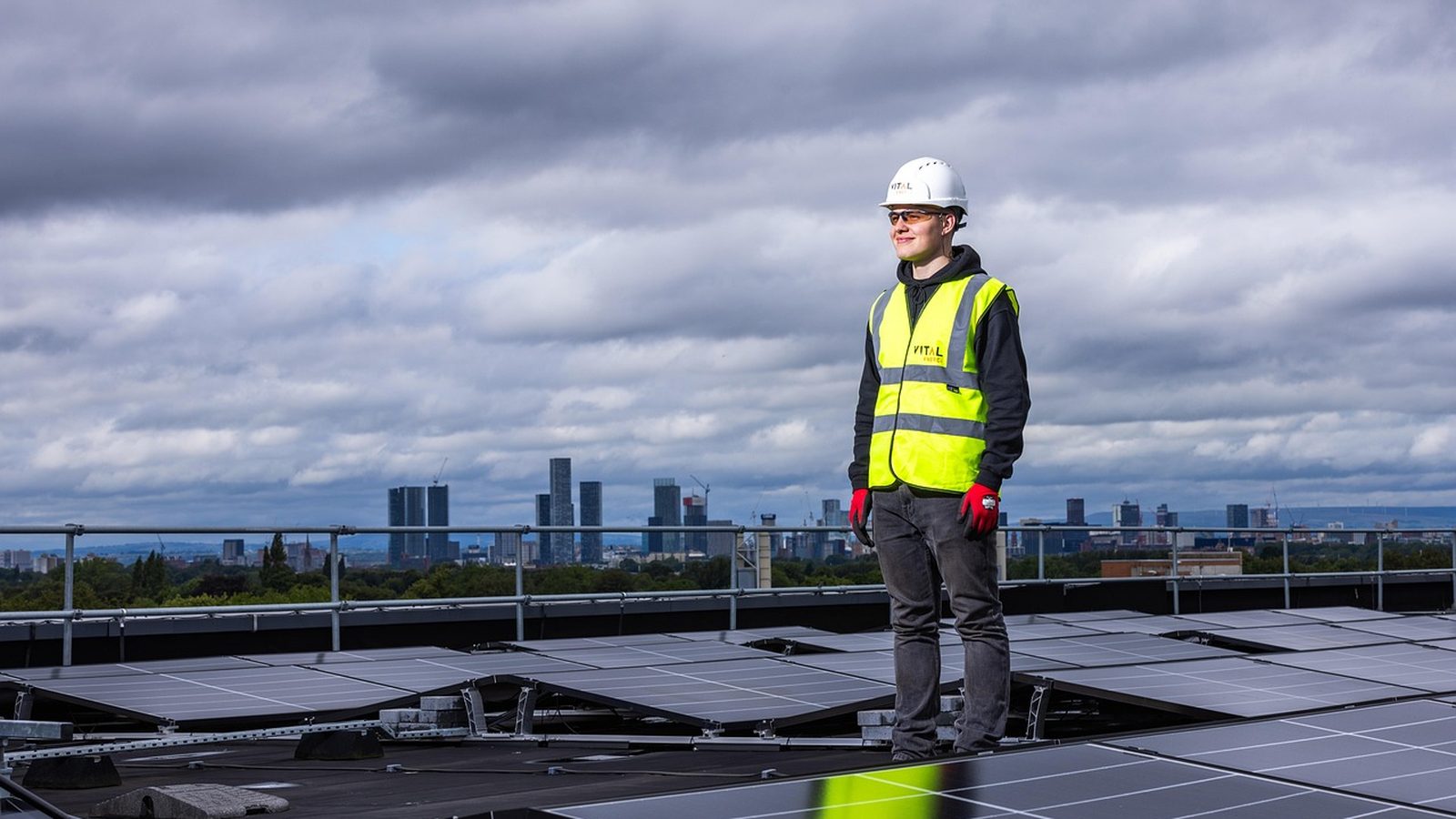
Photo: This_is_Engineering, via Pixabay
California · Visalia
Solar in Visalia: expensive power, a split permit path
Written by the Solar Learning Lab research deskUpdated August 24, 2026
Visalia is not a complicated utility map. It is PG&E, full stop. No community choice program is serving Tulare County, so there is no second generation supplier to unwind before comparing a solar proposal. The pressure comes from the price of the electricity being avoided: PG&E's 2024 average residential price was 39.617872 cents per kWh, roughly 39.6 cents.
That makes a cheap-looking solar deal easy to overtrust. Visalia also has two City permit prices for the same basic size range, a live SolarAPP+ platform, and a state tracking entry that says no SB 379 annual report had been submitted as of August 3, 2026. Those facts belong in the due diligence, not in the footnotes.
Start with the bill, not a percentage-off claim
Use the estimator to test system sizes before a high PG&E rate gets turned into an oversized design.
Estimate Visalia solarPG&E is the whole retail backdrop in Visalia
PG&E lists Visalia ZIP codes in its service area. Its own CCA page and the CPUC's 2026 CCA status report do not identify a program serving Visalia or Tulare County. That means generation and delivery are not being split between PG&E and a local CCA here. Check the service-area page and the CPUC territory report if an offer suggests otherwise.
| Energy source | Type | Average price | What that means |
|---|---|---|---|
| PG&E | 2024 average residential price | 39.6¢ per kWh | EIA-861 bundled residential average, not a personalized tariff. |
| PG&E E-1 / E-TOU | available residential rate plans | varies by tariff and time | PG&E publishes E-1, E-TOU-C and E-TOU-D pricing separately. |
| Solar exports | Net Billing compensation | hourly avoided-cost values | Export value is not the retail price of a kWh bought from the grid. |
| Solar used in the home | avoided purchase | retail value depends on usage time | Self-consumed output is the part a proposal should model carefully. |
EIA residential price data, PG&E residential pricing, and the CPUC Net Billing page.
The CPUC Net Billing Tariff applies to customers submitting interconnection applications on or after April 15, 2023. Export compensation uses hourly Avoided Cost Calculator values, averaged under the tariff's rules. A big annual production number does not turn every exported kilowatt-hour into a 39.6-cent credit. The CPUC's adopted calculation materials spell out why load timing matters.
Visalia publishes a clean fork in the permit price
The FY 2026-27 Development Fee Book places a 1 to 15 kW residential PV job at $450 with standard plan review and $375 with SolarAPP+ instant issuance. Above 15 kW, the published formula is the base fee plus $15 per kW over 15 kW. There is no reason for a proposal to blur those two lanes. Read the City's fee book.
The $450 standard-review figure matches the statewide cap stated in Government Code 66015 for a residential system up to 15 kW, absent the statute's finding exception. The lower SolarAPP+ number is not a sale price from a contractor. It is a separate City fee tier. Ask the bidder which pathway the actual design qualifies for and whether battery, panel work or roof conditions change the answer.
Visalia's Building Division is the permitting authority. We did not find a City-published turnaround commitment for conventional review in the supplied materials, so do not convert SolarAPP+ availability into a blanket time promise for every project. The Building Division page is where the City directs applicants.
A working automated platform and a reporting gap can both be true
California's automated permitting statute is Government Code 65850.52, added by SB 379. The CEC tracking spreadsheet lists Visalia as a SolarAPP+ Platform jurisdiction, with a September 2023 deadline and an annual-report field marked “None.” The same spreadsheet was last updated August 3, 2026.
That is not a finding that Visalia's program is noncompliant. The CEC expressly says it does not certify whether a jurisdiction's platform complies with SB 379 and that enforcement is outside its jurisdiction. It is a narrower, useful fact: Visalia appears to offer the automated platform while the CEC record did not show an annual report submission at that vintage. See the CEC tracking file.
For a homeowner, the operational question stays simple. Have the contractor name the City path, show the SolarAPP+ eligibility basis, and separate City permit fees from its own project price. Administrative confidence is valuable. It is not a substitute for an accurate electrical and roof scope.
The valley model is useful, not magical
Our standardized downtown run produces 1,634.8 kWh annually per installed kW. May is the modeled high point at 168.6 kWh per kW, with December at 85.4. Visalia's semi-arid setting and long cooling season make onsite daytime use worth examining, but nobody can infer a roof's shade or household schedule from a city model.
May is the modeled high month at 168.6 kWh per kW. The bill outcome still depends on when the household is using power.
PVGIS v5.2 model run by Solar Learning Lab on August 24, 2026, using the NSRDB radiation database. Fixed south-facing mount, 30 degree tilt, 14 percent losses, downtown Visalia coordinates. Your roof will differ. The standardized comparison comes from PVGIS. Visalia also has a large detached-home base: the state's 2026 estimate counts 39,922 single-detached units out of 52,053 total units. That is a large rooftop opportunity set, not a guarantee that each roof is ready for solar. The state housing table supplies the inventory.
Skip the imaginary city rebate, check the targeted programs
We found no Visalia municipal solar or battery rebate in the supplied City materials. The programs worth a real eligibility check are more specific. The statewide Residential Solar and Storage Equity budget lists $3,100 per kW for solar and $1,100 per kWh for storage for qualifying low-income households. The CPUC SGIP page is the starting point, not a reason to put money into a quote before eligibility is documented.
DAC-SASH is another address and household test, not a broad Visalia discount. GRID Alternatives describes an owner-occupied, single-family, CARE or FERA income requirement plus disadvantaged-community eligibility. The San Joaquin Valley pilot category makes it relevant to investigate here, but a specific tract still needs to be checked. GRID Alternatives' program page provides the conditions.
The federal homeowner 25D credit ended for expenditures after December 31, 2025. Do not let a 2026 proposal quietly deduct it from your cash price. CRS IN12611 explains the completion-date rule and preserved carryforward for qualifying earlier expenditures.
Use the calculator to challenge the cheerful version
Start with a system size that makes sense against twelve months of usage. Then pull the production slider down before accepting the first result. The tool does not recreate PG&E's hourly export treatment, so it is better at comparing possibilities than certifying savings.
The high setting is a standardized downtown Visalia PVGIS result. The lower setting is 85 percent of it, a useful sensitivity test rather than a forecast for a particular roof.
Cash quotes in Visalia cluster near $2.46 per watt, against a $3.50 national 2024 median (LBNL). Use your quote.
Assumptions you can change
Use the rate on your actual lease or PPA quote. There is no published statewide average we trust enough to hardcode.
Cash purchase
$8,856 after state credit
- Year 1 benefit
- $163/mo
- Payback
- 5 years
- 20 year net position
- $38,631
This screening tool uses California market inputs and a Visalia production model. PG&E tariff choice, hourly export value, roof shade and fixed charges are not bill-level calculations.
Solar loan
$118/mo 15 yr payment
- Year 1 net
- $45/mo
- Upfront
- $0
- 20 year net position
- $26,170
Treat the loan result as a payment comparison, then request the cash price, financed price, dealer fee, APR and prepayment terms separately. A single monthly payment hides too much.
Lease / PPA
$0 down you buy the power
- Year 1 net
- $45/mo
- Upfront
- $0
- 20 year net position
- $14,858
A lease or PPA quote should be judged against the household's actual PG&E bill and the agreement's escalation clause, production guarantee, transfer terms and end-of-term options.
Estimates, not quotes. This tool uses the California average retail rate, a Visalia PVGIS production run and California market cost inputs. It cannot reproduce PG&E hourly export credits, fixed charges or roof-specific shading. We are a solar installer and we also partner with other solar companies. See our disclosures.
What to ask before choosing a Visalia contractor
Ask each bidder for the permit pathway, permit fee, system size, expected self-consumption and the line item for any main-panel or roof work. A project that fits SolarAPP+ should be explained as such. A project that does not fit should not be sold as though it does.
Solar Shine Pros
Visalia, CA
5.0(95 Google reviews)
Air Sun Solar
Visalia, CA
4.7(66 Google reviews)
Ratings snapshot: Google Maps, August 2026, via the DataForSEO SERP feed. Zero companies paid us and none are endorsed by us.
Visalia solar questions that change the decision
Who supplies electricity in Visalia?
Why are there two Visalia solar permit fees?
Has Visalia filed an SB 379 annual report?
Does Net Billing pay the full PG&E retail rate for exports?
Is there a Visalia city solar rebate?
Visalia document trail
Core records: Visalia Development Fee Book, CEC automated-permitting tracker, PG&E residential prices, CPUC Net Billing guidance, CPUC SGIP, state housing estimates, and PVGIS.
Get a Visalia estimate built from the actual bill
Bring the rate plan, twelve months of use and the permit path into the same conversation. That is a better starting point than a generic offset percentage.
What does your monthly electric bill look like?
Visalia average is $167 per month (EIA, 2024).