Skip to content
Solar Learning Lab
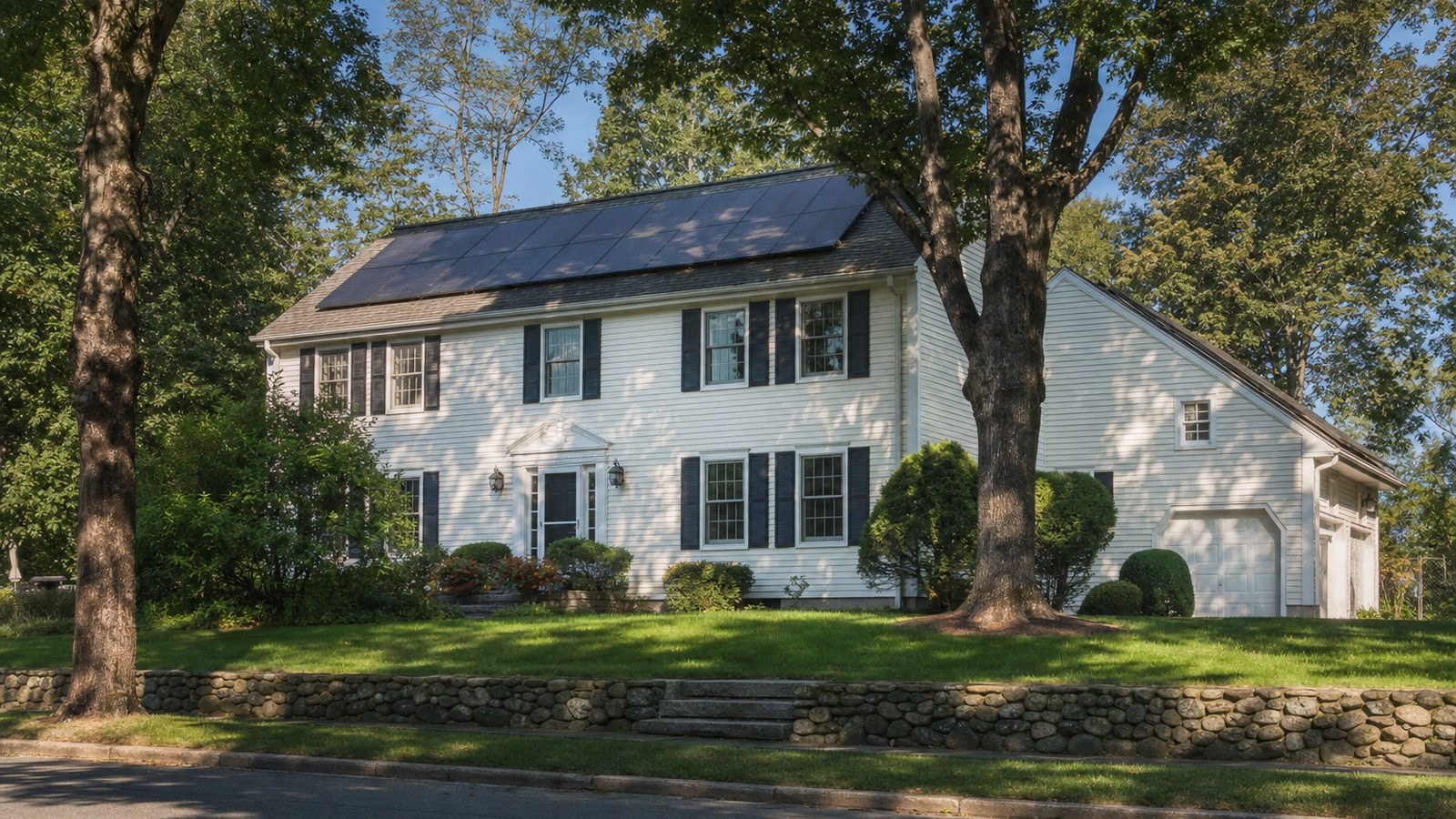
Rooftop solar panels on a suburban Connecticut home under a clear sky

Connecticut / Stamford

Stamford solar starts with one signature

Written by the Solar Learning Lab research deskUpdated August 29, 202612 min read

Stamford sits in Eversource territory, and Connecticut replaced net metering with the Residential Renewable Energy Solutions tariff in January 2022. Before anyone measures your roof, you pick netting or buy-all, and that pick governs 20 years of export value. This page walks the 2026 numbers for both, then the city permit formula and the tax exemptions.

Model a Stamford system

Run the Eversource rate and the Stamford PVGIS output against your actual bill.

Jump to the calculator


Why the RRES election outranks the panel brand

Legacy Connecticut net metering closed to new systems at the end of 2021. Anything interconnected or fully applied for before January 1, 2022 stays on its old terms and cannot move into the successor program, per the PURA program manual. New Stamford systems enroll in Residential Renewable Energy Solutions, a program PURA built under Public Act 19-35 that caps projects at 25 kW and limits them to one to four family homes and qualified affordable multifamily buildings.

The program forces a fork. Netting keeps your solar power in the house and credits exports at the full retail rate. Buy-all sells every kWh the array makes to Eversource at a fixed price. PURA resets the rates for new enrollees each year in an annual review, and the same review recently launched a working group to standardize the Customer Disclosure Forms buyers get before signing. That is a quiet admission that too many Connecticut homeowners have signed contracts without understanding which door they walked through.

Stamford homes qualify on the geography test. The city is not among the 17 municipalities in United Illuminating’s published service area, and Stamford’s own solar resources page points residents to Eversource program materials. If a quote references UI paperwork, someone grabbed the wrong template.

Door one: netting, with a charge most quotes hide

Under netting, Eversource buys your renewable energy certificates and credits exported energy at the prevailing retail rate, supply plus delivery. The 2026 netting REC rate is $0.000 per kWh before adders, so the REC purchase adds nothing to the base economics this year, per the utility RRES FAQ that carries the rate table for both territories.

Here is the line item that goes missing in sales conversations: netting projects pay a Solar Production Charge of $0.0402 per kWh on total generation, not just on exports. A Stamford array producing at the city’s modeled 1,368.7 kWh per kW would hand back roughly 4 cents on every one of those kilowatt hours. Excess credits roll forward month to month, cannot jump between accounts, and only cash out when the account closes. A netting model that omits the production charge overstates the deal on day one.

Adders exist for netting: $0.035 per kWh for low income customers and $0.0175 per kWh in economically distressed municipalities. Whether Stamford carries the distressed designation was not confirmed in our research, so no honest quote should assume it.

Door two: buy-all at 32.89 cents, locked for 20 years

Buy-all inverts the design brief. Eversource purchases all energy and all RECs at $0.3289 per kWh for eligible 2026 applications, and that rate holds for 20 years from enrollment, per the published 2026 rate table. The house keeps buying its power from the grid at whatever Standard Service costs. Payments can split in any percentage between an on-bill credit and an assigned beneficiary, which is how third party arrangements plug in.

For context, the buy-all rate at the January 2022 launch was $0.2943 per kWh, per the Office of Legislative Research report. The 2026 figure is higher, but nobody should count on that direction holding, since PURA reprices for each new enrollment year. The buy-all adders are larger than the netting ones: $0.055 per kWh for low income customers and $0.0275 per kWh for distressed municipalities.

The practical read: buy-all is a production bet with a known price. Netting is a consumption hedge with a floating price and a fixed charge. A household that runs heavy daytime loads leans one way. A small, efficient house with a big south roof can lean the other.

Standard Service refuses to sit still

Netting value floats with the retail rate, so the retail rate history matters. Eversource Rate 1 generation supply hit 24.127 cents per kWh in early 2023, fell to 9.75 cents by July 2025, and sits at 11.58 cents for July through December 2026, down from 12.64 cents in the first half of the year, per the EnergizeCT rate board and the Office of Consumer Counsel advisory. The OCC notes the May and July 2026 adjustments together trimmed the average Eversource monthly bill by about 18 percent.

What I have seen in practice: a netting payback modeled during a rate spike looks brilliant, then the supply rate falls by more than half over two years and the homeowner wonders what happened. The all-in 2024 Eversource CT residential average was 28.51 cents per kWh across more than 900,000 customers, per EIA Table 6. Use a multi-year view, not last month’s bill, when you stress test a netting quote.

The city prices permits by formula, not flat fee

Stamford publishes no solar line item. Residential permits run $13.00 per $1,000 of construction value with a $60.00 minimum, plus a $0.26 per $1,000 State Education Fund fee, and residential electrical work uses the same formula, per the Building Department fee page. Run a $30,000 rooftop job through that formula and it prices around $390 before the education fee, though the city is explicit that the plan reviewer sets the final number. Quote the formula, not a fixed total.

The Building Department tracks permits issued after October 2013 in ViewPoint Cloud, with older records back to 1950 in the Municipal Search database. That archive matters when you buy a Stamford house with panels already on it: pull the permit history and check the interconnection date against the January 2022 RRES cutoff. Connecticut law also lets municipalities waive building permit fees for Class I renewable projects under CGS Section 29-263, per the OLR analysis, but our research could not confirm Stamford has adopted such an ordinance, so budget the formula.

Two state exemptions, one federal subtraction

Connecticut exempts qualifying residential solar from property tax under CGS Section 12-81(57) for systems installed since October 2007 on one to four family homes, provided estimated annual production does not exceed estimated annual load. Tariff participation or third party ownership does not break the exemption, but the filing does: the application goes to the assessor on or before November 1. The equipment purchase is also exempt from sales and use tax under CGS Section 12-412, documented with form CERT-140, per the Department of Revenue Services.

The subtraction is federal. The Section 25D homeowner credit was repealed for expenditures after December 31, 2025, and the statute counts an expenditure when the installation finishes, so a system completed in 2026 gets no credit even if the contract predates the deadline, per the Congressional Research Service. Stamford math in 2026 rests on the tariff and the exemptions, not on a tax refund.

What a Stamford kilowatt produces

Our PVGIS run for downtown Stamford models 1368.7 kWh per kW per year, peaking at 143.6 kWh per kW in July and bottoming at 71.3 in December. Coastal Fairfield County gets real winters, and the December to July spread is wide enough that netting households should picture their credit bank draining through February.

Jan
Feb
Mar
Apr
May
Jun
Jul
Aug
Sep
Oct
Nov
Dec

A location model, not a roof survey. Shade and orientation move these bars.

PVGIS v5.2. PVGIS v5.2 model run by Solar Learning Lab on August 29, 2026, NSRDB radiation database. Fixed south facing mount, 30 degree tilt, 14 percent losses, downtown Stamford coordinates. Your roof will differ.

Numbers the calculator uses

Energy sourceTypeAverage priceWhat that means
Eversource CT2024 residential average28.51¢ per kWh, EIA Table 6All-in average across supply and delivery, 2024 bundled retail sales.
Standard ServiceSupply only, Jul to Dec 202611.58¢ per kWhOffice of Consumer Counsel advisory, July 2026.
StamfordPVGIS reference1368.7 kWh per kW per yearFixed south facing model at 30 degrees.

Supply rates reset twice a year. Check the linked OCC advisory before treating any single figure as your tariff.

Interview installers on the election, not the hardware

Census data puts Stamford at 54,165 households with 47.6 percent owner occupancy, so roughly half the city rents and the addressable rooftop market is smaller than the skyline suggests. The useful interview question for any of these companies: which RRES option are you quoting, and show me the same system under the other one.

Ratings snapshot: Google Maps, August 2026, via the DataForSEO SERP feed. Zero companies paid us and none are endorsed by us.

SunQuest Solar logo

SunQuest Solar

Westport, CT

4.9(88 Google reviews)

Read the graded profile

GS Power Partners logo

GS Power Partners

Stamford, CT

4.1(54 Google reviews)

Altus Power, Inc. logo

Altus Power, Inc.

Stamford, CT

3.9(40 Google reviews)

Northeast Custom Solar logo

Northeast Custom Solar

4.4(13 Google reviews)

INSTALL SUN LLC logo

INSTALL SUN LLC

Norwalk, CT

4.3(11 Google reviews)

Ratings and review counts are Google Maps ratings for Stamford local results, retrieved August 17, 2026 via the DataForSEO SERP API. We list the highest rated established companies we found. No company paid to appear here, and appearing here is not an endorsement. Check current reviews and licensing before you sign anything.

Stress test your bill

$200
1,369

The high bound is the downtown Stamford PVGIS run. The low bound trims it 15 percent as a planning cushion, not a shade study.

$2.67

Cash quotes in Stamford cluster near $2.67 per watt, against a $3.50 national 2024 median (LBNL). Use your quote.

Assumptions you can change
2.5%
7%
15
24c

Use the rate on your actual lease or PPA quote. There is no published statewide average we trust enough to hardcode.

2%
Estimated system: 6.2 kWAnnual usage: 8,418 kWhState credit: $0

Cash purchase

$16,554 after state credit

Year 1 benefit
$202/mo
Payback
7 years
20 year net position
$42,157

A Stamford quote that skips the RRES netting versus buy-all election is a draft, not a proposal. The election reshapes what each exported kWh is worth for 20 years.

Solar loan

$216/mo 15 yr payment

Year 1 net
-$14/mo
Upfront
$0
20 year net position
$19,891

Financing uses the Connecticut cost benchmark. Add Stamford permit fees from the $13 per $1,000 formula rather than a guessed flat number.

Lease / PPA

$0 down you buy the power

Year 1 net
$32/mo
Upfront
$0
20 year net position
$11,663

Third party contracts still commit the house to one RRES option. Ask which one, in writing, before signing.

Estimates, not quotes. Inputs pair the 2024 Eversource CT residential average from EIA with our Stamford PVGIS run and the state cost benchmark. Permit fees, RRES enrollment timing, and roof condition sit outside the model. We are a solar installer and we also partner with other solar companies. See our disclosures.

Stamford questions, answered from the record

Does Stamford still have net metering?
Not in the classic sense. New systems enroll in RRES and choose netting or buy-all. Systems interconnected or fully applied for before January 1, 2022 keep their legacy arrangements and cannot switch into RRES.
What does the buy-all option pay in 2026?
$0.3289 per kWh for all energy and RECs, fixed for 20 years for eligible applications received beginning January 1, 2026.
What does a Stamford solar permit cost?
There is no flat solar fee. Residential permits run $13.00 per $1,000 of construction value with a $60 minimum plus a $0.26 per $1,000 education fee, and the plan reviewer sets the final figure.
Is Stamford served by Eversource or United Illuminating?
Eversource. Stamford does not appear in UI’s published 17 town service list, and the city’s solar page directs residents to Eversource materials.
Will panels raise my property taxes?
Qualifying residential systems are exempt under CGS 12-81(57) if production does not exceed load, but you must file with the assessor by November 1.

Get a Stamford estimate

We are a solar installer and we also partner with other solar companies. Read our disclosures.

What does your monthly electric bill look like?

Connecticut average is $167 per month (EIA, 2024).