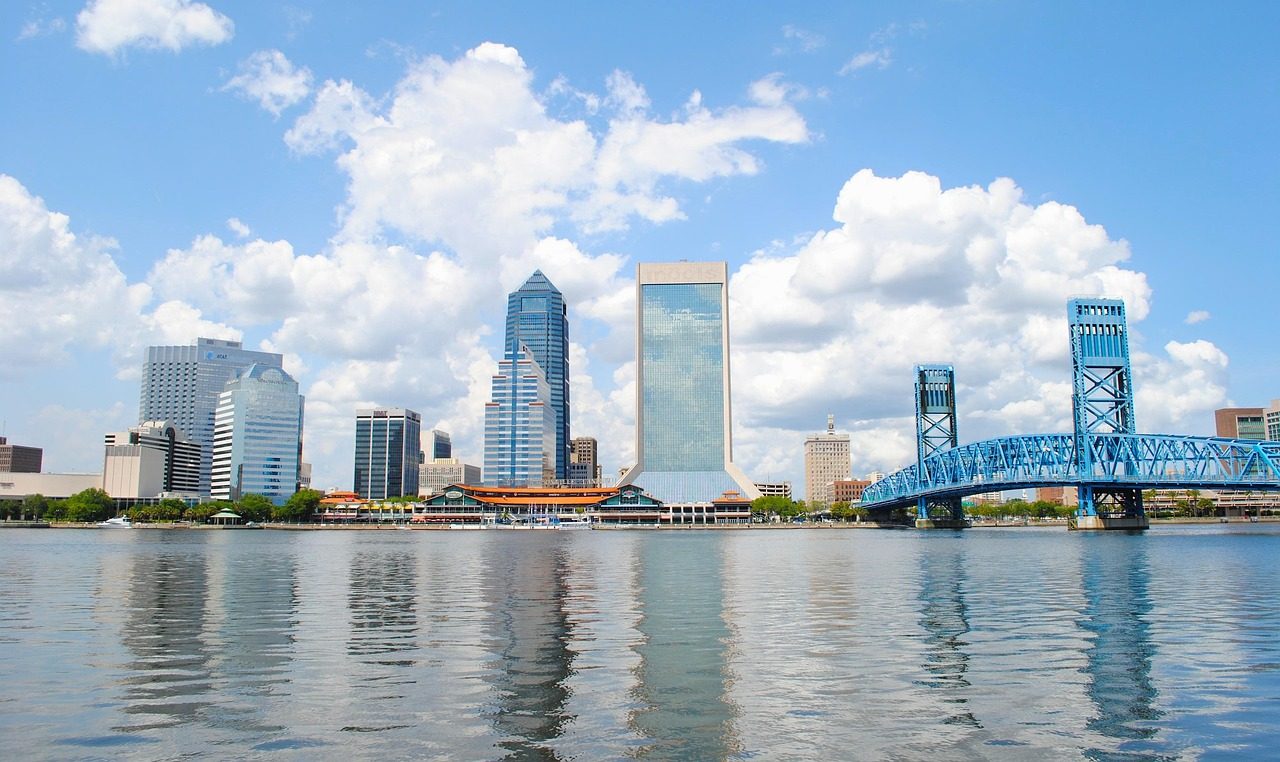
Photo: 12019, via Pixabay
Florida · Jacksonville
Jacksonville solar in 2026
Written by the Solar Learning Lab research deskUpdated August 21, 202611 min read
Jacksonville solar is a self-consumption decision, not a retail-export decision.
Plan a Jacksonville solar system
Start with your actual bill and this page's documented rules.
Get an estimateWhat changes the Jacksonville math
JEA calls its program Distributed Generation, not net metering. It credits exported power at the fuel rate, while its first-tier retail energy plus fuel price is 10.971 cents per kWh and the embedded fuel component is 4.125 cents. That gap is the local fact that changes the design brief: use your own solar first, then be cautious about deliberately oversized annual export. Credits roll as dollars through the calendar year, with a year-end balance paid to the customer. rates source dg source
Jacksonville Building Inspection Division is the AHJ. All permit types require electronic submission through JaxEPICS, and the review clock begins only after Zoning, Concurrency, and Development Services approval and payment of the plan-review fee. The city says architectural plans review may take up to seven days, but publishes no PV-specific review service level. portal source permit source The city schedule does not publish an all-in residential rooftop-PV fee. It identifies a $22 solar-collector line, electrical service charges, and minimum fees, but that is not a defensible PV all-in total. Exact all-in PV permit fee: n.a. fees source
JEA charges a $17.50 monthly basic charge. For the first 1,000 kWh, the April 2025 schedule lists 6.846 cents energy and 4.125 cents fuel per kWh; use above 1,000 kWh raises the energy component. Duval County taxes are separate. rates source The DG policy caps gross power rating at 90% of service rating and calculates inverter-based rating as DC nameplate times 0.85. A household system must still pass interconnection, not merely get a permit. policy source
The reviewed JEA rebate program covers efficiency measures, not PV. No JEA residential PV rebate or battery rebate was verified. Florida section 163.04 prohibits association and local restrictions that prohibit solar, while allowing specified non-impairing roof location rules. rebates source rights source Residential 25D credit ended December 31, 2025; lease and PPA providers may claim 48E. federal source
Our PVGIS reference result is 1,502.5 kWh per installed kW annually. April is the high month at 144.3 kWh per kW and December is 106.9. It is a fixed south-facing reference, not a shade study. pvgis source Jacksonville International Airport normals list a 68.6°F annual mean and 52.39 inches of precipitation. ACS 2023 lists 384,741 households, 57.4% owner occupancy and 64.8% single-family housing. That is market context, not a promise that a particular roof works. climate source census source
A decision should begin with the utility rule, then move to physical design. For Jacksonville, put twelve months of bills beside a proposed annual output of 1502.5 kWh per kW. Separate the kWh you expect to use at home from the kWh you expect to export. The first number is a bill-offset question. The second is a tariff question. Do not treat them as interchangeable. PVGIS method.
Then audit the scope. A useful proposal names permitting, engineering, interconnection, roof work, service-panel work, monitoring, meter work, inspections, and every contingency. If a number cannot be documented before signature, label it as an allowance. That is especially important where the public fee schedule does not publish a flat all-in PV permit amount. The right response to an unknown is n.a., followed by the question that will resolve it.
Finally, plan for the calendar rather than a brochure. A production forecast of 116.0 kWh per kW in January and 128.0 in July means monthly bill behavior will change. The model is deliberately conservative about certainty: it does not know the roof shade, the roof condition, the household schedule, the contract rate, or future utility action. That restraint is useful. It keeps a planning page from becoming a pretend quote.
Permit and interconnection checklist
City permitting and utility permission to operate are separate approvals. Get both dates, each responsible party, and the fee assumptions in writing. The cited city material controls if a sales statement conflicts with this page.
Before final design, confirm roof condition, structural scope, electrical service, ownership or association approval, and the exact account holder. None of those project facts can be inferred from a city average.
Rate and export value
| Energy source | Type | Average price | What that means |
|---|---|---|---|
| Local planning input | Electricity | 10.971¢ per kWh | Verified city research input or transparent state planning input. |
| Rooftop solar | Electricity | Variable by on-site use and export rule | Solar used on site and solar exported are not automatically worth the same amount. |
See the cited local utility materials above.
Incentive discipline
Do not subtract any credit, rebate, or REC payment until eligibility, timing, ownership, and program capacity are confirmed. The source-linked claims above are what was verified on August 21, 2026.
Monthly production, not an annual slogan
The highlighted month is highest in the reference run. Your roof will differ.
PVGIS v5.2. PVGIS v5.2 model run by Solar Learning Lab on August 21, 2026, NSRDB radiation database. Fixed south facing mount, 30 degree tilt, 14 percent losses, downtown Jacksonville coordinates. Your roof will differ.
Jacksonville design notes: the avoided purchase is the prize
The JEA difference deserves a concrete worked example. At the first residential tier, the published energy and fuel components total 10.971 cents per kWh. The fuel component embedded in that total is 4.125 cents. A kWh made at noon and consumed immediately avoids a retail purchase at the higher combined component. A kWh that becomes annual excess in the Distributed Generation program is credited at the fuel-rate mechanism. The arithmetic does not make a rooftop system bad. It makes load matching more valuable. Pool pumping, cooling schedules, water heating, and charging are household-specific, so the research does not assign a made-up self-consumption percentage to any Jacksonville roof. JEA residential rates and JEA Distributed Generation.
JEA also carries DG credits as a dollar balance through the end of the calendar year, then pays remaining year-end credit to the customer. That is not the same as indefinite retail-value banking. The DG policy adds two design guardrails: gross power rating cannot exceed 90% of the utility distribution service rating, and JEA calculates an inverter-based system’s gross power rating as the DC nameplate multiplied by 0.85. Systems at 50 kW or more have standby and supplemental-service rules, while systems above 100 kW have an application fee and $2 million general-liability requirement. Those thresholds are beyond most homes, but they explain why the utility treats solar as generation, not an automatic bill credit. JEA DG program mechanics and JEA DG policy.
The permit process has a separate timing trap. JaxEPICS is mandatory for electronic submission, but submission does not start technical plan review by itself. The City says the clock starts after zoning, concurrency, and Development Services approvals are complete and after the plan-review fee has been paid. Residential permits are issued by Building Inspection Division at 214 North Hogan Street, and the City says architectural plans review may take up to seven days. That is the only published review window in the research. There is no PV-specific promise, no named SolarAPP+ path, and no published instant solar permit. A contract should describe who monitors each prerequisite instead of treating one upload as a permit approval. City online submission instructions and City residential permit information.
Jacksonville’s public fee schedule needs careful reading. The listed mechanical “Solar collector system” line is $22, but the same schedule has a $60 mechanical minimum. It also lists residential electrical-service charges of $80 for 0 to 100 amps, $100 for 101 to 200 amps, and $20 for each additional 50 amps, with a $60 electrical minimum. There is a $40 residential plan-review sheet-revision line. None of those entries states an all-in rooftop-PV price. Calling $22 the residential PV permit fee would be wrong. The defensible answer is that the City does not publish a single rooftop-PV total in the reviewed material. City of Jacksonville fee schedule.
There is no published JEA cash rebate for residential PV in the research. InvestSmart is an efficiency-rebate program, and SolarSmart is a subscription-style solar option for people who do not own panels. JEA also offers a free Solar Concierge Program. Those can help a resident sort options, but they should not be entered as a per-watt rebate. The utility’s own solar page contains outdated federal-credit percentages, which is a useful warning against copying program summaries without checking dates. In 2026, the residential 25D credit ended December 31, 2025; a lease or PPA provider may claim the 48E business credit. JEA residential rebates, JEA solar options, and Congressional Research Service credit summary.
Jacksonville is also a more detached-house market than Miami or Orlando in the supplied Census figures: 64.8% of its housing is single-family and 57.4% of households are owner occupied. That does not waive a roof inspection, a landlord’s consent, or a homeowner-association process. Florida Statute 163.04 says local rules and deed restrictions may not prohibit solar collectors. It permits an association to specify a roof location within a southern orientation, including up to 45 degrees east or west of due south, only where effective operation is not impaired. The law is protection against a blanket ban, not a substitute for a complete design submission. ACS 2023 Census data and Florida Statute 163.04.
The production chart should be read against Jacksonville’s weather rather than against a national summer stereotype. The NOAA normal at Jacksonville International Airport is 68.6°F annual mean temperature and 52.39 inches of annual precipitation. Our modeled production reaches 144.3 kWh per kW in April, not in June, and drops to 106.9 in December. The reference roof is fixed, south facing, tilted 30 degrees, and modeled with 14% losses using the NSRDB database. A north or west roof, a tree line, a different tilt, or a different equipment choice is not hidden inside that city number. NOAA climate normals and PVGIS.
Jacksonville JEA contractor comparison
The installer list is an orientation tool, not a ranking. Check whether each written proposal identifies fuel-rate export treatment, a 90% service-rating calculation, JaxEPICS work, and the actual meter or disconnect scope.
Ratings snapshot: Google Maps, August 2026, via the DataForSEO SERP feed. Zero companies paid us and none are endorsed by us.
Sunpath Solar LLC
Jacksonville
5.0(59 Google reviews)
Synergy Solar and Roofing
Jacksonville
4.9(279 Google reviews)
Masterpiece Solar
Jacksonville
5.0(33 Google reviews)
SOLAR BOSS
Ponte Vedra Beach
5.0(27 Google reviews)
AMD Solar
5.0(19 Google reviews)
A1A Solar & Air
Jacksonville
4.8(618 Google reviews)
Solar Energy Labs
Jacksonville
4.7(49 Google reviews)
Bluenergy Solar
Jacksonville
4.5(344 Google reviews)
Ratings and review counts are Google Maps ratings for Jacksonville local results, retrieved August 17, 2026 via the DataForSEO SERP API. We list the highest rated established companies we found. No company paid to appear here, and appearing here is not an endorsement. Check current reviews and licensing before you sign anything.
JEA contractor comparison
This city run is a fixed south-facing reference, not a roof-specific shade study.
Cash quotes in Jacksonville cluster near $2.17 per watt, against a $3.50 national 2024 median (LBNL). Use your quote.
Assumptions you can change
Use the rate on your actual lease or PPA quote. There is no published statewide average we trust enough to hardcode.
Cash purchase
$24,738 after state credit
- Year 1 benefit
- $157/mo
- Payback
- 12 years
- 20 year net position
- $20,864
Local utility export terms may differ from retail consumption value. Read the city page before treating savings as a quote.
Solar loan
$345/mo 15 yr payment
- Year 1 net
- -$189/mo
- Upfront
- $0
- 20 year net position
- -$16,554
Loan cost and dealer fees vary by offer.
Lease / PPA
$0 down you buy the power
- Year 1 net
- -$186/mo
- Upfront
- $0
- 20 year net position
- -$49,362
A lease or PPA provider may claim federal 48E; compare contract escalation and export mechanics.
Estimates, not quotes. We are a solar installer and we also partner with other solar companies. See our disclosures.
JEA questions from the local tariff record
Does JEA pay a retail rate for annual excess?
What must be true before JEA considers a system?
What should I ask before JaxEPICS submission?
Why is an oversized Jacksonville array risky?
Which public PV rebate is currently documented?
Jacksonville source-by-source evidence register
This extended register preserves the supplied local research in short audit notes. Each note is anchored to a city research URL retained in this page’s source map.
- Jacksonville evidence note 001: Jacksonville, FL : residential solar research Permits and AHJ - AHJ : City of Jacksonville Building Inspection Division research citation.
- Jacksonville evidence note 002: (Public Works Department), 214 N. Hogan St., Room 280, Jacksonville FL 32202; (904) 255-8500, option 4. Residential permits, research citation.
- Jacksonville evidence note 003: including electrical and mechanical trade permits, are issued here. Architectural plans review may take up to seven days. research citation.
- Jacksonville evidence note 004: ( City of Jacksonville residential permits ( - Portal : JaxEPICS ( Online electronic permit submission is required research citation.
- Jacksonville evidence note 005: for all permit types. The plan review clock starts only after Zoning/Concurrency/Development Services approval and after the plan research citation.
- Jacksonville evidence note 006: review fee is paid. ( Online Permit Submission ( - Fees : No solar-PV-specific permit fee line is research citation.
- Jacksonville evidence note 007: published. Relevant published lines in the City Fees schedule: mechanical Solar collector system $22.00 (mechanical minimum fee $60.00); research citation.
- Jacksonville evidence note 008: residential electrical service charge 0 100A $80 , 101 200A $100 , each additional 50A $20 ; electrical research citation.
- Jacksonville evidence note 009: minimum fee $60 ; residential plan review sheet revision $40 ; plan review fee 67% of the BID research citation.
- Jacksonville evidence note 010: permit fee or $90 minimum for new construction other than buildings. ( City of Jacksonville fee schedule ( research citation.
- Jacksonville evidence note 011: - Exact all-in residential rooftop PV permit fee : n.a. (not published as a single line item on research citation.
- Jacksonville evidence note 012: any City page fetched). - SolarAPP / instant permitting : n.a. No City of Jacksonville page fetched mentions research citation.
- Jacksonville evidence note 013: SolarAPP or instant/automated solar permit issuance. - Solar-specific checklist : n.a. The Building Inspection Division's checklists and forms research citation.
- Jacksonville evidence note 014: page lists no solar or photovoltaic checklist (only aluminum enclosure, new building, pool/spa, tubular steel). ( Checklists, Forms research citation.
- Jacksonville evidence note 015: and Documents ( - Review timeline : architectural plans review up to seven days; no separately published PV research citation.
- Jacksonville evidence note 016: review SLA. ( residential permits ( Utility and rates - Utility : JEA , a municipal utility (not research citation.
- Jacksonville evidence note 017: FPSC rate-regulated for retail rates in the way IOUs are; JEA publishes its own rates and DG policy). research citation.
- Jacksonville evidence note 018: - Residential tariff / rates effective April 1, 2025 (approved March 25, 2025): basic monthly charge $17.50 ; research citation.
- Jacksonville evidence note 019: first 1 1,000 kWh: energy $0.06846 fuel $0.04125 $0.10971/kWh ; above 1,000 kWh: $0.08346 fuel $0.04125 $0.12471/kWh . research citation.
- Jacksonville evidence note 020: Duval County customers also pay a 3% franchise fee, 2.5641% gross receipts tax, and 10% public service tax. research citation.
- Jacksonville evidence note 021: ( JEA rates ( - Export program : JEA's Distributed Generation program (JEA's pages use Distributed Generation, not research citation.
- Jacksonville evidence note 022: net metering, for the current policy). Customers apply for interconnection; exported kWh are credited at JEA's fuel rate research citation.
- Jacksonville evidence note 023: , not the full retail rate. Credits carry forward as a dollar balance and are applied each billing research citation.
- Jacksonville evidence note 024: period through the end of the calendar year; any remaining year-end credit balance is paid to the customer. research citation.
- Jacksonville evidence note 025: DG customers may not enroll in JEA MyWay. ( JEA Distributed Generation ( - DG policy mechanics (policy research citation.
- Jacksonville evidence note 026: effective April 1, 2018): system gross power rating must not exceed 90% of the customer's utility distribution service research citation.
- Jacksonville evidence note 027: rating ; inverter-based GPR DC nameplate 0.85 ; DG-1 2 MW (Small Generator Interconnection Agreement required); systems 50 research citation.
- Jacksonville evidence note 028: kW must take standby/supplemental service under Rate SS-1; systems 100 kW pay an application fee per the JEA research citation.
- Jacksonville evidence note 029: Electric Service Tariff and must carry $2M general liability. JEA issues a 1099-MISC to customers with $600 in research citation.
- Jacksonville evidence note 030: annual credits. ( JEA Distributed Generation Policy ( - Current fuel rate value (the export credit rate) : research citation.
- Jacksonville evidence note 031: n.a. as a numeric value from the monthly table page; JEA publishes a 2026 Monthly Fuel Rates (Rate research citation.
- Jacksonville evidence note 032: per 1000 kWh consumption) table with entries through August 2026 but the values did not render in the research citation.
- Jacksonville evidence note 033: fetched page. ( JEA rates page ( The fuel component embedded in the residential rate is $0.04125/kWh as research citation.
- Jacksonville evidence note 034: of April 1, 2025. ( JEA rates ( - Also relevant: JEA reimburses excess generation at a variable research citation.
- Jacksonville evidence note 035: monthly avoided-cost (fuel) rate, and offers a free JEA Solar Concierge Program plus JEA SolarSmart for customers without research citation.
- Jacksonville evidence note 036: panels. Note: JEA's solar page still displays outdated federal tax credit percentages, so do not treat that page research citation.
- Jacksonville evidence note 037: as current federal-incentive guidance. ( JEA solar ( Local incentives - JEA residential solar PV rebate : n.a. research citation.
- Jacksonville evidence note 038: JEA's residential rebate program (InvestSmart) covers efficiency measures, not PV. ( JEA residential rebates ( - JEA battery research citation.
- Jacksonville evidence note 039: rebate : n.a. (none published on the pages fetched). - JEA SolarSmart : subscription-style solar option for residential research citation.
- Jacksonville evidence note 040: and business customers who do not have panels. ( JEA SolarSmart ( - JEA Solar Concierge Program : research citation.
- Jacksonville evidence note 041: free to homeowners, provides guidance on going solar. ( JEA solar ( - Florida state : no state research citation.
- Jacksonville evidence note 042: income tax credit exists to claim; Florida's operative statutory protection is the solar rights law below rather than research citation.
- Jacksonville evidence note 043: a cash incentive. City/county cash rebates for residential PV in Jacksonville: n.a. City texture 1. Climate normals (1991 research citation.
- Jacksonville evidence note 044: 2020) : Jacksonville International Airport (station USW00013889) annual normal mean temperature 68.6 F , annual normal precipitation 52.39 research citation.
- Jacksonville evidence note 045: in . ( NOAA NCEI annual/seasonal normals API ( 2. Florida solar rights law (F.S. 163.04) : local research citation.
- Jacksonville evidence note 046: ordinances that prohibit or have the effect of prohibiting solar collectors are expressly prohibited, and deed restrictions/HOA covenants research citation.
- Jacksonville evidence note 047: may not prohibit them. An HOA may only specify the location on the roof within an orientation south research citation.
- Jacksonville evidence note 048: or within 45 east or west of due south, and only if that does not impair effective operation. research citation.
- Jacksonville evidence note 049: The prevailing party in litigation recovers costs and reasonable attorney's fees. ( 2025 Florida Statutes 163.04 ( 3. research citation.
- Jacksonville evidence note 050: JEA's own generation is shifting to utility-scale solar, not rooftop : JEA purchases from eight solar PV facilities research citation.
- Jacksonville evidence note 051: ranging 1 MW AC to 12 MW AC , added 150 MW of solar via PPA in 2023, research citation.
- Jacksonville evidence note 052: and awarded 125 MW of solar plus 50 MW of battery storage expected available by the end of research citation.
- Jacksonville evidence note 053: 2026. ( JEA generation strategy ( 4. Export economics are fuel-rate based, which is the single biggest local research citation.
- Jacksonville evidence note 054: modeling variable : retail energy plus fuel is roughly $0.10971/kWh at the first tier while exports are credited research citation.
- Jacksonville evidence note 055: only at the fuel rate ( $0.04125/kWh as embedded April 2025), so self-consumption dominates value in Jacksonville. ( research citation.
- Jacksonville evidence note 056: JEA rates ( JEA DG policy ( 5. Permitting friction is administrative, not solar-specific : the plan review research citation.
- Jacksonville evidence note 057: clock does not start until zoning/concurrency review clears and the plan review fee is paid, and all submissions research citation.
- Jacksonville evidence note 058: must go through JaxEPICS. ( Online Permit Submission ( Sources - - - - - - - - research citation.
Jacksonville solar proposal stress test
These local checks turn the supplied permit and utility record into a proposal-review sequence. They are not a savings guarantee or an equipment recommendation.
Start with the mismatch, not the headline rate
JEA calls its current rooftop arrangement Distributed Generation. Under that program, a kilowatt-hour that leaves the home is credited at the fuel rate rather than at the full residential retail charge. The April 2025 first-tier retail components total 10.971 cents per kWh, including 6.846 cents energy and 4.125 cents fuel. That means a proposal that treats every generated kWh as if it avoided the full retail price is using the wrong local mechanism. Source.
A worked export check
For a simple illustration, 100 kWh used inside the house during the first JEA tier avoids the stated 10.971-cent energy-plus-fuel component, while 100 kWh exported under the published fuel component would correspond to $4.125 in credit before other bill elements. This is not a production forecast. It is a way to see why daytime load shape matters more here than a generic net-metering label. Source.
Read the annual settlement language
JEA carries a distributed-generation dollar balance from bill to bill through the end of the calendar year and pays any remaining year-end credit to the customer. A homeowner should ask for the installer model to show monthly imports, monthly exports, and the assumed calendar-year settlement. A spreadsheet that silently rolls unused value forever is not following the stated policy. Source.
Check the system size rule before designing
JEA limits gross power rating to 90% of the customer utility distribution service rating. For an inverter-based system, the policy calculates GPR as DC nameplate multiplied by 0.85. That is a practical design constraint, not a footnote. It should be checked against the actual service equipment before a homeowner agrees to a panel count. Source.
Separate ordinary homes from larger DG projects
A small residential system can fall in DG-1, which covers systems up to 2 MW and requires a Small Generator Interconnection Agreement. At 50 kW and above, JEA requires standby or supplemental service under Rate SS-1. Over 100 kW, the policy adds an application fee and $2 million in general liability coverage. Those thresholds do not belong in a standard home quote unless the project actually approaches them. Source.
Do not confuse a fee schedule with an all-in quote
Jacksonville does not publish one single rooftop-PV permit figure in the supplied fee schedule. It publishes relevant lines, including a $22 solar collector line, a $60 mechanical minimum, $80 to $100 residential electrical-service lines, a $60 electrical minimum, and a $40 plan-review sheet revision. A bid can include a permit allowance, but it should not present a city-certified all-in PV fee that the City has not posted. Source.
Time the permit task correctly
JaxEPICS is required for electronic submissions. The City says the plan-review clock begins only after Zoning, Concurrency, and Development Services approval and payment of the plan-review fee. Architectural review may take up to seven days, yet the supplied record has no separate rooftop-PV review SLA. Treat that sequence as a scheduling dependency, not as proof of instant approval. Source.
Know what is not published
No supplied City page establishes SolarAPP+ adoption, automatic residential solar permit issuance, a solar-specific City checklist, or a single all-in PV permit charge. Those are n.a. items, not omissions that a sales deck may fill with invented certainty. The honest answer is that the published process requires JaxEPICS and the visible administrative gates. Source.
Keep JEA programs in their lanes
The supplied JEA rebate material does not show a residential PV rebate or a battery rebate. InvestSmart covers efficiency measures rather than photovoltaic equipment. JEA does offer Solar Concierge guidance for homeowners and SolarSmart as a subscription option for customers without panels, which are useful alternatives but not a cash reduction in the price of a rooftop array. Source.
Do not cite stale federal information from a utility page
JEA has a solar information page, but the supplied research flags its federal-credit percentages as outdated. The page is appropriate for learning about JEA programs, not for current federal incentive advice. The federal-credit language on this page needs to remain tied to the supplied congressional source rather than being backfilled from the utility marketing page. Source.
Use Florida law as a roof-placement tool
Florida Statute 163.04 bars local rules and private restrictions from prohibiting solar collectors. An association may specify a location within south or 45 degrees east or west of south only when that location does not impair effective operation. In a Jacksonville proposal, that is a reason to document the proposed roof planes and output impact, not a reason to assume every preferred layout is automatic. Source.
Put climate in its proper place
Jacksonville International Airport has a 1991 to 2020 normal annual mean temperature of 68.6 degrees Fahrenheit and 52.39 inches of precipitation. Those are local context figures, not a substitute for the PVGIS production input required elsewhere on the page. They can help explain why weather and roof condition deserve a site-specific look, but they do not turn into a guaranteed annual yield. Source.
Ask the right final question
The Jacksonville question is not simply how many panels fit. It is how much of the modeled output will displace first-tier or higher-tier JEA consumption inside the home, how much will be exported at the fuel-rate mechanism, and whether the JaxEPICS sequence is ready to move. A quote that cannot answer those three points is incomplete for this utility territory. Source.
Jacksonville field notes: what a model has to show
Fuel-only exports change array sizing
JEA states that exported generation receives the fuel rate, while the retail bill includes separate energy and fuel components. In a home with modest daytime use, increasing panel count can send more modeled output into the lower-value export bucket. A responsible design review should show the incremental self-consumed kWh and incremental exported kWh for each proposed system size, rather than assuming a larger array improves the result at the same rate. Source.
The first rate tier is not the whole bill
The April 2025 JEA schedule identifies 6.846 cents energy plus 4.125 cents fuel for the first 1,000 kWh, then 8.346 cents energy plus the same 4.125-cent fuel component above 1,000 kWh. Duval County customers also face the listed franchise fee, gross-receipts tax, and public-service tax. The rate arithmetic should be presented as components, with the model clear about which parts are avoided by on-site production and which exported energy does not receive. Source.
A dollar balance needs a dated assumption
JEA handles export value as a dollar balance that applies through the calendar year. A financing model that runs on a different year boundary should state how it treats the actual December closeout. Otherwise a homeowner may believe January exports settle under the same accounting year as prior summer exports when the utility policy says the balance is calendar-year based. Source.
MyWay is a compatibility check
JEA says Distributed Generation participants may not enroll in JEA MyWay. This matters for a household that uses the program’s billing structure or expects to keep it. The pre-contract question is simple: confirm the current account arrangement and show any billing-plan consequence in writing before the interconnection application changes the customer’s options. Source.
Permit details should be owned by the installer
Jacksonville’s materials do not publish a separate solar checklist. The fee schedule also has disparate mechanical and electrical lines rather than one clean residential PV amount. An installer asking the owner to accept a vague permit figure should identify the intended electrical-service category, whether plan review applies, and who pays if a drawing revision triggers the listed $40 sheet-revision charge. Source.
Do not read utility-scale activity as a homeowner credit
JEA has purchased output from eight solar facilities, added 150 MW by PPA in 2023, and awarded 125 MW of solar plus 50 MW of battery storage expected by the end of 2026. Those portfolio facts describe the utility’s resource strategy. They do not raise the distributed-generation export rate or create a residential rooftop incentive. Source.
Jacksonville proposal audit
The final review should include the service-rating calculation, DC nameplate multiplied by 0.85, JaxEPICS submission readiness, a calendar-year export balance, and an explicit fuel-rate export assumption. That is the local checklist. A generic Florida net-metering calculator is not enough for a JEA customer. Source.
Jacksonville closing checks
Service equipment drives the ceiling
JEA’s gross-power limit is tied to the customer’s utility distribution service rating, not merely the roof’s physical area. A roof that could hold more modules may still need a smaller system after the 90% rule and the 0.85 inverter conversion are applied. Ask to see that calculation, including the actual service rating, before accepting a maximized-array design. Source.
An oversized system may create tax paperwork
JEA states that it issues a 1099-MISC when annual credits reach $600 or more. That does not mean every home will produce a taxable payment, but it is another reason not to casually plan a large persistent annual export balance. Homeowners should keep the utility settlement terms in view when sizing beyond expected self-use. Source.
The practical local priority
Jacksonville’s production case lives or dies on what the household consumes while the array is producing. Get that answer right first. The utility’s fuel-rate export policy, not a generic Florida slogan, is the governing constraint. Source.
Jacksonville meter and settlement record
Confirm the export rate on the actual utility record
JEA publishes a monthly fuel-rate table, but the supplied research could not verify a rendered current numeric entry from that table. The April 2025 residential tariff does show a 4.125-cent fuel component. A proposal should label that figure as the embedded published component and should not represent it as a permanently fixed monthly fuel credit without checking the current JEA rate record. Source.
Keep a distinction between avoided use and paid generation
JEA describes excess generation reimbursement as a variable monthly avoided-cost fuel rate. That is a different stream from a reduction in the household’s delivered energy charges. The model should preserve both lines so the homeowner can see whether savings come from using solar inside the house or from receiving a year-end distributed-generation payment. Source.
There is no reason to invent a local rebate
The supplied Jacksonville materials show no municipal residential PV cash rebate, no JEA PV rebate, and no JEA battery rebate. That absence is actionable: remove speculative incentive lines from the quote and let the proposed economics stand on production, self-consumption, JEA credits, and any separately verified federal treatment. Source.
Get a Jacksonville estimate
We are a solar installer and we also partner with other solar companies.
What does your monthly electric bill look like?
Florida average is $167 per month (EIA, 2024).