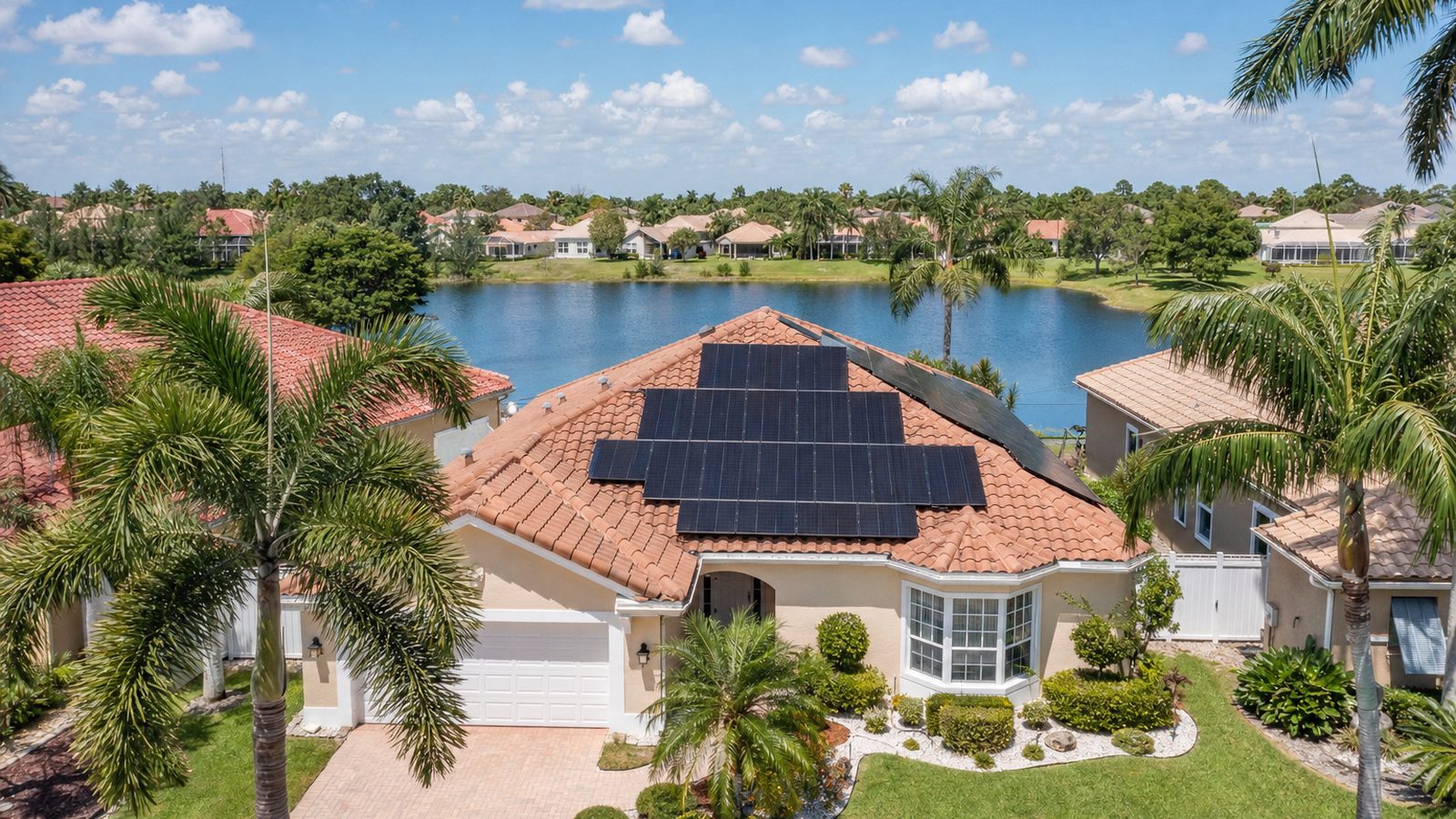
Florida · Pembroke Pines
Solar in Pembroke Pines starts with a wind speed, not a price
Written by the Solar Learning Lab research deskUpdated August 30, 202612 min read
Before anyone talks payback in Pembroke Pines, the racking has to survive a number: 170 miles per hour. Broward is one of only two counties inside the Florida Building Code's High-Velocity Hurricane Zone, and Section 1620 sets the 3-second gust design speed for a Risk Category II house here at 170 mph, with every building treated as Exposure Category C. That single requirement explains most of what makes a Pines solar project different from an inland one: the signed and sealed structural drawings, the triple plan review, the attachment engineering line item on the quote.
The good news is the city tells you exactly what it wants. Pembroke Pines publishes its own solar permit checklist, item by item, including one requirement we have not seen phrased this way anywhere else: an HOA affidavit you must file even if you have no HOA. This page goes through the engineering, the paperwork, and the FPL math in that order, because that is the order the project actually happens in.
Size it before you spec it
The estimator below runs on FPL's documented 2024 average and our Pembroke Pines production model.
Try the Pines estimatorThe HVHZ is a design constraint, and it prices in early
The Florida Building Code names Broward and Miami-Dade as the High-Velocity Hurricane Zone. Section 1620.2 sets Broward's 3-second gust design velocities at 156 mph for Risk Category I structures and 170 mph for Risk Category II, the category covering ordinary homes. Miami-Dade runs slightly hotter at 165 and 175. The current 2023 FBC Building, 8th Edition carries these HVHZ wind-load provisions in Section 1620, and everything in the zone is designed as Exposure Category C.
For a rooftop array, that flows through ASCE 7 chapters 26 through 31: the modules, rails, and every attachment point must be engineered for those loads, and the engineering must be documented. It is why the city's checklist demands signed and sealed drawings rather than a generic racking cut sheet. An inland Florida installer who has never priced HVHZ attachment work will underquote a Pines roof and then discover the difference in plan review. Ask early whether the bid includes HVHZ-specific engineering, because it is not optional and it is not free.
The city hands you the checklist. Read it like a contract.
Pembroke Pines publishes a Solar Panel / Voltaic Permit Checklist that removes the guesswork. The required stack: two sets of plans, plan review by Building, Electrical, and Fire, an Electrical Application on the Broward County Uniform Permit Application, a Building Application where applicable, and those signed and sealed drawings. Under additional documents sits a PV System Rapid Shutdown Affidavit, and a Special Inspector Report is required before final inspection when it applies, with the Special Inspector Form due at plan review.
Three separate reviewing departments means three separate chances for a sloppy package to bounce. The installers who move fast here are the ones who submit complete the first time. When you compare bids, ask each company how many of its last ten Pines permits cleared review without a correction cycle. The answer tells you more than the star rating does.
Where it all gets filed: the Development HUB
Submittals run through the Pembroke Pines Development HUB, the EnerGov platform the city switched on April 4, 2022, covering Building, Planning, Landscaping, Engineering, Code Compliance, and permit record searches. The Building Department counter sits at 601 City Center Way, 2nd Floor, (954) 435-6502, and permit questions go to Pinespermits@cgasolutions.com, an outside services firm running day-to-day permit operations. The HUB navigation lists a Permit Fee Schedule, but no city page we fetched states the solar permit fee in dollars, so confirm the number inside the HUB rather than trusting any quote's placeholder.
One boundary worth knowing: the Engineering Division issues its own permits for work in rights-of-way and easements with two-week minimum processing, but a normal rooftop PV job is Building Department business and never touches that queue.
Two paperwork traps, one of them genuinely odd
The odd one first. The checklist requires a Homeowners Association Affidavit of Awareness and then adds, in the city's own capitals: "IMPORTANT: Must be submitted even if you do not belong to an Association." No HOA, no exemption; you file the affidavit saying so. It is a short form that stops a permit cold when it is missing, and out-of-town installers miss it constantly. Worth knowing alongside it: Florida Statutes 163.04 keeps any HOA that does exist from prohibiting collectors outright, while letting it steer placement within due south or 45 degrees east or west, so long as the placement does not impair performance. Prevailing parties in a 163.04 fight collect fees, which keeps most fights from starting.
The second trap is the Notice of Commencement. Any non-mechanical job over $5,000 in value, which is essentially every residential PV contract, needs an NOC recorded, submitted, and displayed before the first inspection. The city prefers it filed in advance so it does not hold up your inspection request. Get it recorded the week the permit is issued and the trap never springs.
FPL power is cheap. That changes the strategy, not the verdict.
FPL averaged 13.71 cents per residential kWh in 2024 across 5,236,277 customers, per EIA Table 6, among the cheaper big utilities in the country. The Florida PSC's December 2024 comparative rate tables put a 1,000 kWh FPL bill at $118.06 and a 1,500 kWh bill at $182.31, before local taxes and franchise fees. Pembroke Pines households lean hard on that meter: ACS 2023 shows 91.4 percent of the city's 63,994 households heat with electricity, and the cooling load in a tropical monsoon climate needs no footnote.
| Energy source | Type | Average price | What that means |
|---|---|---|---|
| FPL | 2024 residential average | 13.71¢ per kWh | EIA Table 6, 5,236,277 customers |
| FPL | Typical 1,000 kWh bill | $118.06 Dec 2024, pre-tax | FL PSC comparative rate statistics |
| FPL | Typical 1,500 kWh bill | $182.31 Dec 2024, pre-tax | FL PSC comparative rate statistics |
| Pembroke Pines | PVGIS output | 1,525.8 kWh per kW annually | Fixed south facing model; individual roofs differ. |
Cheap grid power means the win comes from offsetting your own usage, not from exporting. Size accordingly.
Rule 25-6.065 giveth monthly, and taketh back in December
Florida's net metering rule, Administrative Code Rule 25-6.065, binds every investor-owned utility including FPL. Your excess generation in any month rolls into the next month's bill as a credit, and credits accumulate for up to twelve months. Then comes the catch: each calendar year closes with a true up, and FPL settles whatever credits you never used at an average annual figure tied to its COG-1 as-available energy tariff, a number nowhere near retail.
How far below? The 2023 statewide net metering report shows FPL customers delivered 531,669,096 kWh to the utility that year, and total year-end payments came to $1,064,678. Run that division and you understand why nobody oversizes on purpose in FPL territory. The kWh you offset is worth retail; the kWh you bank past your own use is worth fractions of a cent at true up.
The rule also protects you at the front door. Home-scale systems fall in Tier 1, 10 kW or less measured by gross power rating, with an inverter system's AC rating counted as DC nameplate times 0.85. Tier 1 customers cannot be charged application fees beyond what non-generating customers pay, cannot be required to carry liability insurance (the utility may only recommend it), and get the metering equipment installed at no additional cost. The utility owes you written notice within 10 business days of receiving your application, either confirming completeness or naming the deficiency. If anyone quotes you an FPL interconnection fee for a Tier 1 system, the rule text is your rebuttal.
The tax treatment that survived the federal repeal
The federal 25D homeowner credit is gone for 2026 purchases; P.L. 119-21 ended it for expenditures after calendar 2025, with carryforward preserved only for pre-2026 credits. Florida's two exemptions still stand, and they are worth naming precisely. Sales tax: solar energy systems and all components are exempt from sales and use tax under Department of Revenue TIP 19A01-09, citing sections 212.02(26) and 212.08(7)(hh); the seller documents the exemption with a purchaser certification. Property tax: Florida Statutes 193.624 tells assessors to ignore whatever just value a renewable energy source device adds when valuing a home. Modules, inverters, storage, wiring, and structural supports are all covered.
Neither exemption requires an application fee or a lottery. They simply mean the sticker price is the price and the array does not inflate your tax bill. In a state with no income tax credit, that pair plus retail-rate offset is the whole incentive story.
March is your best month. June is not. Blame the rain.
Our Pembroke Pines PVGIS run totals 1,525.8 kWh per installed kW per year, but the monthly shape is the interesting part. March leads at 147.2 kWh per kW, then output sags to 116.9 in June, right when NOAA normals for the area show the wet season arriving in force, 8.72 inches of June rain at nearby North Perry Airport. Production recovers through late summer between storms. A flat-monthly savings pitch ignores this curve; a good proposal models it.
March models 147.2 kWh per kW, the annual peak, arriving before the wet season cuts into daily sun.
PVGIS v5.2 model run by Solar Learning Lab on August 30, 2026, NSRDB radiation database. Fixed south facing mount, 30 degree tilt, 14 percent losses, downtown Pembroke Pines coordinates. Your roof will differ. Tool documentation at PVGIS.
Western Broward has installers who know this checklist cold
Pembroke Pines is an owner's market by South Florida standards: 70.8 percent of households own, 60 percent of the stock is single family, and median household income sits at $81,675 per ACS 2023. The vetting question that separates local pros from truck-roll tourists is specific: ask each bidder to name the documents in the city's solar checklist from memory. Anyone who mentions the HOA affidavit unprompted has actually pulled a permit here.
Sun Electronics
Miami Gardens, FL
4.6(54 Google reviews)

Solar Prime Usa
Hollywood, FL
4.9(45 Google reviews)
Solar Champs LLC
Hollywood, FL
4.4(38 Google reviews)
Sprightful Solar
Weston, FL
5.0(36 Google reviews)
AlliTech Solar
Davie, FL
5.0(15 Google reviews)
Ratings snapshot: Google Maps, August 2026, via the DataForSEO SERP feed. Zero companies paid us and none are endorsed by us.
Estimate against the FPL numbers, not a national average
The calculator pairs our Pembroke Pines production run with FPL's 13.71 cent 2024 average. It does not model the year-end COG-1 true up, which is exactly why you should size to your consumption and treat any bid that oversizes past it with suspicion.
The high end is the Pembroke Pines PVGIS model; the low end assumes 85 percent for shade or orientation. Broward's wet season shows up in the monthly curve more than in the annual total.
Cash quotes in Pembroke Pines cluster near $2.17 per watt, against a $3.50 national 2024 median (LBNL). Use your quote.
Assumptions you can change
Use the rate on your actual lease or PPA quote. There is no published statewide average we trust enough to hardcode.
Cash purchase
$19,313 after state credit
- Year 1 benefit
- $155/mo
- Payback
- 10 years
- 20 year net position
- $25,867
No 25D federal credit remains for a 2026 purchase and Florida has no state income tax. The cash case here rests on offsetting FPL consumption at its 13.71 cent 2024 average, skipping sales tax on the equipment, and keeping the panels out of your assessment under FS 193.624.
Solar loan
$270/mo 15 yr payment
- Year 1 net
- -$114/mo
- Upfront
- $0
- 20 year net position
- -$3,346
Financed quotes start from EnergySage Florida cash pricing plus the LBNL loan-over-cash spread. In an HVHZ city, confirm the quote already covers the wind load engineering and sealed drawings before you compare lenders.
Lease / PPA
$0 down you buy the power
- Year 1 net
- -$116/mo
- Upfront
- $0
- 20 year net position
- -$30,109
With third party ownership, ask who pays for the structural engineering, who signs the city permit paperwork, and how the contract treats FPL's year end true up at the as-available rate. Those answers move real money here.
Estimates, not quotes. Production uses our Pembroke Pines PVGIS run; the rate is FPL's 2024 EIA average, not your tariff. Year end credit payouts at the small as-available rate are not modeled. We are a solar installer and we also partner with other solar companies. See our disclosures.
Pembroke Pines questions, answered from the documents
Do I really need an HOA affidavit if I have no HOA?
What wind load must my racking be engineered for?
Can FPL charge me an interconnection fee or require insurance?
What happens to solar credits I have not used by December?
When does the Notice of Commencement have to be in place?
Receipts
Documents checked August 30, 2026. Since fpl.com refuses automated fetching, every utility claim above stands on Florida PSC publications, federal EIA data, and the administrative rule itself, never on marketing copy.
- Building Department, department directory, Development HUB, permits page, solar checklist, and storm recovery page
- EIA Table 6, FL PSC comparative rates, and 2023 net metering report
- Rule 25-6.065, TIP 19A01-09, FS 193.624, and FS 163.04
- FBC HVHZ Section 1620, current HVHZ wind-load provisions, CRS IN12611, city background, and Census ACS 2023
Get a Pines quote with the engineering already in it
A real Pembroke Pines bid names the HVHZ engineering, the checklist documents, and the HUB filing plan up front. We are a solar installer and we also partner with other solar companies. Read our disclosures.
What does your monthly electric bill look like?
Pembroke Pines average is $167 per month (EIA, 2024).