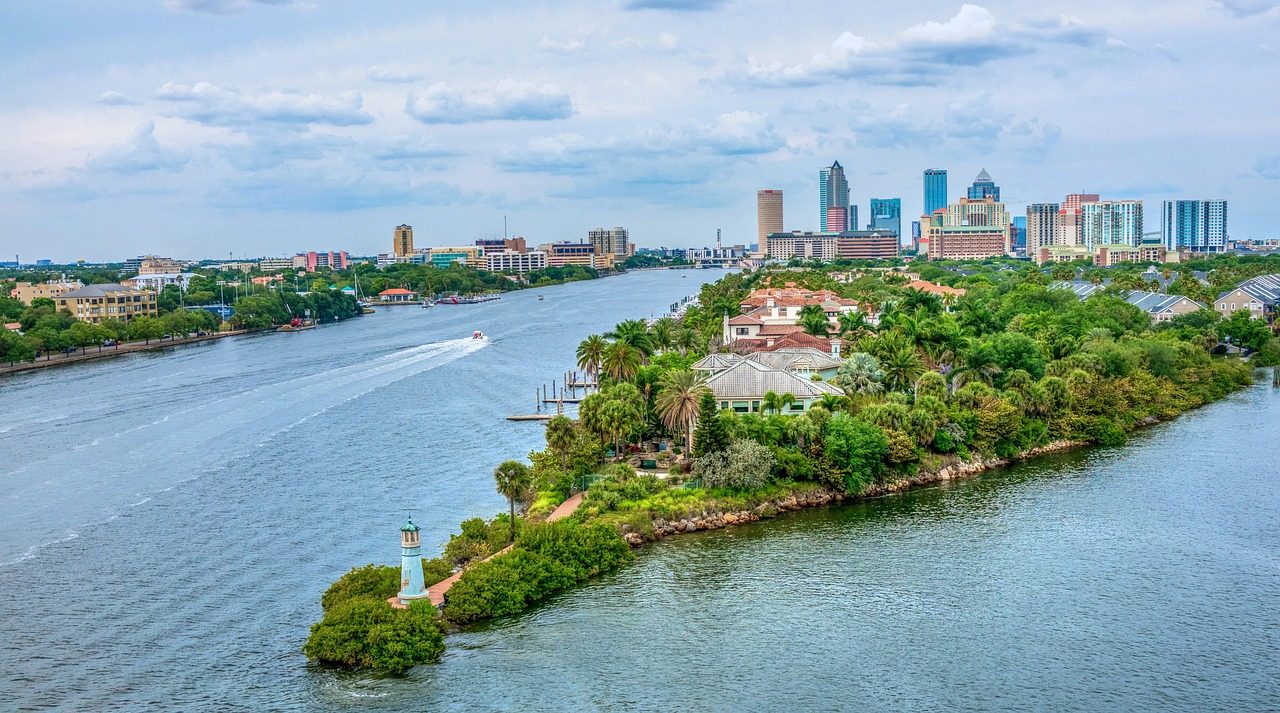
Photo: Michelle-Maria, via Pixabay
Florida · Tampa
Tampa solar in 2026
Written by the Solar Learning Lab research deskUpdated August 21, 202611 min read
Tampa makes city permits easy. The utility approval still has its own work.
Plan a Tampa solar system
Start with your actual bill and this page's documented rules.
Get an estimateWhat changes the Tampa math
Tampa is not a place to confuse a swift city permit with a completed solar project. The City says residential PV trade permits auto-issue when the application and fee are submitted, but TECO still needs an interconnection application, inspection, and permission to operate. The good news is that NM-1 credits in-year delivered and received kWh at the customer current retail energy rate. Excess remaining at the annual true-up is paid at a COG-1 rate, so a system should still be built around the home load. check source tariff source
Tampa Construction Services is the AHJ. Residential PV requires an electrical trade permit and the city directs customers to Accela Citizen Access. The solar checklist says a residential trade permit auto-issues after submission and payment. check source The published residential photovoltaic-cell fee is $120. A 2.5% Florida Building Permit Surcharge, $4 minimum, also applies. Do not call it a zero-permit city or combine a complex service upgrade into the $120. fees source
TECO January 2026 first-tier charges include 9.569 cents energy, 3.210 cents fuel, 0.717 cents storm protection, 0.406 cents clean-energy transition, and 1.995 cents storm surcharge per kWh. The temporary storm surcharge is scheduled to end August 2026. rates source Tier 1 interconnection at or under 10 kW AC has no application fee. TECO says complete approval may take up to 30 calendar days and requires a passing inspection plus a documented manual disconnect. connect source
TECO has a $1,000 solar water-heater rebate for qualifying owner-occupied systems, not a rooftop-PV rebate. It requires an audit and FSEC-certified equipment. No PV or battery rebate was verified. water source Florida solar-rights law protects against a prohibition while preserving limited association placement rules. rights source Residential 25D ended December 31, 2025; a lease or PPA provider may claim 48E. federal source
The Tampa PVGIS reference run is 1,589.6 kWh per kW annually. March is high at 153.4 and September low at 119.7. That curve makes a generic flat annual estimate misleading. pvgis source Tampa International Airport normals show 73.4°F mean temperature and 46.30 inches precipitation. ACS 2023 identifies 160,527 households, 50.2% owner occupancy and 57.4% single-family housing. climate source census source
A decision should begin with the utility rule, then move to physical design. For Tampa, put twelve months of bills beside a proposed annual output of 1589.6 kWh per kW. Separate the kWh you expect to use at home from the kWh you expect to export. The first number is a bill-offset question. The second is a tariff question. Do not treat them as interchangeable. PVGIS method.
Then audit the scope. A useful proposal names permitting, engineering, interconnection, roof work, service-panel work, monitoring, meter work, inspections, and every contingency. If a number cannot be documented before signature, label it as an allowance. That is especially important where the public fee schedule does not publish a flat all-in PV permit amount. The right response to an unknown is n.a., followed by the question that will resolve it.
Finally, plan for the calendar rather than a brochure. A production forecast of 127.5 kWh per kW in January and 122.5 in July means monthly bill behavior will change. The model is deliberately conservative about certainty: it does not know the roof shade, the roof condition, the household schedule, the contract rate, or future utility action. That restraint is useful. It keeps a planning page from becoming a pretend quote.
Permit and interconnection checklist
City permitting and utility permission to operate are separate approvals. Get both dates, each responsible party, and the fee assumptions in writing. The cited city material controls if a sales statement conflicts with this page.
Before final design, confirm roof condition, structural scope, electrical service, ownership or association approval, and the exact account holder. None of those project facts can be inferred from a city average.
Rate and export value
| Energy source | Type | Average price | What that means |
|---|---|---|---|
| Local planning input | Electricity | 13.902¢ per kWh | Verified city research input or transparent state planning input. |
| Rooftop solar | Electricity | Variable by on-site use and export rule | Solar used on site and solar exported are not automatically worth the same amount. |
See the cited local utility materials above.
Incentive discipline
Do not subtract any credit, rebate, or REC payment until eligibility, timing, ownership, and program capacity are confirmed. The source-linked claims above are what was verified on August 21, 2026.
Monthly production, not an annual slogan
The highlighted month is highest in the reference run. Your roof will differ.
PVGIS v5.2. PVGIS v5.2 model run by Solar Learning Lab on August 21, 2026, NSRDB radiation database. Fixed south facing mount, 30 degree tilt, 14 percent losses, downtown Tampa coordinates. Your roof will differ.
Tampa field notes: an auto-issued permit is not permission to operate
Tampa’s city-side process is unusually straightforward. Its solar checklist says residential trade permits are auto-issued once the application is submitted and the fee is paid. The project still needs an Electrical Trade Permit, and Accela Citizen Access is the named online route. “Auto-issued” is a meaningful improvement over a discretionary plan-review queue, but it does not mean every technical question has gone away. It also does not replace TECO approval. The clean way to manage a job is to treat city permitting, utility interconnection, installation, city inspection, utility inspection, and permission to operate as separate milestones. City of Tampa solar checklist and TECO connection steps.
The City’s published residential photovoltaic-cell trade permit fee is $120. It is not the only potential public charge. The fee schedule says the Florida Building Permit Surcharge is 2.5% of permit value with a $4 minimum. If a project also needs an electrical service upgrade, that scope has its own listed fee line. The right interpretation is narrow: $120 is the published PV trade-permit line, while the final project can include surcharge and other required work. A quote that says “permit included” should say whether it includes those additions and whether it covers a change in scope after site inspection. Tampa trade-permit fee schedule.
TECO NM-1 gives a household more useful in-year export treatment than the JEA fuel-rate approach. Under the tariff, monthly net excess kWh carry to the next month, and the customer’s bidirectional meter is installed at TECO expense with no extra metering or billing charge. At year end, remaining net export is paid at TECO’s annual average COG-1 kWh rate for the prior year. The tariff’s structure makes it sensible to offset annual use, but it does not make leftover year-end production equivalent to a permanent retail credit. A quote should show the system’s expected annual balance, not just its summer peak output. TECO Tariff NM-1.
TECO’s current connection procedure contains physical details that deserve a pre-install check. A Tier 1 system at or below 10 kW AC has no application fee. The utility says approval may take up to 30 calendar days after it receives a complete application and documentation. It also requires a passing TECO inspection, including an acceptable disconnect switch. A visible load-break manual disconnect must sit next to the meter and carry the specified on-site-generation placard; applicants photograph it for the package. An inspection that cannot be completed, including a failed inspection or reinspection, has a $37 fee. This is not paperwork theater. It is a schedule and scope item. TECO net-metering application instructions.
The January 2026 TECO residential bill stack is another reason to use an actual bill. For the first 1,000 kWh, the insert lists 9.569 cents energy, 3.210 cents fuel, 0.717 cents storm protection, 0.406 cents Clean Energy Transition Mechanism, and 1.995 cents storm surcharge per kWh. The storm surcharge ends in August 2026. Above 1,000 kWh, energy and fuel are higher. The same insert says a 1,000 kWh customer sees an $8.88 increase. A single cents-per-kWh calculator input is a transparent estimate, not a reconstruction of every customer’s monthly bill. TECO January 2026 rate insert.
The named TECO solar rebate is for a solar water heater. It is $1,000 per eligible owner-occupied system, with FSEC-certified equipment, a free TECO energy audit before installation, and program timing conditions. It is not a photovoltaic-panel rebate. The reviewed material found no TECO residential PV rebate and no battery rebate. That distinction matters because water-heater marketing often appears beside solar marketing and can make a proposal look as if it contains PV cash support that it does not. The federal residential 25D credit ended December 31, 2025; lease and PPA providers may claim 48E. TECO solar-water-heater standards and Congressional Research Service credit summary.
Tampa International Airport has a 73.4°F annual normal mean temperature and 46.30 inches of normal annual precipitation, the warmest and driest profile of the three Florida cities in this research set. Our city PVGIS curve peaks in March at 153.4 kWh per kW and reaches a low in September at 119.7. Tampa’s ACS profile lists 57.4% single-family homes and 50.2% owner occupancy. That supports a large potential addressable roof base, not an automatic approval for any particular house, roof age, or association. Florida’s solar-rights law remains the relevant guardrail against a prohibition. NOAA climate normals, ACS 2023 Census data, and Florida Statute 163.04.
Tampa TECO project comparison
The cards below are not endorsements. A Tampa bid should make the $120 City PV permit line, any surcharge, NM-1 documentation, Tier classification, and disconnect responsibility visible.
Ratings snapshot: Google Maps, August 2026, via the DataForSEO SERP feed. Zero companies paid us and none are endorsed by us.
Transform Solar
Tampa
5.0(188 Google reviews)
Florida Electric & Solar
Tampa
4.9(805 Google reviews)
Powersol USA
Tampa
5.0(41 Google reviews)
Total Care Installs
Tampa
5.0(34 Google reviews)
Lunex Power
Tampa
4.8(619 Google reviews)
Unicity Solar Energy
Tampa
4.8(498 Google reviews)
Lixia Solar
Tampa
4.7(41 Google reviews)
Tampa Bay Solar
Tampa
4.7(388 Google reviews)
Ratings and review counts are Google Maps ratings for Tampa local results, retrieved August 17, 2026 via the DataForSEO SERP API. We list the highest rated established companies we found. No company paid to appear here, and appearing here is not an endorsement. Check current reviews and licensing before you sign anything.
TECO project comparison
This city run is a fixed south-facing reference, not a roof-specific shade study.
Cash quotes in Tampa cluster near $2.17 per watt, against a $3.50 national 2024 median (LBNL). Use your quote.
Assumptions you can change
Use the rate on your actual lease or PPA quote. There is no published statewide average we trust enough to hardcode.
Cash purchase
$18,445 after state credit
- Year 1 benefit
- $157/mo
- Payback
- 10 years
- 20 year net position
- $27,138
Local utility export terms may differ from retail consumption value. Read the city page before treating savings as a quote.
Solar loan
$257/mo 15 yr payment
- Year 1 net
- -$101/mo
- Upfront
- $0
- 20 year net position
- -$761
Loan cost and dealer fees vary by offer.
Lease / PPA
$0 down you buy the power
- Year 1 net
- -$114/mo
- Upfront
- $0
- 20 year net position
- -$29,328
A lease or PPA provider may claim federal 48E; compare contract escalation and export mechanics.
Estimates, not quotes. We are a solar installer and we also partner with other solar companies. See our disclosures.
Tampa solar questions tied to NM-1
When does a Tampa PV trade permit issue?
Does auto-issue put the array on the TECO grid?
How are remaining NM-1 exports handled?
What fee applies when a TECO inspection cannot be completed?
Is the $1,000 TECO solar rebate for panels?
Tampa source-by-source evidence register
This extended register preserves the supplied local research in short audit notes. Each note is anchored to a city research URL retained in this page’s source map.
- Tampa evidence note 001: Tampa, FL : residential solar research Permits and AHJ - AHJ : City of Tampa Construction Services Division research citation.
- Tampa evidence note 002: (Development Growth Management), 1400 N. Boulevard, Tampa FL 33607. Residential solar PV requires an Electrical Trade Permit (solar research citation.
- Tampa evidence note 003: thermal also requires a Plumbing permit). ( City of Tampa solar checklist PDF ( - Portal : Accela research citation.
- Tampa evidence note 004: Citizen Access at (in-person intake also available at 1400 N. Boulevard). ( solar checklist ( - Instant issuance research citation.
- Tampa evidence note 005: : the City's own solar checklist states residential trade permits are auto-issued once the application is submitted and research citation.
- Tampa evidence note 006: the fee is paid; commercial solar is reviewed within 10 days on a best-effort basis. That is functionally research citation.
- Tampa evidence note 007: instant permitting for residential PV, though it is not SolarAPP . ( solar checklist ( - SolarAPP : research citation.
- Tampa evidence note 008: n.a. (not referenced on any City of Tampa page fetched). - Fees : Trade Permit Fee Schedule lists research citation.
- Tampa evidence note 009: Photovoltaic cells (residential) $120.00 ; Electrical general $120; Service Upgrade $120. All permits are also subject to the research citation.
- Tampa evidence note 010: Florida Building Permit Surcharge of 2.5% of permit value, $4.00 minimum. ( Trade Permit Fee Schedule PDF ( research citation.
- Tampa evidence note 011: index page: Construction Services fees ( - Review timeline : residential PV trade permit auto-issued on payment; no research citation.
- Tampa evidence note 012: plan review queue published for residential PV. ( solar checklist ( Utility and rates - Utility : Tampa research citation.
- Tampa evidence note 013: Electric Company (TECO) . - Residential tariff : Standard Residential (RS) . Rates effective January 2026 : Basic research citation.
- Tampa evidence note 014: Service Charge 0.45 cents/day ; Energy Charge 9.569 /kWh up to 1,000 kWh and 10.569 /kWh above 1,000 research citation.
- Tampa evidence note 015: kWh; Fuel 3.210 (first 1,000 kWh) / 4.210 ; Storm Protection 0.717 ; Clean Energy Transition Mechanism 0.406 research citation.
- Tampa evidence note 016: ; Storm Surcharge 1.995 (ends August 2026). RSVP-1 energy charge 8.462 . A 1,000 kWh residential customer sees research citation.
- Tampa evidence note 017: an increase of $8.88 . ( TECO residential rates insert, Jan 2026 ( - Export program : Net research citation.
- Tampa evidence note 018: metering under Tariff NM-1, Net Metering Service (tariff sheet effective date shown January 1, 2022). Mechanics: generator 2,000 research citation.
- Tampa evidence note 019: kW; signed Standard Interconnection Agreement (Tier 1/2/3) required; monthly net excess kWh carry to the next month; at research citation.
- Tampa evidence note 020: year end, remaining net export is paid at TECO's annual average COG-1 kWh rate for the prior year research citation.
- Tampa evidence note 021: . A single bi-directional meter is installed at TECO's expense with no additional metering or billing charge. ( research citation.
- Tampa evidence note 022: TECO tariff section 3 PDF ( - Credit rate during the year : exported kWh offset consumption at research citation.
- Tampa evidence note 023: the customer's current retail energy rate ; the bill shows kWh Delivered and kWh Received. Net metering is research citation.
- Tampa evidence note 024: not compatible with the Energy Planner rate, so participants must move to the standard residential rate. TECO cites research citation.
- Tampa evidence note 025: FPSC Rule 25-6.065. ( TECO connecting your solar ( - Interconnection process and fees : approval may take research citation.
- Tampa evidence note 026: up to 30 calendar days from receipt of a complete application plus all documentation, and also depends on research citation.
- Tampa evidence note 027: a passing TECO inspection including verification of an acceptable disconnect switch. Tier 1 ( 10 kW AC, agreement research citation.
- Tampa evidence note 028: sheet 8.1000): no application fee . Tier 2 ( 10 100 kW, sheet 8.1035): $250 plus $1,000,000 general research citation.
- Tampa evidence note 029: liability insurance with annual renewal. Tier 3 ( 100 kW 2 MW, sheet 8.1070): $500 plus $2,000,000 liability. research citation.
- Tampa evidence note 030: Battery subsystems 1 kW use sheet 8.1150 ($100,000 liability at or below 15 kW AC; $1,000,000 above). A research citation.
- Tampa evidence note 031: $37 fee applies to any inspection that cannot be completed, including failed inspections and each re-inspection. A visible research citation.
- Tampa evidence note 032: load-break manual disconnect adjacent to the meter with an engraved ON-SITE GENERATION UTILITY DISCONNECT SWITCH placard is required, research citation.
- Tampa evidence note 033: photographed with the application. ( TECO Steps to Connect ( Local incentives - TECO Residential Solar Water Heater research citation.
- Tampa evidence note 034: Rebate : $1,000 per system , one per premise, owner-occupied homes, FSEC-certified equipment, a free TECO energy audit research citation.
- Tampa evidence note 035: required before installation, 90 days to install after the audit, reservations open October 1 through September 30 on research citation.
- Tampa evidence note 036: a first-come first-served basis, new construction limited to 20% of rebated systems. ( TECO solar water heater rebate research citation.
- Tampa evidence note 037: program standards PDF ( - TECO residential solar PV rebate : n.a. (none found on TECO pages fetched). research citation.
- Tampa evidence note 038: TECO's enhanced residential programs highlight efficiency rebates such as up to $550 for AC. ( TECO media release research citation.
- Tampa evidence note 039: on enhanced programs ( - TECO residential battery rebate : n.a. Batteries are interconnected under a battery agreement research citation.
- Tampa evidence note 040: (sheet 8.1150) with insurance requirements, not a rebate. ( TECO Steps to Connect ( - City of Tampa research citation.
- Tampa evidence note 041: rebate for residential solar : n.a. (none found on tampa.gov pages fetched). City texture 1. Climate normals (1991 research citation.
- Tampa evidence note 042: 2020) : Tampa International Airport (USW00012842) annual normal mean temperature 73.4 F , annual normal precipitation 46.30 in research citation.
- Tampa evidence note 043: : the warmest annual mean of the three Florida cities researched here and the driest of the three. research citation.
- Tampa evidence note 044: ( NOAA NCEI normals API ( 2. Florida solar rights law (F.S. 163.04) applies in Tampa: ordinances prohibiting research citation.
- Tampa evidence note 045: solar collectors are expressly prohibited, HOAs and deed restrictions cannot ban rooftop solar, and an HOA may only research citation.
- Tampa evidence note 046: dictate roof location within south or 45 east/west of due south where that does not impair operation; prevailing research citation.
- Tampa evidence note 047: party gets attorney's fees. ( 2025 Florida Statutes 163.04 ( 3. Permitting is one of the least friction-heavy research citation.
- Tampa evidence note 048: in this five-city set : residential trade permits (including PV) are auto-issued upon application and payment at a research citation.
- Tampa evidence note 049: flat $120 photovoltaic residential trade permit fee. ( solar checklist ( trade permit fee schedule ( 4. Utility research citation.
- Tampa evidence note 050: bill volatility is a live sales variable : TECO's January 2026 residential package added $8.88 for a 1,000 research citation.
- Tampa evidence note 051: kWh customer, and includes a temporary Storm Surcharge of 1.995 /kWh that ends August 2026 plus a Clean research citation.
- Tampa evidence note 052: Energy Transition Mechanism charge. ( TECO Jan 2026 rates insert ( 5. City climate policy exists but with research citation.
- Tampa evidence note 053: no published numeric renewable target on the page fetched : Tampa released its first Climate Action Equity Plan research citation.
- Tampa evidence note 054: with 143 initiatives across 10 categories and commissioned a 100% Renewable Energy Roadmap for Municipal Operations ; specific research citation.
- Tampa evidence note 055: percentage and year targets are n.a. from that release. ( City of Tampa CAEP release ( Sources - research citation.
- Tampa evidence note 056: - - - - - - - - - - - research citation.
Tampa NM-1 bill reading guide
These local checks turn the supplied permit and utility record into a proposal-review sequence. They are not a savings guarantee or an equipment recommendation.
Treat Tampa as a tariff exercise
TECO calls the program Net Metering Service under Tariff NM-1. Its central feature is monthly netting: surplus kWh carries to the next billing month, while remaining net export at year end is paid at the prior year annual average COG-1 kWh rate. The distinction matters because a customer can receive retail-rate offset during the year without a promise that unused year-end export will receive that same retail value. Source.
Build the bill from the current components
For the first 1,000 kWh in TECO Standard Residential service, the January 2026 insert lists 9.569 cents energy, 3.210 cents fuel, 0.717 cents Storm Protection, 0.406 cents Clean Energy Transition Mechanism, and a 1.995-cent Storm Surcharge scheduled to end in August 2026. The basic charge is 0.45 cents per day. A model should state which components it assumes solar offsets and should not hide the expiration date of the temporary surcharge. Source.
Use the 1,000 kWh threshold carefully
TECO publishes higher first-tier energy and fuel figures above 1,000 kWh: 10.569 cents and 4.210 cents respectively. A household that often exceeds 1,000 kWh does not have a single uniform marginal energy value across the month. The useful quote shows the load profile and tier exposure rather than multiplying every annual kWh by one blended number. Source.
Show the published change without treating it as a promise
TECO says a 1,000 kWh residential customer sees an $8.88 increase in the January 2026 rate insert. That statement is a current tariff context point, not a forecast of future increases or a justification for an assumed escalation rate. It belongs in a careful discussion of bills, not in a claim that solar savings will automatically track that exact amount. Source.
Read the meter sentence literally
Under NM-1, TECO installs the single bidirectional meter at its expense and states there is no additional metering or billing charge. The bill reports kWh Delivered and kWh Received. That makes those two lines useful audit evidence after permission to operate: the homeowner can compare the actual pattern against the installer model rather than rely on an annual marketing total. Source.
Check the rate-plan restriction
TECO says net metering is not compatible with the Energy Planner rate. Joining NM-1 requires the customer to use the standard residential rate. A quote that compares a pre-solar Energy Planner bill with a post-solar Standard Residential bill needs to make that rate-plan change visible, otherwise the purported solar-only savings comparison is muddled. Source.
Map the interconnection clock
TECO says approval may take up to 30 calendar days after it receives a complete application and documentation, subject to a passing inspection. The language does not promise a 30-day completion date for a customer who has not supplied a complete packet. Schedule closing dates around application completeness, inspection readiness, and the utility disconnect requirements. Source.
Do not treat Tier 1 and Tier 2 as the same file
Tier 1 is 10 kW AC or less and carries no application fee. Tier 2 spans more than 10 through 100 kW and carries a $250 application fee plus $1 million general liability insurance with annual renewal. Tier 3 starts above 100 kW, carries a $500 fee, and requires $2 million liability coverage. Most homes fit the first category, which is precisely why a larger-system template should not be copied into every Tampa proposal. Source.
The disconnect is an inspection item
TECO requires a visible load-break manual disconnect adjacent to the meter, a placard reading ON-SITE GENERATION UTILITY DISCONNECT SWITCH, and a photograph with the application. TECO also lists a $37 charge for an inspection that cannot be completed, including a failed inspection and each re-inspection. That is operational detail worth confirming before the crew leaves the site. Source.
Keep batteries separate from the rebate conversation
The supplied research shows a battery agreement and insurance requirements for battery subsystems at or above 1 kW. It does not show a residential TECO battery rebate. It also shows no residential TECO PV rebate. A proposal can discuss a battery’s load-shifting role, but it should not smuggle an unavailable rebate into the economics. Source.
Do not confuse water heating with photovoltaic support
TECO offers a $1,000 residential solar water-heater rebate, subject to conditions such as owner occupancy, FSEC-certified equipment, a pre-install energy audit, and a 90-day installation window after that audit. That program concerns solar thermal equipment. It is not a $1,000 credit toward a photovoltaic array, even though both products use the word solar. Source.
Let permitting be one of Tampa’s advantages
The City’s checklist says residential trade permits are auto-issued when the application is submitted and the fee is paid. The published residential photovoltaic-cell fee is $120, with a 2.5% Florida Building Permit Surcharge and a $4 minimum. That is materially different from a manually reviewed solar permit path, but it does not erase TECO’s separate interconnection and inspection process. Source.
Use the Florida protection precisely
Florida law prevents local ordinances and restrictive covenants from prohibiting solar collectors, subject to the specified roof-location standard. It is useful when an association discussion becomes a blanket no. It does not remove TECO interconnection duties, City permit requirements, or the need to design a system that meets the actual roof and service conditions. Source.
Put the weather figures in their lane
Tampa International Airport’s 1991 to 2020 normals show a 73.4-degree Fahrenheit annual mean and 46.30 inches of annual precipitation. Those data establish local context. They are not a production promise and they do not replace the required PVGIS production scenario for an individual roof. Source.
The Tampa decision in one sentence
A sound Tampa model needs monthly NM-1 carryforward, a year-end COG-1 settlement assumption, current tiered rate components, the standard-rate requirement, and a real inspection plan. The auto-issued City permit is welcome, but it is not the whole project. Source.
Tampa operational notes: from permit to PTO
The City permit is fast, but the project is not yet interconnected
Tampa’s auto-issued residential trade permit is a favorable beginning. It does not replace TECO’s signed interconnection agreement, meter work, application review, disconnect verification, and passing inspection. A sales timeline should show these as separate stages. Calling the project approved immediately after City payment sets the wrong expectation for permission to operate. Source.
The published fee contains a small but real add-on
The residential photovoltaic-cell permit line is $120. Tampa’s schedule also subjects permits to a 2.5% Florida Building Permit Surcharge with a $4 minimum. The point is not that this transforms the project budget. The point is that a quote should say whether its permit figure includes the surcharge instead of giving a neat $120 number that is only part of the published charge. Source.
COG-1 is the year-end exposure
Under NM-1, the monthly balance can be favorable during high-generation periods because excess kWh carries forward. Yet the remaining annual amount is paid at the prior year’s average COG-1 kWh rate. A household that intentionally designs to produce a large annual surplus should request the model’s expected year-end surplus and its COG-1 valuation. Retail monthly netting is not the same as an unlimited retail cashout. Source.
Temporary storm charges should not become a twenty-year assumption
The January 2026 rate insert lists a 1.995-cent Storm Surcharge ending August 2026. It may influence a current bill, but a long-term solar illustration should not embed that temporary component as though the tariff promises it for decades. This is a common modeling discipline issue: distinguish a present charge from a contracted future rate. Source.
Battery paperwork includes insurance bands
TECO’s battery agreement path names $100,000 liability coverage at or below 15 kW AC and $1 million above 15 kW AC. That is a specific interconnection requirement, not proof that a battery has a financial rebate. It belongs in a battery proposal’s administrative checklist alongside electrical scope, not in the incentive line. Source.
Reinspection cost is avoidable project friction
The $37 inspection charge applies when an inspection cannot be completed, including failed work and each reinspection. The meter-adjacent disconnect, engraved placard, and required photo are not decorative details. They are exactly the sort of field requirements that a crew should verify before asking TECO to inspect. Source.
Tampa proposal audit
A Tampa buyer should receive a bill model with delivered versus received kWh, the standard-residential tariff after leaving Energy Planner if applicable, monthly carryforward, annual COG-1 settlement, and a complete disconnect checklist. Those are the operating mechanics of NM-1, not optional fine print. Source.
Tampa final implementation checks
The application must be complete before the stated clock matters
TECO’s up-to-30-calendar-day language applies after receipt of a complete package with documentation. The interconnection agreement, disconnect photo, equipment information, and any required insurance should be assembled before the customer treats that window as a scheduling commitment. Missing material is not a utility delay in the tariff sense. Source.
Monthly carryforward does not erase a large surplus decision
NM-1 lets excess kWh move forward month by month. That can suit a household with seasonal variation, but it should not justify designing for a deliberately oversized annual export. The prior-year COG-1 settlement at year end is the relevant backstop, and it is a different valuation from the current retail energy offset during a billing cycle. Source.
The practical local priority
Tampa has a good City permit path and a real utility net-metering structure. The project still needs a clean NM-1 file, a visible field-ready disconnect, and a model that stops treating the annual COG-1 payout as retail credit. Source.
Tampa bill-review addendum
Charge categories need a transparent treatment
The January 2026 TECO insert separates energy, fuel, storm protection, the clean-energy transition mechanism, and the temporary storm surcharge. A solar estimate may simplify billing for presentation, but the underlying workbook should document the treatment of every published category. Otherwise a customer cannot see why its expected savings differ from a bill that contains several non-energy components. Source.
The standard rate decision should be documented
Because NM-1 is incompatible with Energy Planner, a customer using that rate should receive a before-and-after bill comparison that identifies the selected standard residential rate. This is more than a disclosure sentence. It is the only way to separate the solar effect from the effect of changing bill structures at enrollment. Source.
Tier labels are not just names
TECO’s Tier 1 paperwork applies at 10 kW AC or below, and the no-fee status belongs to that band. A proposal that refers only to panel DC rating can leave a customer unable to verify the relevant tier. The agreement category should match the AC capacity on the utility application. Source.
Solar thermal needs its own permit conversation
Tampa requires an Electrical Trade Permit for residential solar PV, while solar thermal also needs a Plumbing permit. A contractor selling both technologies should keep the scopes distinct. Combining the thermal rebate narrative and the PV permit narrative creates needless confusion about what has actually been filed and what incentive, if any, applies. Source.
Tampa buyer’s final record
Keep the City receipt, TECO interconnection agreement, disconnect photograph, inspection outcome, and first few bills showing Delivered and Received kWh. These documents make it possible to check real performance against the original NM-1 model after permission to operate. Source.
Get a Tampa estimate
We are a solar installer and we also partner with other solar companies.
What does your monthly electric bill look like?
Florida average is $167 per month (EIA, 2024).