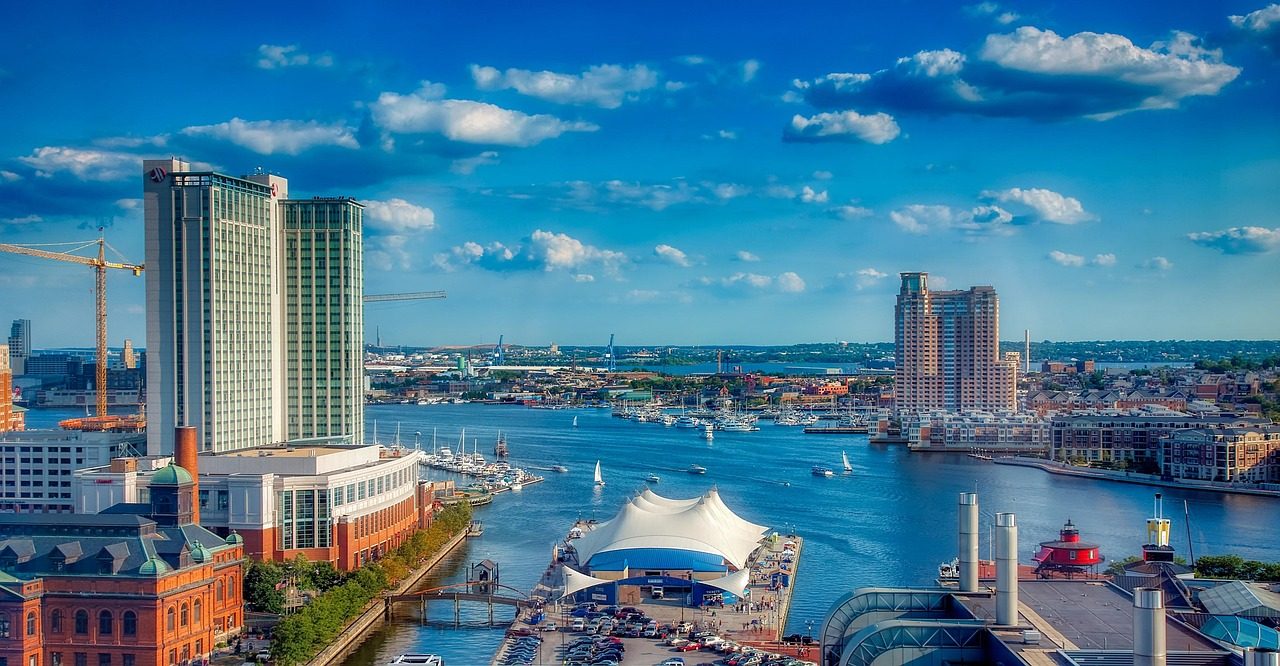
Photo: 1778011, via Pixabay
Maryland · Baltimore
Solar in Baltimore in 2026
Written by the Solar Learning Lab research deskUpdated August 21, 202612 min read
Baltimore keeps the local solar question unusually tangible. Count the panels for the permit fee, measure the rooftop array's 42-inch height, check the three-foot front setback on a flat roof, and then model the Maryland net-metering election carefully.
1368.1 kWh
Annual PVGIS output per kW
21.77¢
Calculator electricity-rate input
250,608
City households in ACS 2023
Price this against your real roof
Use the local permit, utility, and rooftop facts on this page to challenge a generic Baltimore proposal before requesting a quote.
Get my estimateBaltimore roof geometry and a module-count fee
Baltimore DHCD Permits and Inspections is the authority having jurisdiction, using ePermits. It publishes a fast administrative service standard: most electrical permits are ready for payment within an hour, and other applications submitted before 9 a.m. receive a response by 2 p.m. the same day. Planning and historic-district referrals remain exceptions, so the headline turnaround is not a blanket construction schedule. DHCD permits guidance.
The photovoltaic permit itself is $25 for one through 25 panels, plus $5 for each additional 10 panels, with a $25 minimum. Application fees and a 5% Building Code Permit Tax can add to the final cost. Baltimore's zoning rule limits a rooftop array to 42 inches above the roof surface; on a flat roof it must sit three feet back from the front facade. These details are not decorative. They can rule out a preferred tilt-rack layout on a rowhouse before the electrical work is even considered. Building Code Section 109 fee schedule; Zoning Code Section 15-517.
Maryland accrual choices, not a made-up BGE rate
BGE bills net of customer generation and issues credits when the customer sends more electricity to the grid than BGE delivers. Its available program material does not state a local credit rate or true-up date, so we do not manufacture one. The verified Maryland statute supplies the operational rule: eligible systems are capped at 2 MW, use a bidirectional meter, and the customer owns the RECs. BGE solar incentives and rebates; Maryland Public Utilities Section 7-306.
Maryland allows a 12-month accrual period ending with the billing cycle immediately before the end of April, or, except for municipal and cooperative customers, indefinite accrual. At the 12-month election, remaining net excess is paid within 30 days at the averaged prior-12-month generation or commodity portion of the rate. That is not automatically full retail cash. The calculator uses Maryland's verified EIA residential average and should be treated as a planning tool, not a substitute for the BGE supply and distribution lines on a current bill. Statutory true-up and valuation language; EIA price context.
| Energy source | Type | Average price | What that means |
|---|---|---|---|
| Maryland residential context | Electricity | 21.77¢ per kWh | Calculator input from the verified EIA state residential price context. |
| Owned rooftop solar | Electricity | Variable per kWh | Output and avoided-bill value depend on this roof, tariff, export arrangement, and system cost. |
See the utility and statutory sources cited in this section. The table is an orientation tool, not a quote or tariff replacement.
Baltimore output and the timing of Maryland net excess
The annual number is 1368.1 kWh per kW, but its rhythm matters. In this fixed, south-facing model, July is the high point at 138.1 kWh per kW. Roof direction, shade, equipment, and local conditions can move a real project away from this line.
July is the highest modeled month. Use the monthly curve with your utility billing pattern rather than relying only on an annual headline.
Method: PVGIS v5.2. PVGIS v5.2 model run by Solar Learning Lab on August 21, 2026, NSRDB radiation database. Fixed south facing mount, 30 degree tilt, 14 percent losses, downtown Baltimore coordinates. Your roof will differ.
Baltimore incentive claims need proof, timing, and an owner
The useful current Maryland program is the Maryland Solar Access Program, not a Baltimore City per-watt rebate. FY27 applications opened July 29, 2026, close at 3 p.m. ET May 31, 2027, use a two-step capacity reservation and payment-request process, and require an FY27 participating contractor. The research does not identify a standing Baltimore City residential rebate, so that field is n.a. Maryland Solar Access Program; Baltimore DHCD permits.
The previous FY26 announcement set income-eligible grant figures, but eligibility and cycle rules matter. Treat program availability as a reservation question for a qualifying household, not a universal line item in a sales worksheet. The residential 25D federal credit ended December 31, 2025; lease and PPA providers may claim 48E. That distinction is material because a provider can price a federal benefit into a contract without giving the homeowner the tax credit. MEA current-cycle information; CRS federal-credit summary.
Federal credit disclosure: residential 25D credit ended December 31, 2025; lease/PPA providers may claim 48E. Congressional Research Service.
What shapes a Baltimore rooftop project
Baltimore's rowhouse logic is plain in the City's comprehensive-plan data: single-family attached homes account for 58.2% of the cited housing mix, while detached single-family homes are 13.0%. Flat roofs and tight street-facing facades make the height and setback rules especially consequential. A generic design with tall tilted modules may look efficient in an illustration and still fail the local roof geometry. Baltimore Comprehensive Master Plan, LIVE chapter; Baltimore solar zoning rules.
Baltimore's published per-panel fee is predictable, which is refreshingly different from a valuation-based system. But predictable is not synonymous with uncomplicated. A design needs the roof height, facade setback, line drawing of electrical components, applicable plan-review fee, and any historic or planning referral squared away. The right question is not whether Baltimore permits solar quickly. It is whether this particular roof fits the code before an installer orders hardware. Baltimore permit-fee rules.
ACS 2023 records 250,608 households, median income of $59,623, 47.5% owner occupancy, 64.8% single-family housing, and 31.0% electric heat for Baltimore. These are city-wide context statistics, not a prediction for one home. US Census Bureau, ACS 5-year estimates, 2023.
A Baltimore decision sequence that starts with geometry
The practical first question is not “how many panels fit?” It is “what can the roof legally carry and show from the street?” On a flat roof, Baltimore's three-foot front-facade setback and 42-inch height limit can affect tilt, row spacing, and visual layout. Get a scaled design before comparing production estimates. A flat-rowhouse roof is not automatically a problem, but the local exception is bounded. Baltimore Section 15-517.
Then count panels and carry the fee calculation into the proposal. The published PV permit cost is $25 for one through 25 panels plus $5 for each additional 10 panels, but the application fee and a 5% Building Code Permit Tax can also apply. This is far clearer than a vague “permit allowance,” and it gives the owner a simple way to check that a later change in module count has not silently altered the budget. Baltimore Building Code Section 109.
For utility value, choose the Maryland statutory accrual option deliberately. The 12-month option has an April-cycle true-up and values remaining excess at the prior-year average generation or commodity component. Indefinite accrual has a different rhythm. Neither option should be described as a generic cash payment at the retail bill rate. Ask the installer which election and which BGE bill elements were used in the savings model. Maryland Section 7-306; BGE solar guidance.
Finally, if a household appears eligible for Solar Access, verify contractor participation and capacity reservation before assuming grant dollars. If it does not, leave the city rebate line blank because no standing Baltimore City residential amount was verified. That is not pessimism. It is the difference between a proposal that can survive paperwork and one that only looks good in the kitchen. MEA program information.
Ownership and building type still matter. ACS 2023 puts Baltimore owner occupancy at 47.5% and single-family housing at 64.8%. A rowhouse owner with authority over the roof has a different path from a tenant or an owner in a shared building. The published code constraints are roof-specific, so a contractor should verify roof control, historic or planning referrals, and the electrical layout before collecting money for an allegedly simple job. ACS 2023 city data; DHCD permit information.
A sound Baltimore comparison also separates the modeled bill offset from renewable-energy-credit treatment. Maryland law says the customer owns RECs, and its net-excess rules set out how credits carry or are paid based on the selected accrual arrangement. The proposal should identify this ownership and choice in plain language. It is a much better conversation than debating an uncited “average savings” number. Maryland net-metering statute.
Baltimore flat-roof file: code, fees, and credits
The 42-inch measurement affects design choices. Baltimore's zoning rule permits roof-mounted solar as a height exception only when it rises no more than 42 inches above the roof surface. Tilt, rack profile, and wind design can interact with that dimension. A homeowner should request the dimension on the drawing instead of assuming the equipment will pass because it is called “roof mounted.” Baltimore Zoning Code Section 15-517.
Street-facing flat roofs have a separate setback detail. The same provision requires rooftop arrays on flat roofs to be three feet back from the front facade. Rowhouse owners should see a roof plan showing the facade side and the setback line, especially when a contractor proposes a densely packed arrangement. This is the type of constraint a citywide production estimate cannot catch. A clear drawing avoids the later surprise of lost modules or revised tilt. Baltimore solar zoning language.
Panel count makes the permit fee legible. Under Building Code Section 109, one through 25 photovoltaic panels cost $25 for the permit, followed by $5 for each additional 10 panels. The section also provides application-fee rules and a Building Code Permit Tax equal to 5% of final permit cost. Give the owner a module count and a fee computation. That is more transparent than burying a code-based cost in a broad “soft costs” label. Baltimore Building Code Section 109.
DHCD's quick response language has boundaries. The department says most electrical permits are ready for payment within an hour, 24 hours per day. It also says other application types submitted before 9 a.m. receive a response by 2 p.m. that day, with later submissions addressed by the next business day. Planning or Historic district locations require referral. Those statements describe an administrative process; they do not guarantee a completed solar construction schedule. DHCD permits page.
Maryland gives the customer a choice about the accrual period. Public Utilities Section 7-306 allows a 12-month option ending with the billing cycle just before the end of April, or, for eligible customers other than municipal and cooperative utility customers, indefinite accrual. A 12-month election pays leftover net excess at an averaged prior-12-month generation or commodity component. The election changes the financial story. It should be visible in writing. Maryland Public Utilities Section 7-306.
REC ownership should be stated in the contract. The statute says a customer-generator owns renewable energy credits. That is a different asset from BGE bill credits and different again from a contractor's marketing claim. If a lease, PPA, or third-party service agreement asks for RECs, the homeowner should know what is transferred and what remains. Unlabeled REC treatment creates confusion later, when a buyer expects revenue or environmental claims that the contract assigned away. Maryland distributed-generation statute.
Solar Access is targeted, not automatic. The Maryland Energy Administration's FY27 cycle opened July 29, 2026, runs to May 31, 2027, and uses a capacity-reservation then payment-request approach through participating contractors. A Baltimore household that meets the program's criteria should examine it. A household that does not should not be shown the grant as a universal Maryland discount. Baltimore City's reviewed DHCD pages do not publish a separate per-watt residential rebate. Maryland Solar Access Program.
BGE program language is deliberately narrower than a sales claim. BGE says it bills customers net of generation and issues credits when customer output exceeds delivered electricity. The accessible BGE materials reviewed here do not state a local distribution rate or a specific credit-rate and true-up detail. This page uses the state statute for those mechanics and leaves the missing BGE specifics as n.a. That restraint is intentional. BGE solar incentives and rebates page.
Baltimore roof review: the drawing drives the deal
Start with a physical measurement, not a savings graphic. Baltimore's zoning provision creates a rooftop solar height exception only up to 42 inches above the roof surface. That is a design boundary. Tilt, attachment profile, and row spacing cannot be treated as afterthoughts when the available vertical clearance is defined. Ask for the tallest point marked on the plan. The question is objective and can prevent a contractor from changing the layout after a homeowner has already committed to an expected production number. Baltimore zoning rule.
Flat roofs need an exterior-face check as well. The same Baltimore provision calls for a three-foot setback from the front facade. That matters for a rowhouse because the street-facing side is often the side a crowded module plan wants to use. A good drawing labels the front facade, the setback line, access space, and every module. The owner should compare that drawing with the roof itself rather than assume a satellite rendering recognizes a local zoning edge. Section 15-517.
Count modules when reviewing the permit budget. City code lists $25 for one through 25 photovoltaic panels, followed by $5 for each additional 10 panels. It also includes application-fee language and a 5% Building Code Permit Tax. The arithmetic is simple enough to show on a proposal. That does not make the entire project simple, but it makes an otherwise hidden cost testable. If module count changes during design, the owner can ask whether the permit calculation changes too. Baltimore fee schedule.
Read DHCD response language as service information, not a blanket construction promise. The department states that most electrical permits are ready for payment within an hour and explains a same-day response target for other timely submissions. It also identifies Planning and Historic district referrals as separate conditions. A homeowner can welcome quick electrical processing while still requiring a timeline that names every referral, inspection, and utility step. Fast administrative intake does not solve an address-specific design issue. DHCD permit information.
Choose the Maryland credit approach consciously. Section 7-306 allows a 12-month accrual period ending with the billing cycle immediately before the end of April, or indefinite accrual for eligible customers other than municipal and cooperative utility customers. At the 12-month election, remaining net excess is paid at an average prior-12-month generation or commodity component. That wording is why a proposal should identify the chosen approach rather than calling every export dollar a retail-rate cash payment. Maryland statute.
Keep three value streams separate. BGE describes billing net of customer generation and credits for output that exceeds delivered energy. Maryland law speaks to net excess and customer REC ownership. A state assistance program has its own eligibility rules. These are different mechanisms. A financial model that uses one term, “solar credit,” for all three cannot be audited. The owner should see bill credits, any REC treatment, and grant eligibility in separate rows with separate evidence. BGE solar page; REC statute.
Do not treat Solar Access as a generic discount. The FY27 materials say applications opened July 29, 2026, close May 31, 2027 at 3 p.m. ET, and use capacity reservation followed by payment request through participating contractors. Those dates and steps make it a program process, not a permanent price sheet. If the household appears eligible, ask the bidder for participating-contractor status and capacity evidence. If not, leave the grant column out. Maryland Solar Access Program.
Use Baltimore housing facts only as a screening signal. The City plan describes 58.2% of cited homes as single-family attached and 13.0% as detached. Those proportions explain why roof geometry can dominate the local discussion. They do not prove that a particular address has a flat roof or can fit a compliant array. A site-specific drawing and ownership check remain more valuable than a broad neighborhood story. Baltimore comprehensive plan.
Confirm who controls the roof and account. ACS reports 47.5% owner occupancy citywide, a contextual number that should not be mistaken for a permit criterion. It does support a basic intake question: can this person authorize roof work and utility-account changes? Tenants, condominium owners, and shared-building owners may need another party's approval. Handling that question before design prevents a valid solar layout from becoming an unusable proposal. ACS city data.
End with federal ownership clarity. The residential 25D credit ended December 31, 2025, while a lease or PPA provider may claim 48E. The homeowner should compare the stated contract price, escalation, net-credit handling, and REC transfer with an owned-system alternative. The federal distinction does not tell a Baltimore buyer which structure is best. It does eliminate the false idea that a provider's tax claim is a personal customer credit. CRS federal summary.
Baltimore closeout questions
Have the contractor mark the array's highest point and the facade setback on the same drawing. The 42-inch cap and three-foot flat-roof front setback are most useful when they are translated into the proposed arrangement. A homeowner should not have to compare a zoning paragraph with an unlabeled marketing rendering. If the final design gives up modules to remain compliant, the production report and permit cost should be updated at the same time. Baltimore roof-array rule.
Ask which Maryland accrual option the estimate uses and when the selected path ends. The statute's 12-month option is connected to the billing cycle before the end of April and assigns a generation or commodity value to unused net excess. That deserves more care than a vague statement that BGE will “buy back” power. The household's expected use, output, and chosen election should be visible next to each other. Section 7-306.
Keep the grant workflow separate from code compliance. Solar Access can be valuable for a qualifying household, but capacity reservation, a participating contractor, and the payment request are program milestones. Height limits, setbacks, and permit fees exist whether a grant is received or not. A proposal that is still sensible after removing the grant is safer for the buyer, especially where the physical roof layout controls the practical system size. Solar Access details.
Baltimore's strongest proposals are drawings backed by documents: fee math tied to module count, zoning dimensions, a stated BGE or statutory credit approach, and any assistance shown only with its program evidence. That is enough to make a sober choice without turning a rowhouse roof into a generic statewide case study. City fee language.
Solar installers appearing in the Baltimore local-results dataset
Ratings snapshot: Google Maps, August 2026, via the DataForSEO SERP feed. Zero companies paid us and none are endorsed by us.
Use ratings as one screening signal, not a substitute for reading the proposal, checking licensure, comparing equipment, and confirming who owns incentives and renewable-energy credits.
Solar-Verse
Millersville
5.0(274 Google reviews)
410 Energy Solutions
Linthicum Heights
5.0(177 Google reviews)
Lumina Solar
Baltimore
4.9(835 Google reviews)
Power Factor
Baltimore
5.0(27 Google reviews)
Innovative Electric Inc
4.9(70 Google reviews)
Rising Sun Solar Solutions LLC
Nottingham
5.0(24 Google reviews)
Renewable Energy Corporation
Timonium
4.7(362 Google reviews)
Solar Energy World
Laurel
4.6(994 Google reviews)
Ratings and review counts are Google Maps ratings for Baltimore local results, retrieved August 17, 2026 via the DataForSEO SERP API. We list the highest rated established companies we found. No company paid to appear here, and appearing here is not an endorsement. Check current reviews and licensing before you sign anything.
Pressure-test a Baltimore layout before modeling BGE savings
This tool uses the Baltimore PVGIS run as a starting point. It cannot infer the permit route, tariff election, physical roof limits, or incentive reservation that make this city different.
The upper bound is our fixed, south-facing PVGIS run for Baltimore. Roof orientation, shade, equipment, and local code can lower output.
Cash quotes in Baltimore cluster near $2.59 per watt, against a $3.50 national 2024 median (LBNL). Use your quote.
Assumptions you can change
Use the rate on your actual lease or PPA quote. There is no published statewide average we trust enough to hardcode.
Cash purchase
$17,353 after state credit
- Year 1 benefit
- $166/mo
- Payback
- 9 years
- 20 year net position
- $31,072
City-specific production is used here. The cash price is the verified state EnergySage benchmark, not a quote. The residential 25D credit ended December 31, 2025.
Solar loan
$228/mo 15 yr payment
- Year 1 net
- -$62/mo
- Upfront
- $0
- 20 year net position
- $7,342
Loan pricing can differ materially from cash pricing because dealer fees can be embedded in the offer. Compare total financed dollars, not only the monthly payment.
Lease / PPA
$0 down you buy the power
- Year 1 net
- -$17/mo
- Upfront
- $0
- 20 year net position
- -$2,395
A lease or PPA provider may claim 48E. Confirm the contract's export-credit treatment, escalator, and renewable-energy-credit ownership.
Estimates, not quotes. Inputs use a verified state electricity-price context, our Baltimore PVGIS run, and EnergySage state cost data. We are a solar installer and we also partner with other solar companies. See our disclosures.
Baltimore questions with local answers
What must be measured on a Baltimore rooftop array?
What changes on a flat rowhouse roof?
How does module count affect City permit cost?
Does an electrical permit being ready for payment end all review risk?
Who owns Maryland renewable energy credits?
Is Solar Access a universal Baltimore discount?
Sources and research limits
The linked documents separate Baltimore-specific rules from values that were not published or were not currently reservable. Missing data remains n.a. rather than becoming a convenient estimate.
- https://dhcd.baltimorecity.gov/pi/permits
- https://codes.baltimorecity.gov/us/md/cities/baltimore/code/building-codes/II/109
- https://codes.baltimorecity.gov/us/md/cities/baltimore/code/32/15-517
- https://www.bge.com/SmartEnergy/MyGreenPowerConnection/Pages/HomeBusiness/SolarIncentivesRebates.aspx
- https://mgaleg.maryland.gov/mgawebsite/Laws/StatuteText?article=gpu§ion=7-306&enactments=false
- https://energy.maryland.gov/residential/Pages/incentives/Maryland-Solar-Access-Program.aspx
- https://planning.baltimorecity.gov/sites/default/files/05%20LIVE.pdf
- https://www.eia.gov/electricity/monthly/epm_table_grapher.php?t=epmt_5_6_a
- https://www.congress.gov/crs-product/IN12611
Get a Baltimore estimate built around your roof
We are a solar installer and we also partner with other solar companies. Read our disclosures.
What does your monthly electric bill look like?
Maryland average is $167 per month (EIA, 2024).