Skip to content
Solar Learning Lab
Brick mill buildings along a canal in Lowell, Massachusetts

massachusetts / Lowell

Lowell solar: the fastest permit desk in the state

Written by the Solar Learning Lab research deskUpdated September 1, 202612 min read

Lowell asks for one electrical permit and promises a residential decision within three business days. Pair that with the highest 2024 utility average in our Massachusetts set and the payback story writes itself, once you clear the historic board and respect the snow. PVGIS production source.

Model a Lowell roof

City production run plus the National Grid rate average, with every input named.

Open the payback model

One permit, three business days

Most Massachusetts cities want a building permit and an electrical permit for rooftop solar. Lowell wants one. The city's solar permitting checklist states that a solar installation requires a single permit, an electrical permit, downloadable online or available at City Hall, Office of Development Services, 375 Merrimack Street. Then it goes further: all residential solar projects are expedited, with a decision or a request for more information within three business days of receipt. Commercial roof mounts get the same treatment, ground mounts a 10 day target, and state law backstops everything at 30 days. The fee schedule is plain arithmetic too: $50 for the first $1,000 of electrical construction cost, then $10 per additional $1,000 or fraction. In a state where soft costs eat margins, that is a real, citable local advantage.

Sources: Lowell solar checklist, electrical permit fees

The checklist contradiction

Read the whole checklist before you celebrate. The same city document that declares no separate building permit is needed later instructs installers to have the building permit in hand before installation. Which sentence controls? We do not know, and neither does anyone who has not asked the desk recently. Call Development Services at 978-674-4144 or write buildingpermits@lowellma.gov and get the current answer in writing. Two more process notes. First, online submission requires a Contractor/Customer ID issued through the system and linked before filing, and first time users are told to contact staff in advance. Second, work started without a permit is charged triple the initial fee. The three day promise rewards installers who prepare; it does not rescue the ones who skip steps.

Sources: solar checklist, online permitting, fee schedule

Eleven review districts, friendly zoning

Lowell's zoning could not be friendlier to panels: rooftop and ground mounted systems are allowed in every district without special permits, conditions, or variances, and the city cites MGL 40A Section 3, which bars zoning rules from unreasonably regulating solar. The check that does bite is historic. The Lowell Historic Board, created by a 1983 Special Act of the Legislature, holds design review, permitting, and enforcement authority across 11 districts: Downtown Lowell from 1983, the Acre from 1999, eight neighborhood districts added in 2005 inside existing National Register districts, and one more in 2011. This is a mill city. A downtown loft conversion or a rowhouse near the canals may need LHB signoff before the electrical permit moves. The sequence that works: confirm the district map first, contact LHB staff early, then file. Reversing that order is how a three day permit becomes a three month project.

Sources: city zoning treatment, LHB review districts

Reading a National Grid bill

Lowell is Massachusetts Electric d/b/a National Grid, confirmed by the DPU municipality list and by National Grid's own territory map. That matters for the math. The EIA 2024 residential average for Massachusetts Electric was 33.59877 cents per kWh, higher than the 29.913775 cent Eversource MA figure, which makes each solar kWh worth more here than in most of the state. The current stack: fixed Basic Service supply of 17.185 cents per kWh for August 1, 2026 to January 31, 2027, up from 15.372 cents the prior period, sitting on top of delivery line items that include a $10.00 monthly customer charge, 10.422 cents of distribution, 5.464 cents of transmission, 2.713 cents of energy efficiency, plus a 2.451 cent net metering recovery surcharge and a 0.935 cent distribution solar charge. Those last two lines are worth noticing: Lowell bills already carry the cost recovery for other people's solar. Export credits for a small Class I system are built from 100 percent of excess kWh valued at basic service, distribution, transmission, and transition components under the DPU approved framework; systems of 25 kW or less are nameplate cap exempt.

Sources: DPU territory list, National Grid service rates, Basic Service table

The SMART 2.0 window still open here

Territory determines program access, and Lowell's National Grid address carries a quirk: SMART 2.0 incentives remain available in the Eversource and National Grid territories until 2027, even as SMART 3.0 runs alongside. Under SMART 3.0, filed as final regulations in August 2025 and clarified by emergency regulations in June 2026, a small system of 25 kW AC or less earns a flat $0.03 per kWh generated in Program Year 2026, with low income units at $0.06. The DPU approved both the revised 2.0 provision and the 3.0 provision without changes on May 19, 2026. Practical takeaway for a Lowell buyer: ask any installer which SMART generation of enrollment their proposal assumes and what happens to the quote if that assumption misses. A proposal that never names the program vintage was not priced carefully.

Sources: DOER SMART 3.0, Sherin analysis

State benefits that apply in Lowell

Three Massachusetts rules still work for a 2026 Lowell buyer, and one federal rule works against. Against: the 25D federal credit is gone for expenditures made after December 31, 2025, with completion date controlling, so no 2026 completion qualifies. For: the Schedule EC credit returns 15 percent of net expenditure up to a $1,000 lifetime cap per principal residence, open to owners and to tenants who occupy the home, but not to landlords or vacation properties. Purchases are exempt from sales tax under chapter 64H section 6(dd). And Clause Forty-fifth shields a qualifying system from property tax, covering owned or leased systems that produce no more than 125 percent of the property's annual needs or come in at 25 kW or less with documented capacity. Add a battery and ConnectedSolutions pays National Grid customers $275 per kW of average summer event performance, worth up to about $1,375 a year at a 5 kW contribution.

Sources: CRS federal note, Schedule EC, Clause 45

Snow, mill roofs, and the output curve

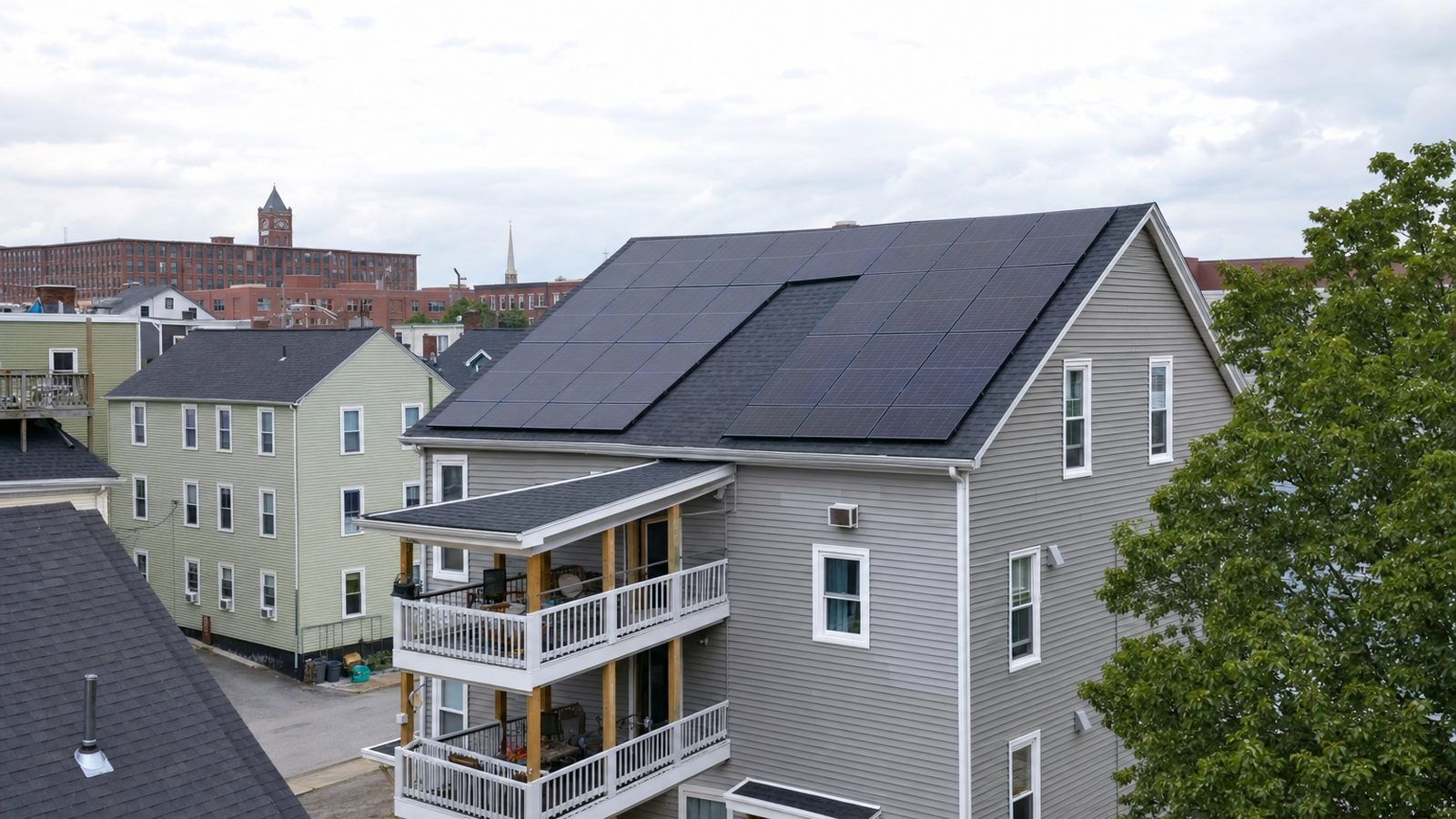
Lowell averages 56.1 inches of snow a year, January alone averaging 15.9 inches, and the 2014 to 2015 winter dumped a record 120 inches. On housing built for a city that had the largest industrial complex in the country by the 1850s, that means two engineering questions come before any panel spec: can the roof structure take array weight plus drifted snow, and where does shed snow land. Our downtown model run totals 1331.9 kWh per kW per year, peaking at 138.6 in July and bottoming at 67.5 in December. The winter trough is real but survivable; December's modeled 67.5 kWh per kW is less than half of July's 138.6, before any snow cover.

Jan
Feb
Mar
Apr
May
Jun
Jul
Aug
Sep
Oct
Nov
Dec

January carries an average 15.9 inches of snowfall on top of this modeled figure.

PVGIS. PVGIS v5.2 NSRDB, run by Solar Learning Lab on August 31, 2026, 30 degree tilt, 14 percent losses, downtown coordinates. Your roof will differ.

Who works Lowell roofs

Several of the firms below sit in Chelmsford and Lowell itself, which matters when a February service call involves a snowed in array. Vet them on the local sequence: LHB district check, CID setup, single permit filing, National Grid interconnection.

Ratings snapshot: Google Maps, August 2026, via the DataForSEO SERP feed. Zero companies paid us and none are endorsed by us.

Solar On Earth

Chelmsford, MA

4.7(84 Google reviews)

PosiGen Home Solar

Lowell, MA

4.4(23 Google reviews)

Read the graded profile

iSun Solar

North Chelmsford, MA

5.0(10 Google reviews)

Patriot Solar Energy, Inc

4.5(8 Google reviews)

DeFreitas Enterprises, LLC

Chelmsford, MA

4.4(7 Google reviews)

Ratings and review counts are Google Maps ratings for Lowell local results, retrieved August 17, 2026 via the DataForSEO SERP API. We list the highest rated established companies we found. No company paid to appear here, and appearing here is not an endorsement. Check current reviews and licensing before you sign anything.

Test the payback

$167
1,332

The upper bound is the downtown Lowell PVGIS run at 1,331.9 kWh per kW. The lower bound is 85 percent of that, which is a buffer for planning, not a site measurement.

$3.50

Cash quotes in Lowell cluster near $3.50 per watt, against a $3.50 national 2024 median (LBNL). Use your quote.

Assumptions you can change
2.5%
7%
15
24c

Use the rate on your actual lease or PPA quote. There is no published statewide average we trust enough to hardcode.

2%
Estimated system: 4.5 kWAnnual usage: 5,964 kWhState credit: $1,000

Cash purchase

$14,750 after state credit

Year 1 benefit
$183/mo
Payback
7 years
20 year net position
$37,550

Lowell rides the highest 2024 EIA utility average in our Massachusetts set, so a cash purchase here pays back on rate pressure, not on any special city rebate.

Solar loan

$181/mo 15 yr payment

Year 1 net
$2/mo
Upfront
$0
20 year net position
$19,700

Financing inputs are statewide numbers. Lowell's single electrical permit keeps soft costs low, so scrutinize dealer fees, which the city process does nothing to justify.

Lease / PPA

$0 down you buy the power

Year 1 net
$48/mo
Upfront
$0
20 year net position
$15,640

A third party offer in National Grid territory should name the SMART enrollment path it assumes and state who receives the bill credits on a multi unit roof.

Estimates, not quotes. Inputs use the 2024 EIA utility average for Massachusetts Electric, our Lowell PVGIS run, and state cost benchmarks. Snow losses, roof structure on mill era housing, and utility approval are not modeled. We are a solar installer and we also partner with other solar companies. See our disclosures.

Asked about Lowell

Is a building permit required for rooftop solar in Lowell?
The city's own solar permitting checklist says a single electrical permit is all a solar installation needs. The same document later tells installers to have the building permit in hand before installation, so call Development Services at 978-674-4144 and confirm current practice before scheduling a crew.
How long does the permit decision take?
Lowell publishes a fast track: all residential solar projects get a decision or a request for more information within three business days of receipt, and state law requires a response to every application within 30 days.
Will zoning block a ground mount or an unusual roof?
Lowell permits rooftop and ground mounted solar in every district of the city without special permits, conditions, or variances, citing MGL 40A Section 3. Zoning is rarely the obstacle here; historic review is the step to watch.
Which utility and tariff govern my export credits?
Lowell is Massachusetts Electric d/b/a National Grid territory, not Eversource. Class I facilities of 60 kW or less may net meter and systems of 25 kW or less are nameplate cap exempt. National Grid's own filed net metering tariff PDF returned an error during research, so its tariff number is n.a. on this page.
How much does winter weather cost me?
The city averages 56.1 inches of snow a year with a 120 inch record season in 2014 to 2015. Our model still shows 86.1 kWh per kW in January, but panel snow cover and shedding behavior are outside any location level model.
Is there a Lowell person to ask about solar?
Yes. The city's Go Solar pages direct questions to Energy Manager Katherine Moses at kmoses@lowellma.gov.

Records behind this page

City figures on this page come from the documents below. Anything the research could not confirm, such as National Grid's own filed net metering tariff number, stays marked n.a. rather than guessed.

Get a scoped quote

We are a solar installer and we also partner with other solar companies. Read our disclosures.

What does your monthly electric bill look like?

massachusetts average is $167 per month (EIA, 2024).