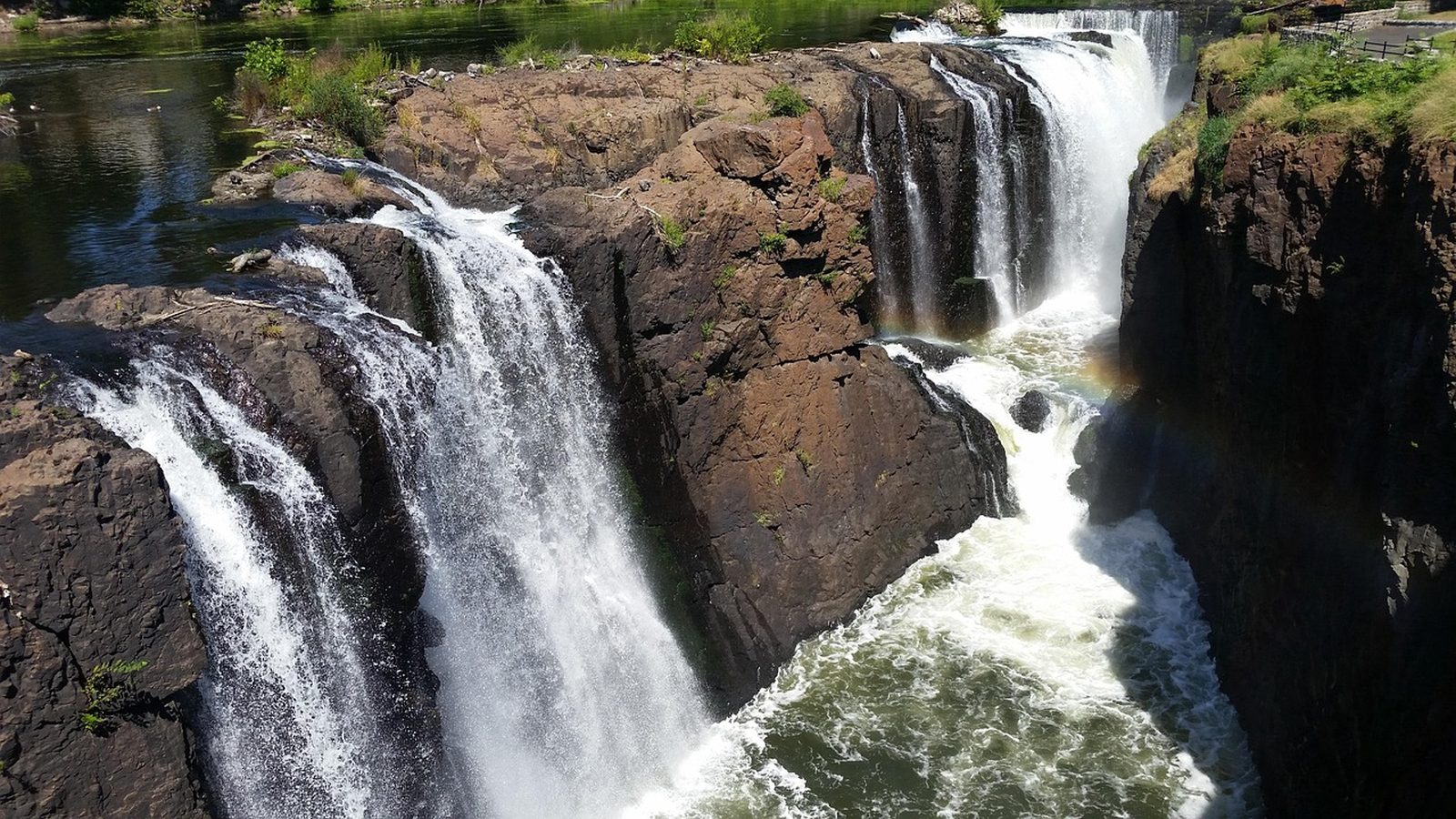
Photo: MoneyforCoffee, via Pixabay
New Jersey · Paterson
Solar in Paterson: count the layers before you count the panels
Written by the Solar Learning Lab research deskUpdated August 30, 202612 min read
Paterson gets about 9 to 10 percent less sun than the Texas and Florida cities we cover, and it does not matter, because New Jersey pays for solar in ways those states abandoned or never had. A Paterson system earns four separate times: every kWh offsets a 20.42 cent PSE&G average rate at full retail through net metering, every megawatt hour mints an SREC-II worth $77 in cash for 15 years, the equipment ships sales tax free, and the added home value stays off the property tax rolls. No other city on this site stacks paper like that.
The catch is that three of the four layers have rules with dates and traps attached, and Paterson itself adds a permitting counter that still works on state paper forms and narrow office hours. Here is the whole picture, with the program documents linked where the claims are made.
Start with the bill side of the stack
The estimator below models the net metering layer on PSE&G's documented 2024 average. SREC-II cash sits on top of whatever it shows.
Open the Paterson estimatorFour layers, counted one at a time
Layer one is net metering. New Jersey requires every NJBPU regulated utility, PSE&G included, to credit customers full retail for each kWh their system produces over the course of a year. Layer two is the Successor Solar Incentive, or SuSI, the state's permanent solar program established by Board Order in July 2021. Its Administratively Determined Incentive pathway pays residential net metered systems one SREC-II per megawatt hour generated, in cash, on top of the bill savings.
Layer three is the sales tax exemption: solar energy devices and systems are exempt, and a resident hands the supplier a completed Form ST-4 instead of paying tax at purchase. Layer four is the property tax exemption under P.L. 2008, c.90, which keeps qualifying renewable systems out of real property taxation. That last one is not automatic; it runs through a certification involving the local enforcing agency, so you request it when the system passes final inspection rather than assuming the assessor noticed.
One layer that is not here yet: battery money. The NJBPU approved the Garden State Energy Storage Program in June 2025 targeting 2,000 MW by 2030, and in August 2026 it floated a straw proposal for roughly 150 MW of residential behind-the-meter storage paid through a 10 year performance incentive. Dollar amounts are unstated and it is a proposal, not a program. Treat any battery incentive claim in a 2026 sales pitch as pending until the Board says otherwise. And one layer that used to exist is gone: the federal 25D homeowner credit ended for expenditures made after calendar 2025, so a 2026 purchase gets no federal credit and the state stack carries the load alone.
The $77 clock started ticking on July 27
Residential SREC-IIs were worth $85 each until this summer. The Board cut the residential figure to $77 per SREC-II for registrations received on or after July 27, 2026 at 12:01 a.m. A project registering in Paterson today locks $77 per megawatt hour, and holds it: a SuSI facility generates SREC-IIs for 15 years from commercial operation, and a later reset does not touch facilities already holding conditional registration or already being paid.
Scale check, framed as an illustration and not a promise: a residential system producing about 7.7 MWh a year, roughly a 6 kW array at Paterson output levels, would mint 7 to 8 SREC-IIs annually, which is in the neighborhood of $540 to $620 a year at $77 each. Over a 15 year qualification life that is a second revenue stream comparable to a meaningful slice of the system cost, and it arrives whether you consume the power or export it.
The forward math matters too. ADI values are reset by Board order no less than once every three years, and absent Board action they automatically step down 10 percent for the following three year period. Translation: waiting for a better SREC-II price is betting against the program's own design. The direction of travel is down.
Your net metering year has an anniversary, and the anniversary has teeth
Through the year, surplus kWh bank at retail value. At the end of the annualized period, whatever excess remains is credited at the wholesale value of electricity, a fraction of retail. Two design rules follow directly. First, size to your consumption: state rules cap system capacity at your annual electric needs anyway, and every kWh past your own usage earns wholesale, not 20 cents. Second, guard the anniversary. Under N.J.A.C. 14:8-4.3(j), switching your third party electric supplier or changing the anniversary date cashes out your banked credits at wholesale locational marginal pricing and zeroes the balance. Rate shoppers who jump suppliers every winter can quietly liquidate a summer of banked solar at the worst possible price. Time any switch to land right after the true up, not before it.
Interconnection itself is the easy part. Under N.J.A.C. 14:8-5.2, a certified inverter based system of 10 kW or less, which describes nearly every rowhouse and two family roof in Paterson, goes through Level 1 review, the simplest track the rule offers.
What PSE&G power costs, and why the offset is worth so much
PSE&G lists the City of Paterson in its electric service area among Passaic County municipalities, and it keeps a walk-in customer service center in town at 301 Main Street, weekdays 8 a.m. to 4 p.m. The 2024 EIA figure for PSE&G residential service averages 20.42 cents per kWh across 1,966,950 customers. Inside that number, the current Basic Generation Service residential pricing effective September 15, 2025 charges 12.6236 cents per kWh for supply in summer and 13.4599 in winter, with delivery charges layered on top under Tariff B.P.U.N.J. No. 17, the book posted July 15, 2026. Net metering credits you against the full retail construction, not just the supply piece. That is the whole reason a modest Paterson roof can outperform a sunnier one in a cheap-power state.
| Energy source | Type | Average price | What that means |
|---|---|---|---|
| PSE&G | 2024 residential average | 20.42¢ per kWh | EIA Table 6, 1,966,950 customers |
| PSE&G BGS supply | Summer, from Sep 15, 2025 | 12.6236¢ per kWh, supply only | Delivery charges additional under Tariff No. 17 |
| PSE&G BGS supply | Winter, from Sep 15, 2025 | 13.4599¢ per kWh, supply only | Delivery charges additional under Tariff No. 17 |
| Paterson | PVGIS output | 1,347.3 kWh per kW annually | Fixed south facing model; individual roofs differ. |
EIA Table 6, 2024 and PSE&G BGS-RSCP pricing. The calculator below uses the EIA average.
Permits happen at 111 Broadway, on state forms, at odd hours
New Jersey standardized construction permitting statewide under the Uniform Construction Code, so the paperwork for a Paterson solar job is the state form set from the Department of Community Affairs, filed with the city's Division of Community Improvements at 111 Broadway, (973) 321-1232, open 8:30 a.m. to 4:30 p.m. The UCC Construction Bureau at (973) 321-1549 issues permits for all construction projects, large or small, and its state licensed building, electrical, plumbing, and fire inspectors carry the job through final approval.
Two local realities to plan around. Inspectors are physically in the office only 8:30 to 10:00 a.m. and 3:30 to 4:30 p.m.; outside those windows they are out inspecting, so schedule calls and counter visits accordingly. And no online permit portal was confirmed on any city page we fetched, a genuine throwback compared with the portal-first cities we cover elsewhere. On fees, Paterson's own ordinance is not publicly fetchable, so the only citable scale is the state model rule the UCC guidance quotes, $65 for photovoltaic systems of 1 to 50 kW, from April 2017 guidance. Confirm the city's adopted figure with the Division by phone before anyone prints it in a contract.
Silk City roofs, honestly assessed
Paterson packs 159,732 people into 8.41 square miles, 18,986.3 per square mile, the 11th densest municipality of New Jersey's 565. The tenure numbers set expectations: ACS 2023 counts 49,688 households with just 26.2 percent owner occupied and 20.9 percent of units single family. This is a city where the household that controls its own roof is the exception, and where the housing stock, 47,946 units at the 2010 count and growing under 2 percent that decade, skews old and multifamily.
We would rather say that plainly than pretend every reader has a colonial with a south gable. If you own a one or two family house here, the incentive stack above is unusually generous and the Level 1 interconnection track was built for your system size. If you rent or share a roof, the owner has to be at the table before any of this math applies to you. Median household income of $53,766 also argues for financing quotes scrutinized line by line, not signed on the porch.
July carries December, and the credit bank is the bridge
Our Paterson PVGIS run models 1,347.3 kWh per installed kW annually, with the widest seasonal spread of any city in this batch: July at 140.5 kWh per kW, December at 72.6, roughly half. In a state without annual retail netting that swing would hurt. Here it is exactly what the 12 month credit bank exists for: summer surplus banks at retail and pays down the short, dim winter months.
July models 140.5 kWh per kW, nearly double December's 72.6. The annual netting cycle smooths this out on the bill.
PVGIS v5.2 model run by Solar Learning Lab on August 30, 2026, NSRDB radiation database. Fixed south facing mount, 30 degree tilt, 14 percent losses, downtown Paterson coordinates. Your roof will differ. Tool documentation at PVGIS.
Installers working Paterson and the surrounding towns
The companies below surfaced in our Paterson pull, several based in the immediate orbit of Passaic and Bergen counties. Interview questions that sort this market fast: who files the ADI registration and on what date, how the proposal treats the SREC-II revenue (yours, theirs, or vaguely unmentioned), and whether the quote assumes the state model permit fee or a confirmed Paterson figure.
Ratings snapshot: Google Maps, August 2026, via the DataForSEO SERP feed. Zero companies paid us and none are endorsed by us.
Solar Living Inc.
5.0(141 Google reviews)
Phoenix Energy
Hackensack, NJ
4.8(34 Google reviews)
Simple Energy Systems
5.0(32 Google reviews)
The Solar Queen
5.0(20 Google reviews)
SunBright Solar
Elmwood Park, NJ
4.8(19 Google reviews)
Ratings and review counts are Google Maps ratings for Paterson local results, retrieved August 17, 2026 via the DataForSEO SERP API. We list the highest rated established companies we found. No company paid to appear here, and appearing here is not an endorsement. Check current reviews and licensing before you sign anything.
Model the bill side; the SREC-II side rides on top
The calculator below handles layer one only: net metering savings at PSE&G's 20.42 cent 2024 average against our Paterson production run. It deliberately excludes SREC-II cash, so whatever payback it shows, the registered reality should beat it. That is the right direction for an estimate to err.
The upper bound is our south facing Paterson model. December models 72.6 kWh per kW against 140.5 in July, so the month to month swing is the story, not the annual total.
Cash quotes in Paterson cluster near $2.70 per watt, against a $3.50 national 2024 median (LBNL). Use your quote.
Assumptions you can change
Use the rate on your actual lease or PPA quote. There is no published statewide average we trust enough to hardcode.
Cash purchase
$15,120 after state credit
- Year 1 benefit
- $128/mo
- Payback
- 10 years
- 20 year net position
- $22,268
No 25D federal credit applies to a 2026 purchase and New Jersey has no state solar income tax credit. What is real in Paterson: retail rate net metering against PSE&G's 20.42 cent 2024 average, 15 years of SREC-II payments at $77 per MWh for new registrations, and the state's two tax exemptions.
Solar loan
$196/mo 15 yr payment
- Year 1 net
- -$68/mo
- Upfront
- $0
- 20 year net position
- $2,053
We model loans at the EnergySage New Jersey cash figure plus the LBNL loan-over-cash spread. SREC-II checks can service part of a payment, but only after the registration is actually filed and the system reaches commercial operation.
Lease / PPA
$0 down you buy the power
- Year 1 net
- -$23/mo
- Upfront
- $0
- 20 year net position
- -$4,443
If a third party owns the system, get in writing who keeps the SREC-II payments and how the contract handles the annual net metering true up. Both default to the system owner, not the roof.
Estimates, not quotes. Production is our Paterson PVGIS run; the rate is PSE&G's 2024 EIA average, and SREC-II income is not included in the calculator output. We are a solar installer and we also partner with other solar companies. See our disclosures.
Paterson questions, answered from the program documents
How much does an SREC-II pay right now?
Is New Jersey net metering really full retail?
Can I still shop for a third party electric supplier?
How big can the system legally be?
Do the tax breaks happen automatically?
Where do I actually file the permit?
Source ledger
First New Jersey city page on this site, reviewed August 30, 2026. Paterson's fee ordinance sits behind a blocked host, so no local fee number appears above; everything else traces here.
- Division of Community Improvements and UCC Construction Bureau
- PSE&G service territory, service centers, electric tariff page, and BGS-RSCP pricing
- Net metering and interconnection, N.J.A.C. 14:8-5.2, SuSI program, ADI incentive values, and SREC-II qualification life rule
- S&U-6 sales tax publication, P.L. 2008, c.90, GSESP approval, Phase 2 straw proposal, and state solar ordinance guidance
- CRS IN12611 on the 25D repeal, EIA Table 6, Paterson background, and Census ACS 2023
Get a Paterson quote with the registration date in writing
The stack only pays if someone files the paperwork. Make the ADI registration date a contract term. We are a solar installer and we also partner with other solar companies. Read our disclosures.
What does your monthly electric bill look like?
Paterson average is $167 per month (EIA, 2024).