Skip to content
Solar Learning Lab
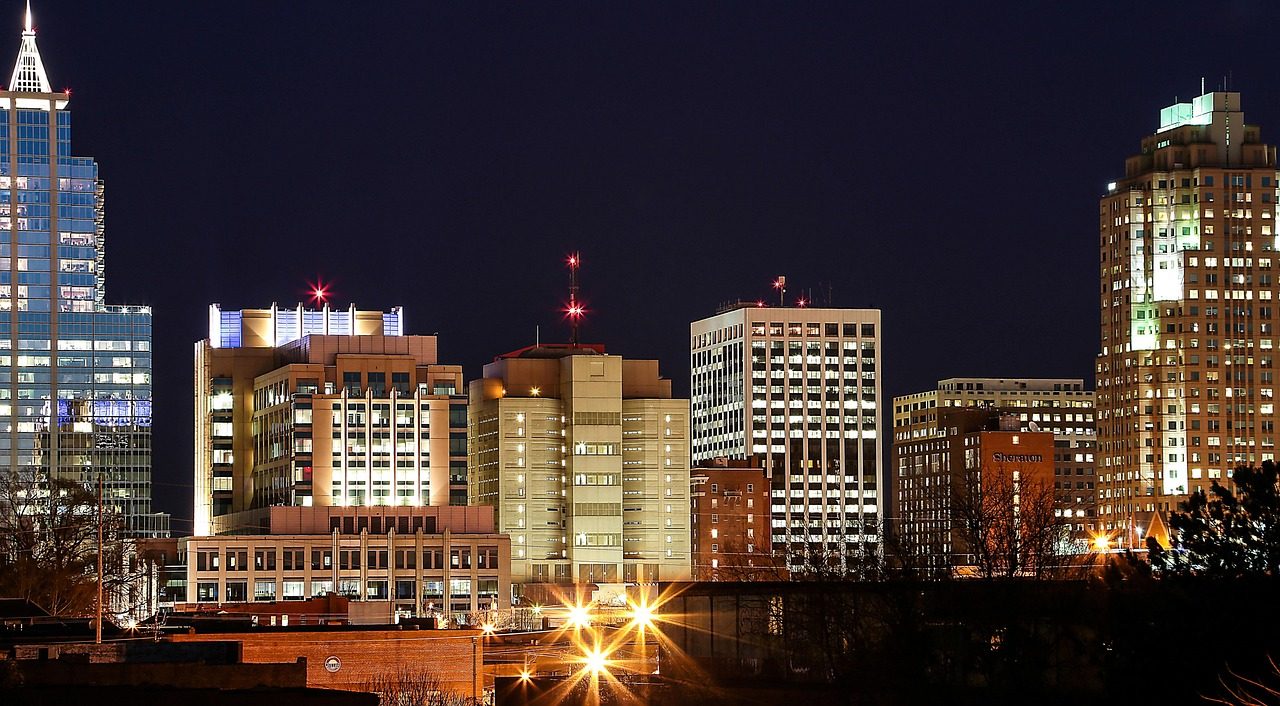
Raleigh downtown skyline in a nighttime cityscape

Photo: MarkThomas on Pixabay

North Carolina · Raleigh

Solar in Raleigh in 2026

Written by the Solar Learning Lab research deskUpdated August 21, 202612 min read

Raleigh has something Charlotte does not: most eligible one- and two-family rooftop systems can be permitted online the same day. That removes a real source of friction. It does not erase the harder part of a Duke Energy Progress project, which is choosing and understanding the successor export structure rather than pretending the old net-metering rules are still on offer.

1460.0 kWh

Annual PVGIS output per kW installed

15.09¢

North Carolina EIA residential benchmark rate, May 2026

51.2%

Owner occupied households in Census ACS 2023

A Raleigh roof models at 1460.0 kWh per kW each year. This page separates verified local rules from the pieces we could not verify, rather than forcing a tidy payback claim from incomplete inputs. PVGIS methodology.

See what your Raleigh roof could produce

Start with your bill, then check the utility, permit, and roof details that decide whether the estimate survives contact with reality.

Get my Raleigh estimate

Raleigh makes the front end unusually direct

Raleigh Development Services runs a dedicated residential solar PV permit path. The city says most one- and two-family rooftop systems are eligible for same-day online permitting through the Permit Portal. The electrical permit is obtained through the licensed electrical subcontractor listing, while projects flagged during intake move to the Customer Service Center. That is a better process than most cities publish, but “most” is not “all.” A complex roof or an intake issue can leave the same-day lane. Source.

Rooftop arrays get a useful zoning rule. No separate zoning permit is required when a roof-mounted system stays within the district height framework, and the UDO permits rooftop solar to extend up to 12 feet above the district height limit. The practical question is still physical: panels, setbacks, roof plane, and electrical path have to fit the house. Zoning flexibility does not turn a shaded or chopped-up roof into an easy install. Source.

The fetched FY26 fee guide lists a $123 minimum trade permit fee, or $128 with the technology surcharge, and a $210 Fire Marshal solar photovoltaic power systems permit. That guide covered July 2025 through June 2026; the city announced a FY27 guide but it was not fetched for this research. Treat current FY27 fee amounts as n.a. until they are verified, rather than silently carrying forward an old schedule. Source.

Permit facts are current only to the cited pages and schedules. When the research did not publish a solar-specific review time or an updated fee, this page marks it n.a. rather than estimating it. Fee source.

Same-day permits do not mean same-day savings

Raleigh is in Duke Energy Progress territory, and new residential systems face the same statewide net-metering transition as Charlotte. Legacy net metering closed to applicants on October 1, 2023. The Net Metering Bridge remains available only through October 1, 2027 with limited annual capacity and an avoided-cost net-excess credit. Residential Solar Choice stays open, requires time-of-use service, includes a non-bypassable charge, a minimum bill, and a grid access fee that scales with system size. Source.

The predictable trap is to design only for annual kWh. On the Residential Solar Choice schedule, summer on-peak runs 6 to 9 p.m. from May through September. That is the exact period a simple south-facing array is fading. A Raleigh household with flexible cooling, EV charging, or a battery may use the rate structure differently from a household that is empty in the day and cooks, cools, and charges after sunset. Source.

The research did not verify a current Duke Energy Progress residential customer charge, energy price, grid fee, minimum bill, or export-credit dollar figure. Those values are n.a. The calculator uses the state EIA average rate as a transparent starting point, not a substitute for a Duke bill analysis. If an installer gives a precise Duke export number, ask for the tariff version and the effective date. Source.

Energy sourceTypeAverage priceWhat that means
Raleigh benchmarkElectricity15.09¢ per kWhNorth Carolina EIA residential average, May 2026. It is a benchmark, not a local bill quote.
Owned rooftop solarElectricityn.a. per kWhWe do not publish a lifecycle price here because roof, financing, tariff, and export assumptions vary.

State benchmark: North Carolina bill benchmark. Local tariff: verified utility filing.

A Raleigh roof, month by month

The model’s annual total is 1460.0 kWh per kW. Its best month is May at 141.8 kWh per kW. The monthly curve is more useful than an annual average when a household has seasonal heating, cooling, or rate periods. PVGIS.

Jan
Feb
Mar
Apr
May
Jun
Jul
Aug
Sep
Oct
Nov
Dec

May is the modeled peak. Treat it as a standardized downtown run, not a substitute for a site-specific shade report.

Raleigh production method: PVGIS v5.2. PVGIS v5.2 model run by Solar Learning Lab on August 21, 2026, NSRDB radiation database. Fixed south facing mount, 30 degree tilt, 14 percent losses, downtown Raleigh coordinates. Your roof will differ.

The incentive is storage-linked and conditional

PowerPair applies in Duke Energy Progress territory, including Raleigh. It is a solar-and-storage pilot approved by the NCUC, with up to $9,000 per residence for qualifying new equipment: up to $3,600 from the solar portion and up to $5,400 from the battery portion. It has a 30 MW Duke Energy Progress cap, a 10-year participation commitment, and different control arrangements depending on the cohort. That is a program with real value and real constraints. Source.

North Carolina’s verified statewide tax provision excludes 80% of a solar energy electric system’s appraised value from property taxation. We found no City of Raleigh residential solar rebate and no active state residential solar income-tax credit from the primary material reviewed. Those are n.a. A clean estimate makes the distinction between a tax treatment, a pilot incentive, and a nonexistent cash rebate visible. Source.

Raleigh’s own climate dashboard reported 2,000 installations with nearly 35 MW of capacity as of January 2023. That demonstrates a local base of experience, not a prediction of what a particular roof will earn. Permit speed and installed capacity are indicators that the city can process solar. They are not evidence that every quote is reasonable. Source.

Federal credit check: The residential 25D credit ended December 31, 2025; lease/PPA providers may claim 48E. Congressional Research Service.

Raleigh’s solar advantage is administrative, not magical

Census ACS estimates put Raleigh at 51.2% owner occupancy and 58.2% single-family housing. That means the page speaks to a meaningful but limited slice of residents. For an owner of a detached home, an online permit and rooftop height relief are practical benefits. For a renter, condominium owner, or homeowner without roof authority, the headline numbers are not a solution. Source.

The city’s same-day option deserves credit because it reduces idle time before installation. It also sets a useful standard for consumer expectations. A contractor should be able to say whether the project is likely to qualify, which item could trigger review, who holds the electrical permit, and how the permit will be closed. Vague answers are not a harmless sales habit. They are how a “simple” system becomes a calendar surprise. Source.

Our Raleigh PVGIS run produces 1,460.0 kWh per kW annually. May peaks at 141.8 kWh per kW, December falls to 92.7. That seasonal shape is modest compared with northern markets, but it still matters. A quote that assumes every month looks like May will overstate the useful output when household heating or evening demand is highest. Production and the Duke time-of-use clock need to be considered together. Source.

Raleigh household data reported by US Census Bureau, ACS 5-year estimates, 2023. 196,924 households, median household income $82,424, and 58.7% electric heat.

Raleigh permit-first review

In Raleigh, start with the application path, then price the equipment

Raleigh is not a place to start by arguing about the panel brand. Start with whether the proposal matches the city’s residential photovoltaic process. The city publishes a specific residential solar PV service page, a dedicated application route, and an inspection sequence. That creates a useful test: ask the installer to name the documents it will submit, the person responsible for each correction cycle, and the inspections that must close before energization. If those answers come after you sign, you are carrying unnecessary execution risk. City of Raleigh residential PV guidance.

Raleigh’s process is not Mecklenburg County’s process with a different logo. The city publishes its own development fee material and updates it by fiscal year. That is why a quote that copies a fixed permit allowance from another Triangle job should not be treated as precise. Obtain the current fee reference attached to the proposal, especially when a service upgrade, revision, or additional review becomes plausible. The city announced the FY27 Development Fee Guide as the current reference for that cycle. Raleigh’s FY27 fee guide notice.

The temptation in a growth market is to assume that every application can be compressed into “same week.” Raleigh provides its own published service information. North Carolina does not appear on the SolarAPP+ availability list, so an installer should not claim an automated solar permit path that the state does not offer. The right question is more concrete: what has been submitted, what is awaiting review, and what is the scheduled inspection date. That gives a homeowner evidence. A glossy timeline does not. SolarAPP+ availability list.

There is a reason the tariff conversation must be separate from the permit conversation. New Duke residential systems are not entering the former legacy net-metering structure. Net Metering Bridge and Residential Solar Choice have different enrollment and operating mechanics. Bridge has a limited window and capacity allocation, while Solar Choice requires time-of-use service and applies a grid access fee tied to system size. Treating both as one simple “net metering” option loses the actual economics. NCSEA's program breakdown.

For a Raleigh household, the summer Residential Solar Choice on-peak period of 6 to 9 p.m. changes the design brief. The relevant question becomes how much load remains after the sun drops, not just what the roof can hold. A system sized to an annual kWh total can still produce weak bill results if the household’s expensive hours concentrate after work. Ask the salesperson to show a month-by-month interval-load assumption and to identify the share of projected generation consumed on site. A single annual-savings number hides the mechanics that matter. Duke time-of-use periods and credit structure.

Do not fill the Duke rate gap with a friendly estimate. Current Duke Energy Carolinas residential basic-charge and per-kWh specifics were n.a. in the supplied research because the utility’s rate pages could not be verified and the reviewed commission file did not contain the relevant Carolinas residential schedule. That means a credible Raleigh proposal needs to use your bills as the evidence base, not a generic rate graphic. Require the model to flag which inputs are known from the bill and which are sales assumptions. NCUC tariff file reviewed for this guide.

Battery proposals need an even cleaner separation between product and program. PowerPair is a solar-plus-storage pilot with up to $9,000 in one-time incentives for eligible new systems, divided between solar and battery incentives and limited by program capacity. It also requires a ten-year commitment. Cohort terms are not interchangeable, and the controlled-battery cohort contemplates utility events. A battery can be valuable, but that does not make every PowerPair illustration a guaranteed homeowner outcome. Check program capacity and cohort eligibility before treating the number as contract value. NC Clean Energy Technology Center overview.

Raleigh’s broader buildings and energy work is useful texture, not a claim that a specific roof will perform. City reporting on community climate action and building energy exists because buildings are part of the local energy conversation. A homeowner should still reject the lazy leap from city goal to property outcome. Shade, roof orientation, attic details, and daytime occupancy belong in the site assessment. The production chart here is model output, while the roof is a physical object that needs an actual review. Raleigh community climate and buildings data.

Build a Raleigh bid package that survives a change order. It should state the equipment models, array layout, interconnection choice, engineering responsibility, permit fee assumption, inspection responsibility, electrical-panel scope, roof exclusions, and who pays when a plan reviewer asks for a revision. Add the finance agreement as a separate document and compare its total payment obligation with the cash scope. Too many homeowners compare a monthly payment with a cash price and call it a savings comparison. It is not.

North Carolina’s solar property-tax provision excludes 80 percent of the appraised value of qualifying solar energy electric systems from taxation. The useful way to phrase that is exactly as narrowly as the statute does. It is a treatment of a qualifying system’s appraised value, not a contractor’s license to promise a property-tax outcome. Ask for the cited legal basis and get professional tax advice when a tax decision depends on it. North Carolina property-tax statute.

For a planned community, get the association review moving before equipment is staged. State law restricts solar covenants that effectively prohibit solar collectors, but it allows defined reasonable restrictions. The board may need a layout and construction detail to make a decision. Do not ask a salesperson whether an HOA “can stop solar” and accept a yes or no. Read the recorded declaration, submit a complete request, and compare any restriction with the statute. North Carolina HOA solar protections.

Raleigh’s advantage is a visible city process. Use it. A homeowner who keeps the city application, utility choice, roof condition, and finance terms in separate columns is much harder to sell a blurry promise to. That is the goal. Not an exciting spreadsheet, just a decision that still makes sense after the sales call ends.

Raleigh bidders to question

Raleigh installer cards are a shortlist for interviews, not endorsements. Make bidders explain their City of Raleigh submittal plan, their approach to Duke’s current choices, and every electrical or roof exception. A strong rating cannot turn a vague construction scope into a good offer.

Ratings snapshot: Google Maps, August 2026, via the DataForSEO SERP feed. Zero companies paid us and none are endorsed by us.

NC Solar Now

Raleigh

5.0(762 Google reviews)

Emerald Energy

Raleigh

5.0(153 Google reviews)

Wiring Solutions Plus, LLC

Raleigh

5.0(55 Google reviews)

8MSolar

Raleigh

4.9(574 Google reviews)

Yes Solar Solutions

Cary

4.9(385 Google reviews)

Southern Energy Management

Raleigh

4.9(274 Google reviews)

Vyomaa Energy Inc

Raleigh

5.0(28 Google reviews)

Renu Energy Solutions

Cary

5.0(22 Google reviews)

Ratings and review counts are Google Maps ratings for Raleigh local results, retrieved August 17, 2026 via the DataForSEO SERP API. We list the highest rated established companies we found. No company paid to appear here, and appearing here is not an endorsement. Check current reviews and licensing before you sign anything.

Model a Raleigh load scenario

Use this Raleigh model to test a design against the city permitting route and the household’s real Duke usage pattern. The output cannot see a roof deck, plan-review correction, or your evening load. It is useful when it makes those missing inputs obvious.

$144
1,460

The top of the range is our fixed south-facing PVGIS run for Raleigh. The lower bound is 85 percent of that model and is not a site-specific shade analysis.

$2.40

Cash quotes in Raleigh cluster near $2.40 per watt, against a $3.50 national 2024 median (LBNL). Use your quote.

Assumptions you can change
2.5%
7%
15
24c

Use the rate on your actual lease or PPA quote. There is no published statewide average we trust enough to hardcode.

2%
Estimated system: 7.8 kWAnnual usage: 11,451 kWhState credit: $0

Cash purchase

$18,720 after state credit

Year 1 benefit
$143/mo
Payback
10 years
20 year net position
$22,982

City-specific estimate using EnergySage North Carolina cash pricing. Export compensation, permit scope, roof work, and utility eligibility can change the result.

Solar loan

$252/mo 15 yr payment

Year 1 net
-$109/mo
Upfront
$0
20 year net position
-$3,729

City-specific loan estimate uses the North Carolina state configuration. Financing terms and dealer fees can change the installed price.

Lease / PPA

$0 down you buy the power

Year 1 net
-$85/mo
Upfront
$0
20 year net position
-$21,436

A lease or PPA provider may claim the federal 48E business credit. Ask how, if at all, it changes the customer rate.

Estimates, not quotes. Production uses our Raleigh PVGIS run, while the rate and cost inputs come from the state configuration. Utility export rules and site conditions are not fully modeled. We are a solar installer and we also partner with other solar companies. See our disclosures.

Raleigh solar questions, answered

These Raleigh answers are tied to city documents and the cited North Carolina utility material. When a source did not publish a solar-specific turnaround or a current Duke residential charge, the answer stays n.a. A polished guess would be worse than an honest gap.

Are Raleigh solar permits really issued the same day?
Most eligible one- and two-family rooftop systems can receive same-day online permitting through the City of Raleigh Permit Portal. Projects flagged during intake are routed for review, so the city does not promise same-day issuance for every design. Source.
Do new Raleigh systems receive legacy Duke net metering?
No. New residential applicants stopped entering legacy net metering October 1, 2023. New projects use the Net Metering Bridge or Residential Solar Choice structure described by NCSEA. Source.
Does Raleigh require a separate zoning permit for roof solar?
Not when the array stays within the stated height framework. The UDO allows rooftop solar to exceed the district height limit by up to 12 feet. Source.
What is the current Duke Progress export price?
n.a. in this research. The available source describes avoided-cost crediting but does not publish the current dollar value. Source.
Is there a Raleigh solar rebate?
No City of Raleigh residential rebate was verified in the city sources reviewed for this page. Source.
Does PowerPair require a battery?
Yes. The program is a new solar-and-storage pilot. Its dollar amounts, capacity limits, and 10-year terms should be read before a buyer counts it as available money. Source.

Raleigh documents, fee references, and open gaps

Raleigh sources are grouped around the city PV process, fiscal-year fee material, Duke’s successor arrangements, and North Carolina law. They are a record of what was verified for this guide, not a promise that a fee, capacity allocation, or tariff condition remains unchanged on your signing date.

Get a Raleigh estimate

Use the estimate form after you have gathered Raleigh permit questions, twelve months of bills, and any HOA requirements. We are a solar installer and we also partner with other solar companies. Read our disclosures.

What does your monthly electric bill look like?

North Carolina average is $167 per month (EIA, 2024).