Skip to content
Solar Learning Lab
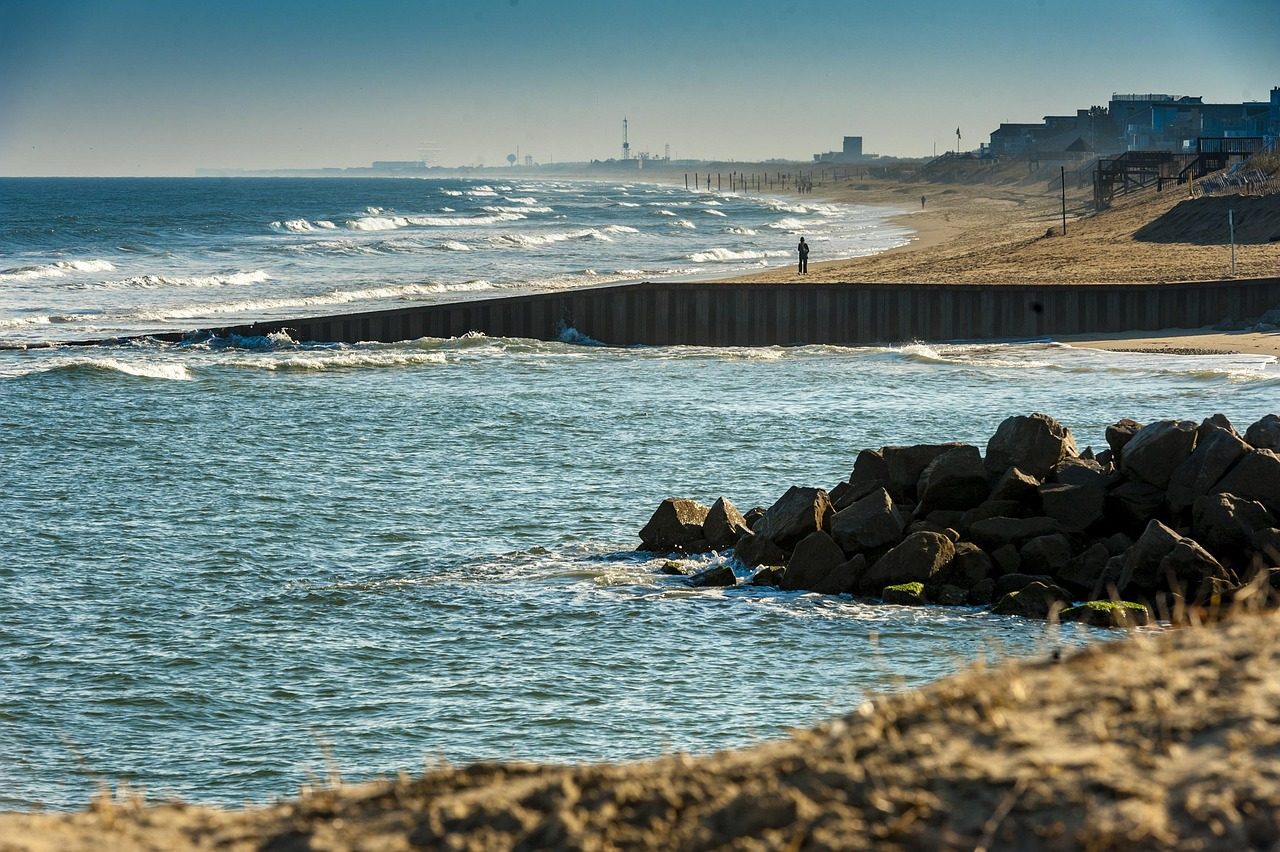
Virginia Beach ocean shoreline under an open sky

Photo: bbarbee15 on Pixabay

Virginia · Virginia Beach

Solar in Virginia Beach in 2026

Written by the Solar Learning Lab research deskUpdated August 21, 202612 min read

Virginia Beach gives a homeowner a familiar coastal project: a city permit, a Dominion tariff, and an installation that needs to make sense on an exposed roof. The most useful number is not a dramatic wind claim from a sales brochure. The city’s adopted table says 110 mph. Use that city document, then let the engineer handle the actual site.

1443.1 kWh

Annual PVGIS output per kW installed

17.61¢

Virginia EIA residential benchmark rate, May 2026

64.9%

Owner occupied households in Census ACS 2023

A Virginia Beach roof models at 1443.1 kWh per kW each year. This page separates verified local rules from the pieces we could not verify, rather than forcing a tidy payback claim from incomplete inputs. PVGIS methodology.

See what your Virginia Beach roof could produce

Start with your bill, then check the utility, permit, and roof details that decide whether the estimate survives contact with reality.

Get my Virginia Beach estimate

Permits are value-based, with separate building and electrical work

The City of Virginia Beach Permits and Inspections Division is the issuing office. Registration through Accela Citizen Access is required for permits and inspections, and the city accepts counter submittals at the Municipal Center. Inspections can be requested online around the clock, scheduled up to five working days ahead, and submitted before 8 a.m. for same-day consideration. The city has not published a residential solar plan-review turnaround, so the timeline is n.a. Source.

For a rooftop retrofit, the residential alteration fee is $50 plus $5 per $1,000 of construction value or fraction. The city’s example puts work valued at up to $10,000 at $100. Residential plan review is $100, counter review is $25, a state levy adds 2% of permit fees, and a $10 technology fee applies to all permits. Electrical additions and repairs start at $50 plus $5 per circuit. A quote needs to show whether the electrical scope and service work are included. Source.

Virginia Beach is not listed as a SolarAPP+ jurisdiction. That is not a verdict on its process, but it removes a shortcut people may have seen advertised in other markets. If a contractor claims an instant permit, ask whether they mean an Accela submission, an inspection schedule, or an actual approval. Those are different milestones. Source.

Permit facts are current only to the cited pages and schedules. When the research did not publish a solar-specific review time or an updated fee, this page marks it n.a. rather than estimating it. Fee source.

Dominion’s retail credit is good, but size still matters

Dominion Energy Virginia’s Schedule 1 has a $7.58 monthly basic charge. Its distribution and generation charges vary by season and usage block, with a 0.970 cent per kWh transmission charge. The tariff also places standby charges only on residential systems larger than 20 kW AC: $4.19 per kW for distribution and $1.32 per kW for transmission. That clears the ordinary residential array, but it makes oversized proposals a different conversation. Source.

For typical eligible net-metered customers, exported energy is credited at the same amount charged for consumption. The system may not be sized to produce more than 150% of expected annual consumption. That ceiling is important for a household planning an EV, heat pump, or addition. The future load must be supportable. “Buy as much solar as fits” is not the governing rule. Source.

Annual excess generation may be purchased under a power-purchase agreement tied to the PJM DOMZONE day-ahead annual simple average LMP. In other words, avoided annual surplus does not become an indefinitely banked retail credit. A practical design starts with a full year of use and a written treatment of planned new loads. The right system is not automatically the biggest permitted one. Source.

Energy sourceTypeAverage priceWhat that means
Virginia Beach benchmarkElectricity17.61¢ per kWhVirginia EIA residential average, May 2026. It is a benchmark, not a local bill quote.
Owned rooftop solarElectricityn.a. per kWhWe do not publish a lifecycle price here because roof, financing, tariff, and export assumptions vary.

State benchmark: Virginia retail benchmark. Local tariff: verified utility filing.

A Virginia Beach roof, month by month

The model’s annual total is 1443.1 kWh per kW. Its best month is May at 147.1 kWh per kW. The monthly curve is more useful than an annual average when a household has seasonal heating, cooling, or rate periods. PVGIS.

Jan
Feb
Mar
Apr
May
Jun
Jul
Aug
Sep
Oct
Nov
Dec

May is the modeled peak. Treat it as a standardized downtown run, not a substitute for a site-specific shade report.

Virginia Beach production method: PVGIS v5.2. PVGIS v5.2 model run by Solar Learning Lab on August 21, 2026, NSRDB radiation database. Fixed south facing mount, 30 degree tilt, 14 percent losses, downtown Virginia Beach coordinates. Your roof will differ.

No verified cash rebate, but a statutory rooftop right

No City of Virginia Beach residential solar rebate was verified. We also did not verify a Dominion Energy Virginia rooftop-PV rebate or local property-tax exemption specifics for this page. Those are n.a. The residential rate index identifies community-solar and solar-purchase programs, not a general rooftop rebate. It is tempting to fill the gap with a national incentive page. We will not. Source.

Virginia law gives the owner of a residential dwelling unit the right to install a rooftop solar facility serving that dwelling, subject to zoning height and setback rules and certain historic, architectural-preservation, or corridor-protection provisions. It does not override private covenants or property-owner association declarations. That makes it a land-use right, not a blank check from the HOA. Source.

The federal residential 25D credit ended December 31, 2025. A lease or PPA provider may claim 48E. That distinction is easy to miss when a financing pitch says “the credit is included.” A buyer should know which party is claiming which federal provision and whether any value is reflected in the customer’s price or rate. Source.

Federal credit check: The residential 25D credit ended December 31, 2025; lease/PPA providers may claim 48E. Congressional Research Service.

Coastal engineering deserves attention without invented drama

The City of Virginia Beach table for climatic and geographic design criteria lists 110 mph wind speed and Seismic Design Category A. We use the city’s adopted value. Higher third-party figures often circulate for Hampton Roads, but they were not verified from a city or state primary source in this research. Precision matters here. A credible installer can show the site-specific structural and attachment design without turning an unverified number into marketing. Source.

Virginia Beach is unusually favorable on roof availability compared with denser coastal cities. ACS estimates show 64.9% owner occupancy and 73.1% single-family housing. That does not answer flooding, roof age, insurance, shading, or homeowner-association questions. It simply means a large share of households have a roof they may actually control. Those owners should still ask whether the roof is worth touching before replacement. Source.

The PVGIS model returns 1,443.1 kWh per kW each year. May reaches 147.1 kWh per kW, while December is 86.5. That winter drop is normal in the model, and it is one reason a design should be compared to monthly bills rather than a single annual number. Production is a useful compass. It is not a structural report, a permit, or a guarantee. Source.

Virginia Beach household figures from US Census Bureau, ACS 5-year estimates, 2023. 179,800 households, median household income $90,685, and 62.4% electric heat.

Virginia Beach project notes

Build the Virginia Beach solar plan around the permit file and the actual Schedule 1 bill

Virginia Beach has a real city-run permit path, and it is detailed enough that a homeowner can use it to pressure-test a proposal. The Permits and Inspections Division accepts residential building work through the City of Virginia Beach. Accela Citizen Access requires registration for permit and inspection activity, inspections can be requested online, and same-day consideration requires the request before 8 a.m. Those details matter because “we handle permits” should mean someone owns the application, the inspection request, and the response to corrections. Virginia Beach residential permit instructions.

There are multiple fee lanes, not one magic permit number. For a residential alteration, the city lists $50 plus $5 per $1,000 of construction value, with a $100 example at up to $10,000. It separately lists a $100 residential plan review, $25 counter review, $75 reinspection, a 2 percent state levy, and a $10 technology fee. Electrical scope has its own schedule. That does not let anyone predict your final permit cost from the internet, but it does make a zero-dollar permit allowance hard to defend. Residential fee schedule.

Electrical work is the point where a lightweight quote can become expensive. The city lists additions and repairs at $50 plus $5 per circuit, while a new single-phase service is $50 plus $20 per 50 amps. The schedule’s 200-amp example is $130 before the broader permit additions. If the array design requires a service change, panel replacement, or circuit work, get that scope written before the sales representative frames the project as a standard rooftop installation. Virginia Beach electrical permit fees.

Do not add unofficial coastal wind numbers to a sales deck. Virginia Beach’s adopted Table R301.2(1) lists a 110 mph wind speed, Seismic Design Category A, and specific flood-hazard dates. Higher figures sometimes circulate for Hampton Roads, but they were not verified from a city or state primary source in the research used here. The disciplined request is simple: ask the installer which adopted criteria and which stamped or engineered documents support the mounting design. The city document says 110 mph. That is the defensible local figure. Virginia Beach climatic design criteria.

On the bill side, Dominion Schedule 1 is not a one-rate tariff. It has a $7.58 monthly basic customer charge, distribution tiers, seasonal generation tiers, and a transmission charge. A sales model that applies one rounded cents-per-kWh number to every unit of annual production may be fine as a rough first pass, but it is not a tariff reconstruction. Ask to see how the model treats the first 800 kWh, usage above 800 kWh, and the June through September generation component. Dominion Energy Virginia Schedule 1.

Virginia’s net-metering rules are comparatively direct, but only if you read the conditions. Eligible Schedule 1 customers are generally credited for exported energy at the same amount charged for consumption. Off-Peak Plan credits stay period-specific. The system may not be sized to produce more than 150 percent of expected annual consumption, and annual excess generation is handled under a company purchase arrangement tied to the PJM DOMZONE day-ahead annual simple average LMP. That is a very different statement from “every exported kilowatt-hour is always worth retail.” Dominion Virginia net-metering terms.

Above 20 kW AC, Schedule 1 triggers a $4.19 per-kW distribution standby charge and a $1.32 per-kW transmission standby charge. Most typical homes will never approach that scale, yet the threshold belongs in a serious review when someone proposes a large roof-filling system or a compound with unusual load. The better discipline is to size from documented annual consumption, the 150 percent ceiling, roof constraints, and future-electricity plans, rather than a sales target measured in panel count. Schedule 1 standby charges.

A cash rebate should not be invented to make the payback look prettier. No City of Virginia Beach residential solar rebate was verified, and no Dominion Energy Virginia rooftop-PV rebate was verified from the residential rate material reviewed. The rate index does list community solar and solar-purchase programs, which are not the same thing as a homeowner rebate for a new roof array. Mark the line n.a. unless the incentive is documented and available to the exact project. Dominion Virginia residential rates and program index.

Virginia law gives owners of residential dwelling units a right to install a rooftop solar facility serving that unit, subject to specified local zoning, historic, architectural-preservation, and corridor-protection provisions. It also does not override private covenants or POA declarations. That is a useful protection, but it is not an excuse to ignore the association’s recorded documents. Send the association a complete plan early, preserve the response, and avoid ordering custom equipment before the path is clear. Virginia Code § 15.2-2288.7.

The city does not list SolarAPP+ as a local option, and the availability directory identified only Culpeper County in Virginia. So the realistic schedule is a city application, review, inspection coordination, and utility interconnection, not an automated permit fantasy. If an installer quotes a start date, ask what has to happen between signing and that date. Permitting and inspections are not bureaucratic footnotes. They are the project. SolarAPP+ Virginia availability.

Use a final Virginia Beach comparison sheet with these columns: contract cash price, financing total, Schedule 1 load assumption, proposed system AC size, expected annual production, self-consumption estimate, net-metering treatment, building and electrical scopes, roof contingencies, wind-design documentation, and every incentive labeled as verified or n.a. A clean sheet will expose the difference between a competent proposal and one that survives only while nobody asks a second question.

Virginia Beach is a case for operational patience. Get the city file correct. Keep the utility math tied to the tariff and your actual use. Do not let a coastal stereotype or a generic solar script substitute for either one.

Virginia Beach companies to research

Consider these Virginia Beach companies as research leads only. Interview them about Accela filing responsibility, 110 mph design documentation, Schedule 1 assumptions, and service work. Marketplace popularity does not prove that a bid accounts for your roof or Dominion billing structure.

Ratings snapshot: Google Maps, August 2026, via the DataForSEO SERP feed. Zero companies paid us and none are endorsed by us.

Southern Solar

Norfolk

5.0(216 Google reviews)

Gladius Solar

Norfolk

5.0(54 Google reviews)

Unlimited Solar

Virginia Beach

4.9(199 Google reviews)

Sunbum Solar and Roofing

Virginia Beach

4.9(70 Google reviews)

The Solar Guy

Virginia Beach

5.0(23 Google reviews)

Trident Solar

Virginia Beach

4.9(57 Google reviews)

Convert Solar

Virginia Beach

4.8(851 Google reviews)

Solar Services

Virginia Beach

4.8(90 Google reviews)

Ratings and review counts are Google Maps ratings for Virginia Beach local results, retrieved August 17, 2026 via the DataForSEO SERP API. We list the highest rated established companies we found. No company paid to appear here, and appearing here is not an endorsement. Check current reviews and licensing before you sign anything.

Test a Schedule 1 scenario

This Virginia Beach model becomes useful when you compare it with your Dominion Schedule 1 statements, permit scope, and roof engineering. It cannot decide whether a panel upgrade is needed or how your own load falls across seasonal charges. Treat the output as a scenario, not a finished design.

$149
1,443

The top of the range is our fixed south-facing PVGIS run for Virginia Beach. The lower bound is 85 percent of that model and is not a site-specific shade analysis.

$2.59

Cash quotes in Virginia Beach cluster near $2.59 per watt, against a $3.50 national 2024 median (LBNL). Use your quote.

Assumptions you can change
2.5%
7%
15
24c

Use the rate on your actual lease or PPA quote. There is no published statewide average we trust enough to hardcode.

2%
Estimated system: 7 kWAnnual usage: 10,153 kWhState credit: $0

Cash purchase

$18,130 after state credit

Year 1 benefit
$148/mo
Payback
10 years
20 year net position
$25,039

City-specific estimate using EnergySage Virginia cash pricing. Export compensation, permit scope, roof work, and utility eligibility can change the result.

Solar loan

$238/mo 15 yr payment

Year 1 net
-$90/mo
Upfront
$0
20 year net position
$246

City-specific loan estimate uses the Virginia state configuration. Financing terms and dealer fees can change the installed price.

Lease / PPA

$0 down you buy the power

Year 1 net
-$54/mo
Upfront
$0
20 year net position
-$12,837

A lease or PPA provider may claim the federal 48E business credit. Ask how, if at all, it changes the customer rate.

Estimates, not quotes. Production uses our Virginia Beach PVGIS run, while the rate and cost inputs come from the state configuration. Utility export rules and site conditions are not fully modeled. We are a solar installer and we also partner with other solar companies. See our disclosures.

Virginia Beach solar questions, answered

The Virginia Beach FAQ keeps municipal permitting, adopted wind criteria, and Dominion terms distinct. A city or utility fact appears only when a cited record supports it. Missing rebate and review-time details remain n.a., even when that makes the answer less convenient.

What wind speed should a Virginia Beach solar design use?
The city’s published climatic and geographic design table lists 110 mph. This page does not substitute unverified third-party values for the city document; a qualified engineer should address the actual roof and site. Source.
Does Dominion Virginia credit solar exports at retail?
For the typical eligible net-metering arrangement, Dominion says exported energy is credited at the same amount charged for consumption. Annual excess has a separate purchase treatment. Source.
Can I oversize a system for a future EV?
A Dominion net-metered system may not be sized above 150% of expected annual consumption. Future load should be documented rather than assumed. Source.
What does a Virginia Beach solar permit cost?
The building alteration fee is value-based, plus electrical fees, the 2% state levy, and the $10 technology fee. The exact total depends on declared work and electrical scope. Source.
Is there a Virginia Beach solar rebate?
n.a. No city rebate and no Dominion residential rooftop-PV rebate were verified in this research. Source.
Can a Virginia HOA block rooftop solar?
Virginia’s statutory rooftop right does not override private covenants or POA declarations. Review those documents before choosing a design. Source.

Virginia Beach documents and confirmed gaps

The Virginia Beach source set includes city permitting and fee records, the adopted climatic table, Dominion’s Schedule 1 and net-metering materials, and the relevant Virginia statute. Those sources identify verified rules. They should be checked again if a quote relies on a current fee, tariff line, or program status.

Get a Virginia Beach estimate

For a Virginia Beach estimate, have your latest Dominion bills, roof information, and any association review requirements ready. We are a solar installer and we also partner with other solar companies. Read our disclosures.

What does your monthly electric bill look like?

Virginia average is $167 per month (EIA, 2024).