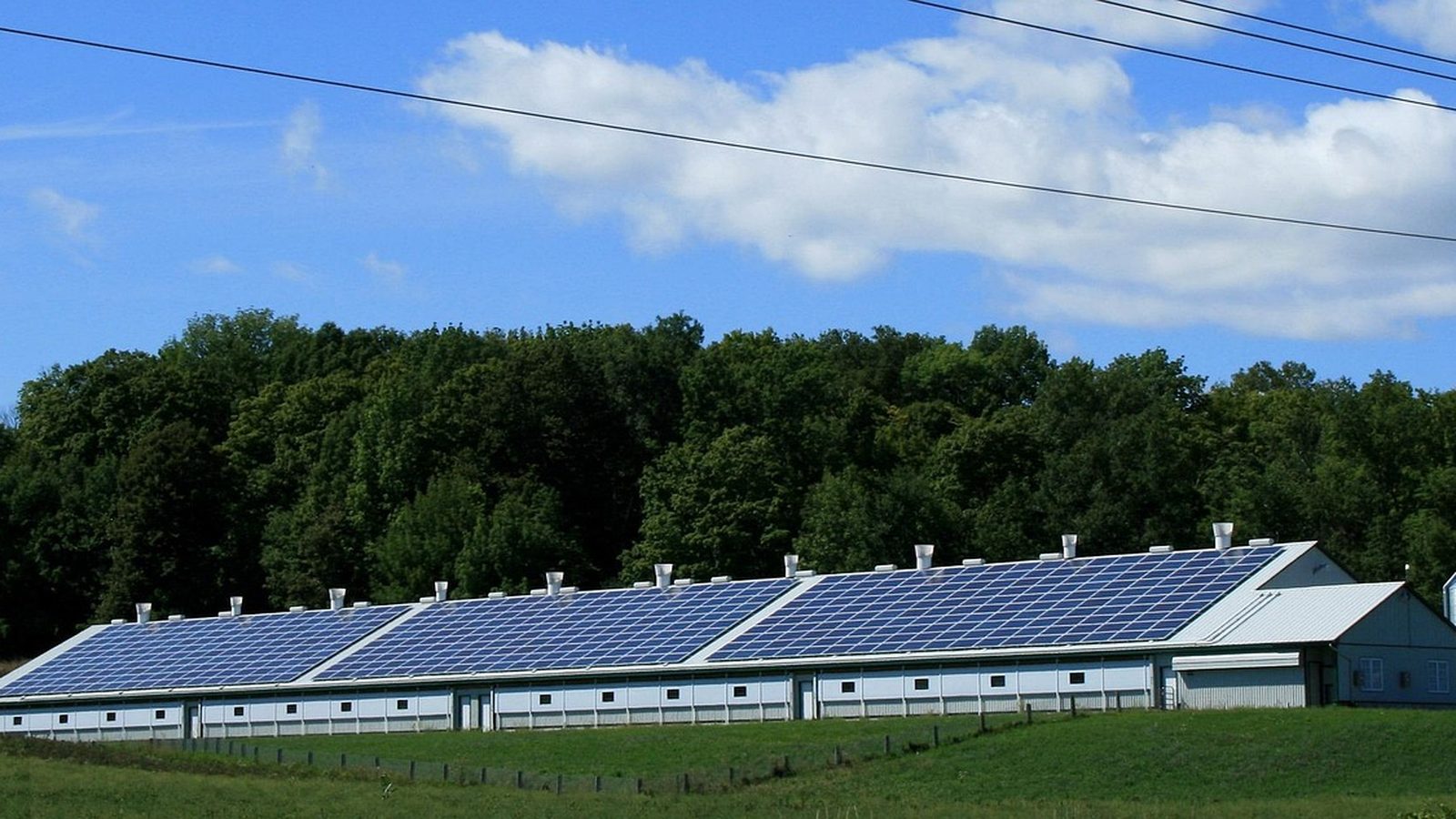
Photo: PublicDomainPictures, via Pixabay
California · Stockton
Solar in Stockton: fast permit, slow math
Written by the Solar Learning Lab research deskUpdated August 22, 202611 min read
Stockton has a strange split personality for solar. A contractor with a plain rooftop PV job can get an OTC Photovoltaic permit auto-issued through the City's Accela process. Then the same household has to make sense of a $314 permit, PG&E delivery charges, Ava Community Energy generation charges, hourly export value, and whether a battery has just knocked the project out of that instant lane. The process moves. The decision does not move by itself.
That is the Stockton mistake: treating a clean permit screen as proof that the quote is clean. It is not. This is a city where the job needs to be separated into three questions: can it be permitted automatically, how much of the output will be used in the house, and which available programs actually reach this address. The answers can be very good. They are just not interchangeable.
Start with your roof and bill
Use the short estimator to pressure-test a system size before an installer turns production into a sales number.
Estimate Stockton solarStockton is a two-speed solar city
The first speed is administrative. The City's Building and Life Safety Division lets a licensed contractor use its Residential Solar One Stop route for eligible rooftop PV. The contractor gets the automated design approval, creates an record in the Accela Citizen Portal, uploads the approval document and number, pays, and prints the permit. The City says it is issued without City plan review once that sequence is complete. For a basic job, that is materially better than waiting for a traditional review queue.
The second speed is economic. Stockton joined Ava Community Energy in 2025, but PG&E still delivers power and sends the bill. That means solar analysis has two utility layers even though the homeowner gets one bill. Ava supplies generation. PG&E owns the wires and applies its delivery side. A proposal that says only “your PG&E rate” is leaving out the operating reality of the account.
Stockton also has a big detached-home base. The state's 2026 housing estimate counts 68,792 single-detached units out of 105,640 total units, roughly 65 percent, which is a large physical canvas for rooftop solar. But roof inventory is not the same thing as good project inventory. Roof age, shade, electrical service and the household's daytime load still decide whether panels are a useful appliance or an overbuilt export machine. The state housing table tells us the first fact, not the rest.
Summer electricity use gives the question some bite. Stockton Metropolitan Airport's climate normals show 3,157.7 cooling degree days at base 57 and just 13.45 inches of annual precipitation. That is a hot, dry annual load shape, not Bay Area mildness. A home with significant afternoon cooling can use more of its solar than a household empty all day. Do not assume either way. Pull twelve bills and look for the months that actually swell. NOAA's Stockton normals are context, not a sizing tool.
The auto-issued permit is real. So are the guardrails.
Stockton calls the record type OTC Photovoltaic. Revisions use OTC Photovoltaic Revision. The automatic route is for licensed contractors, permitted residential main dwelling structures and rooftop PV. It excludes ballasted systems, building-integrated PV and battery backup. The City says battery support is coming soon. That is not a footnote if storage is on your shopping list. It is the line between a one-stop PV filing and a different permitting conversation. Read Stockton's eligibility list before paying for final design work.
For residential PV at 15 kW or less, the current City fee schedule lists a flat $314. Above 15 kW, it is $450 plus $15 per kW above 15 kW. The schedule also contains add-on fee categories tied to permit fees or valuation, so a quote should identify what it includes rather than calling $314 the entire government cost by reflex. The FY 2026-27 Community Development fee schedule is the controlling document here.
The City does not publish a conventional day-count promise for this pathway. What it does say is sharper: a qualifying application is issued without City plan review after the approval document is uploaded and fees are paid. Call that same-session City issuance, not a guaranteed end-to-end installation timeline. Design review, contractor scheduling, inspection availability, PG&E interconnection and correction work sit outside that narrow statement.
There is one dull but important operational detail. Inspection is scheduled in Accela with the permit number. A PV revision has to be submitted in person at the Permit Center rather than online. That can matter when a field condition changes a layout after the sales documents are signed. The right installer keeps contingency in both the job calendar and the contract. The wrong one tells you that a digital permit means nothing can slow down.
Ava supplies the electrons on paper. PG&E still runs the grid.
Stockton's default Ava plan is Bright Choice, described by the City as approximately 55 percent renewable and priced 5 percent below PG&E generation rates. Renewable 100 is Ava's 100 percent solar-and-wind option, priced one-quarter of a cent per kWh above PG&E generation. Customers can opt out to PG&E generation. None of that removes PG&E delivery, the PG&E bill, or the utility's interconnection process. The City's Ava explainer says so plainly.
| Energy source | Type | Average price | What that means |
|---|---|---|---|
| PG&E E-ELEC | solar customer retail rate | 28¢ to 55¢ per kWh | Winter and summer time periods differ. The 4 to 9 p.m. summer price is 55¢. |
| PG&E E-TOU-C | residential TOU reference | 32¢ to 52¢ per kWh | Summer peak runs 4 to 9 p.m.; the spread is why load timing matters. |
| Ava export bonus | non-CARE/FERA late-afternoon add-on | 2.5¢ per exported kWh | Available for exports from 3 to 8 p.m., on top of applicable Solar Billing Plan credits. |
| Onsite solar | self-consumed energy | retail avoided cost not a fixed tariff | A solar kWh used immediately avoids the applicable retail purchase. Exported energy follows a different credit rule. |
PG&E's March 2026 residential rate sheet and Ava's Solar Billing Plan page. The table is a tariff snapshot, not a monthly bill forecast.
For new PG&E interconnections, the relevant framework is the CPUC Net Billing Tariff, which PG&E calls the Solar Billing Plan. Keep this short because the statewide explanation belongs on our California solar page. What matters locally is that onsite production serves onsite load first, while exports earn separate energy export credits and roll through monthly billing toward an annual true-up. PG&E lists a $145 interconnection fee. PG&E's Solar Billing Plan guidance and the CPUC program page set the rule.
Ava makes Stockton more interesting than an ordinary PG&E comparison. Its published 2026 Energy Export Bonus Credit is 0.9 cents per kWh for standard residential customers who interconnect that year, locked for nine years. Its income-qualified 2026 figure is 3.6 cents. Ava also lists a 1-cent export bonus for CARE and FERA customers, while non-CARE and non-FERA customers can receive an extra 2.5 cents for exports from 3 to 8 p.m. These are bonuses, not permission to oversize a system. They reward certain export hours. They do not turn noon exports into retail purchases.
The hard truth is that a Stockton battery creates both an upside and a paperwork clash. Ava's SmartHome Battery program launched with an $11 million budget and offers $90 per kWh for market-rate customers or $500 per kWh for income-qualified customers on the enrolled portion, plus $3 monthly per shared kWh. Yet battery backup is excluded from Stockton's automated PV route. A solar-only permit may glide. A solar-plus-storage job deserves a separate schedule and scope review. Ava's program announcement and the City's permitting page make that tension explicit.
Production is strong here. The monthly shape still matters.
Our model produces 1,654.6 kWh per year for each installed kW at the downtown Stockton location. August is the high point at 176.0 kWh per kW; December is 82.6. That is a useful solar resource, and it aligns with the summer cooling pattern. It is not an output guarantee for a particular roof. Nearby trees, a west-facing plane, panel spacing, attic work and local weather will change the result.
August is the modeled high month at 176.0 kWh per kW. A hot month can support self-consumption, but the household load profile decides how much of that production stays behind the meter.
PVGIS v5.2 model run by Solar Learning Lab on August 22, 2026, NSRDB radiation database. Fixed south facing mount, 30 degree tilt, 14 percent losses, downtown Stockton coordinates. Your roof will differ. The calculation uses the PVGIS tool. Read this as a standardized comparison between roofs, not a proposal. A competent site design should reconcile it against an aerial layout, shade observation and the account's actual consumption before it claims a percentage offset.
A useful Stockton quote asks for an hourly or at least monthly self-consumption assumption. “Annual production equals annual usage” is not enough under the Solar Billing Plan. Two 8 kW systems can have the same annual model and very different bill outcomes if one household runs cooling and laundry during the day while the other exports most of its output. That is the economic difference that sales decks regularly flatten.
In Stockton, the meaningful local help is targeted
The largest local rooftop opportunity is not a citywide coupon. Stockton Rising, delivered with GRID Alternatives under the Transformative Climate Communities award, offers no-cost solar to income-eligible homeowners inside the South Stockton project area. The program plans more than 100 single-family installations and four multifamily installations, with related efficiency work available to renters and owners in the area. That is a real program with a hard geography and eligibility gate. Start at the City sustainability page, not with a generic “free solar” ad.
Outside that program area, we found no City-funded rooftop rebate. There are still two categories worth asking about. The first is Ava's battery program, which has enrollment and ownership conditions. The second is SGIP, the CPUC storage program, whose Equity and Equity Resiliency incentives are listed at $850 per kWh and $1,000 per kWh for qualifying circumstances. High fire-threat exposure, multiple public safety power shutoffs, low income, medical vulnerability and critical facilities affect eligibility. The CPUC SGIP page has the program path. Nobody should place that money in a quote without showing why the household qualifies.
The federal homeowner credit is no longer a planning lever in 2026. The residential 25D credit ended December 31, 2025; a lease or PPA provider may claim the 48E business credit. Congressional Research Service IN12611 describes the change. That distinction is contractual, not semantic. If the provider says “you still get the credit” on a lease, stop and make them state exactly who claims what.
The Stockton installer list is thin. Treat that as information.
We found three Google Maps results with 20 or more reviews for this list, including Phoenix Roofing & Solar, which is a roofing contractor that also does solar. A short list is not evidence that only three competent companies can serve Stockton. It is evidence that the local map result set is thin, so you should widen the bid search deliberately and check the contractor's license, roof scope, electrical scope and permit plan.

Phoenix Roofing & Solar
Stockton, CA
4.8(121 Google reviews)

Ratings snapshot: Google Maps, August 2026, via the DataForSEO SERP feed. Zero companies paid us and none are endorsed by us.
Ask each bidder whether the job stays within Stockton's automated PV rules. Then ask the opposite question: if a battery, service upgrade or layout change moves it outside the lane, who owns the added design, permitting and schedule risk. A serious answer has a process. A vague answer has a change order waiting in it.
Run a Stockton estimate, then make it less optimistic
The calculator is deliberately simpler than Ava and PG&E billing. It uses the California retail-rate context and the local production run. It cannot assign avoided-cost export values to the hours your home does not use production. Use it to compare system sizes, cash versus financing pressure and production sensitivity. Do not use it as a promise about your true-up.
The top of the slider is our downtown Stockton PVGIS run. The lower setting is 85 percent of that output, a practical sensitivity check for a less favorable roof rather than a promise about shading.
Cash quotes in Stockton cluster near $2.46 per watt, against a $3.50 national 2024 median (LBNL). Use your quote.
Assumptions you can change
Use the rate on your actual lease or PPA quote. There is no published statewide average we trust enough to hardcode.
Cash purchase
$8,610 after state credit
- Year 1 benefit
- $160/mo
- Payback
- 5 years
- 20 year net position
- $38,117
This calculator uses the California state rate as a rough retail-value input. Stockton customers have PG&E delivery and Ava generation, while solar exports follow the Solar Billing Plan and Ava adds its own export credits. Treat the result as a screening estimate, not a bill simulation.
Solar loan
$115/mo 15 yr payment
- Year 1 net
- $45/mo
- Upfront
- $0
- 20 year net position
- $26,002
The California loan input includes the state calculator's documented loan-over-cash spread. In Stockton, ask the lender for the cash price, financed price, dealer fee and prepayment terms on separate lines.
Lease / PPA
$0 down you buy the power
- Year 1 net
- $45/mo
- Upfront
- $0
- 20 year net position
- $14,620
A lease or PPA provider may claim the federal 48E business credit. That is not the same as a homeowner credit, and the provider's quoted rate still needs to compete with your actual PG&E and Ava bill.
Estimates, not quotes. This tool uses the California average retail rate, a Stockton PVGIS production run and California market cost inputs. It cannot reproduce PG&E hourly export credits, Ava bonus credits, fixed charges or roof-specific shading. We are a solar installer and we also partner with other solar companies. See our disclosures.
We are a solar installer and we also partner with other solar companies.
Stockton solar questions, answered without the brochure gloss
Can a Stockton solar permit really issue automatically?
What does the Stockton permit cost?
Is my electricity from PG&E or Ava?
Does Ava pay more for solar exports?
Can I get free solar in Stockton?
Does a battery fit Stockton's instant permit route?
Stockton source notebook
Every operational claim above is tied to the following primary pages and tariff documents, reviewed for this page on August 22, 2026.
- City of Stockton Automated Solar Permitting and Online Permitting
- City of Stockton FY 2026-27 fee schedule
- City of Stockton Ava Community Energy page and Ava Solar Billing Plan
- PG&E residential rate pricing, PG&E Solar Billing Plan, and CPUC Net Billing information
- Ava SmartHome Battery announcement and CPUC SGIP participation page
- City of Stockton sustainability and Stockton Rising page
- California Department of Finance E-5 housing estimates, NOAA Stockton climate normals, PVGIS, and CRS federal credit note
Get a Stockton solar estimate built around your bill
Start with the monthly bill, your roof situation and how you want to pay. Then use the output to ask better questions of a contractor.
What does your monthly electric bill look like?
Stockton average is $161 per month (EIA, 2024).