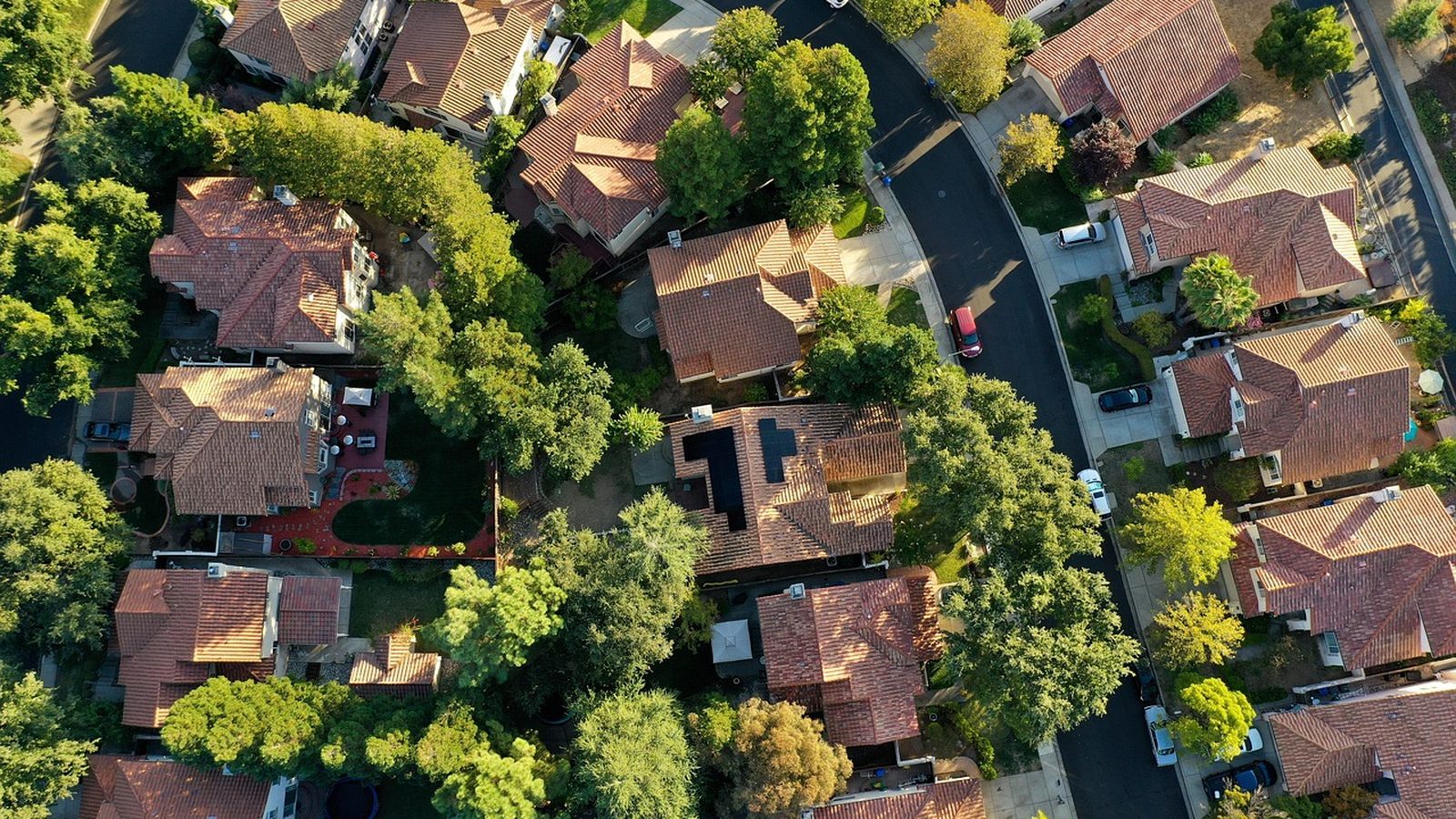
Photo: hamlinjandrew, via Pixabay
California · Whittier
Whittier solar: a homeowner town with a contractor only fast lane
Written by the Solar Learning Lab research deskUpdated August 28, 202611 min read
On paper, Whittier is the strongest owner occupied solar market of the five cities we researched this week. The state counts 20,006 single detached homes out of 30,996 total units, 64.5 percent, in its January 2026 housing estimate, and owner occupancy stood at 57.3 percent at the 2010 census per the city's Wikipedia entry. Lots of roofs, mostly owned by the people under them. That is the raw material rooftop solar wants.
The process, though, has a gatekeeper. Whittier's automated SolarAPP+ permit is open to licensed contractors only, and only if they hold an active City of Whittier business license. Owner builders are excluded outright. And when the panels are up, the first inspection belongs to the Los Angeles County Fire Department, not City Hall. If you understand those two facts, you understand how projects succeed or stall here.
Size it before you shop it
Two minutes with the estimator gives you a defensible system size to test every bid against.
Estimate Whittier solarThe market fact that shapes everything: owned detached roofs
Most cities we cover have a housing mix argument. Whittier barely needs one. Nearly two thirds of the housing stock is single detached, vacancy runs a tight 3.32 percent, and households average 2.87 people, per the Department of Finance E-5 file. This old Quaker citrus town, incorporated in 1898 and named for the poet John Greenleaf Whittier, grew up as a place where people own the roof over their heads, per the city's history.
The constraint is income, not tenure. Median household income was $76,026 in the 2016 to 2020 window, per the same source. That is workable for solar, but it makes financing terms decisive in a way they are not in Redwood City or Buena Park. A quarter point of dealer fee buried in a loan matters more to a $76,000 household than to a $150,000 one. The mistake we see in markets like this is shopping monthly payment instead of total financed cost.
SolarAPP+ works here, but only through a licensed contractor
Whittier runs automated residential solar review through SolarAPP+, and the City's solar permitting page is unusually blunt about who gets to use it: licensed contractors only, and the contractor must hold an active City of Whittier business license. Owner builders cannot use SolarAPP+ and must apply for a regular permit through Building and Safety. Solar permits are accepted online only starting July 15. If you were planning a self install, budget for the slow lane before you budget for panels.
Two project types get bounced from the automated path regardless of who applies: anything that includes a main panel upgrade, and systems over 38.4 kW. Both go through the standard permit process. That 38.4 kW ceiling matches the scope of Government Code 65850.52, the SB 379 statute that forced cities this size to stand up real time automated solar permitting by September 2023.
The state record backs the city's claims. The CEC tracking file dated August 3, 2026 lists Whittier on SolarAPP+ with 2024 annual report data submitted and a $60,000 CalAPP grant awarded December 9, 2022. That grant funded the city's permitting system, not homeowner rebates, a distinction worth making because we have watched sales reps blur it. On fees, no photovoltaic line item was confirmable from the City's published fee schedules this session, so get the number from Building and Safety at (562) 567-9320 at intake. The legal ceiling absent adopted findings is $450 plus $15 per kW above 15 kW under Government Code 66015.
City issuance is not the finish line. LA County Fire inspects first.
Here is the operational detail that separates Whittier from its neighbors: the first inspection is performed by the Los Angeles County Fire Department, per the City's checklist. The referenced LACFD requirements include fire setbacks of 3 feet at exterior walls and gabled ends, 18 inches at ridges and valleys, and a knife switch AC disconnect within 6 feet of the main service panel and within sight.
A designer who treats those setbacks as an afterthought hands you a failed inspection and a redesign. The right sequence is to build the LACFD checklist into the array layout on day one, even when it costs a couple of panels of capacity. In practice, a 3 foot perimeter setback on a modest hip roof can trim more production than any equipment upgrade adds back. Better to know that at proposal time than at inspection time.
Whittier chose the middle tier: Clean Power at 50 percent renewable
Whittier joined Clean Power Alliance in January 2018, with service starting in February 2019, and the City selected Clean Power, 50 percent renewable, as its default, against SCE's then 34 percent renewable content, per the City's own explainer. CPA's 2021 member jurisdiction table confirms the Clean Power default. Today CPA offers three tiers per its rate options page: Lean Power at 40 percent clean energy, Clean Power at 50 percent, and 100% Green Power at 100 percent renewable, with tier switching and opt out to SCE available.
Two CPA programs are directly relevant to a solar shopper here. The Sun Storage Rebate puts $750 toward a battery paired with solar, and Solar and Battery Access provides free solar and battery systems to income qualified homeowners, with average bill savings around 70 percent, per CPA's residential page. In a city with this many owner occupied homes on a moderate income, the income qualified program is not a footnote. Check eligibility before assuming you need to buy.
The bill is still an SCE bill, and exports follow state rules
Southern California Edison delivers Whittier's power, per SCE's communities served filing, with the city in baseline regions 8 and 9. SCE's 2024 bundled residential average was 32.4 cents per kWh in EIA Table 6. New solar interconnections land on the Net Billing Tariff, adopted in Decision 22-12-056 for applications on or after April 15, 2023, per the CPUC: no netting, hourly avoided cost export credits averaged monthly, annual true up.
| Energy source | Type | Average price | What that means |
|---|---|---|---|
| SCE TOU-D-4-9PM | summer weekday peak | 58¢ (48¢ after credit) per kWh | Base Services Charge $0.79 per day; 10¢ baseline credit on metered plans. |
| SCE TOU-D-5-8PM | summer peak | 74¢ (64¢ after credit) per kWh | The steepest evening price signal in the SCE residential lineup. |
| ACC Plus adder, SCE | export credit add-on | 4¢ per exported kWh | 9.3¢ for qualifying low income customers. Exclusions apply, including inherited systems. |
| SCE bundled residential | 2024 average | 32.4¢ per kWh | EIA bundled figure; CPA generation customers are not in this table. |
| Solar used behind the meter | avoided retail | time dependent not a tariff | Self consumption during 4 to 9 p.m. peaks avoids the most expensive power on the bill. |
SCE time of use plans, CPUC decision materials, and EIA Table 6. Orientation table, not a bill simulation.
Note the TOU-D-PRIME requirement: Solar Billing Plan customers are required to take that rate plan, with a 12 month lock after switching, per SCE's plan page. Any proposal that models savings on your current tiered rate is modeling a plan you will not be on.
Inland enough to be sunny, coastal enough to be gentle
Our downtown PVGIS run models 1,711.1 kWh per year per installed kW, with August peaking at 168.0 kWh per kW and December at 112.8. Whittier sits about 15 miles inland, which lifts summer highs into the 84 to 97 degree range per its climate record, and those hot afternoons are exactly when a household with air conditioning can self consume instead of exporting.
August models 168.0 kWh per kW, coinciding with cooling season. Production that lands against your own A/C load is worth retail; production exported at noon is worth much less.
PVGIS v5.2 model run by Solar Learning Lab on August 28, 2026, NSRDB radiation database. Fixed south facing mount, 30 degree tilt, 14 percent losses, downtown Whittier coordinates. Your roof will differ. Full assumptions at the PVGIS tool. Treat this as a comparison baseline. Whittier's older neighborhoods carry mature street trees, and shade eats modeled output faster than any other variable on this page.
Old houses bring two extra checkpoints
Central Park, Hadley-Greenleaf and College Hills are designated historic districts full of Craftsman and Spanish Colonial Revival homes, overseen by the City's Historic Resources Commission, per the city's records. Expect extra review attention on street visible arrays in those neighborhoods. State law still sets the outer boundary: Civil Code 714 makes a restriction unreasonable if it adds more than $1,000 of cost or cuts efficiency more than 10 percent, and undenied applications are deemed approved at 45 days.
The second checkpoint is electrical. Remember that a main panel upgrade disqualifies a job from SolarAPP+ here. Pre war and mid century housing stock frequently needs one. So the practical question for any Whittier bid on an older home is: does this design work within the existing service, and if not, what does the standard permit path add in time and cost? An honest installer answers with a schedule. On the money side, the 2026 toolkit is the same statewide set: the 25D homeowner credit ended December 31, 2025 per CRS IN12611, SGIP equity incentives run $3,100 per kW solar and $1,100 per kWh storage for income qualified households per the CPUC, and the property tax exclusion holds until its scheduled January 1, 2027 sunset.
This installer list needs reading skills, not just scanning
Our Whittier map pull is a study in why review counts matter. It includes a 1.4 star company with 13 reviews, two firms with one or two reviews each, and, at the other end, Semper Solaris with 560 reviews and Sunrun with 285 operating from nearby Santa Fe Springs. A five star rating on two reviews is not a track record. It is two data points wearing a costume.
Best Solar Company Whittier
Whittier, CA
5.0(2 Google reviews)
Max Energy Solar
Whittier, CA
1.4(13 Google reviews)

Power Tek Solar Installation and Supply
Whittier, CA
5.0(1 Google reviews)

Los Angeles Local Solar and Roofing
Santa Fe Springs, CA
4.7(12 Google reviews)


Sunrun
Santa Fe Springs, CA
4.8(285 Google reviews)
Ratings snapshot: Google Maps, August 2026, via the DataForSEO SERP feed. Zero companies paid us and none are endorsed by us.
Whatever bench you assemble, add two Whittier specific screening questions: does the bidder hold an active Whittier business license, since SolarAPP+ requires it, and how do they sequence the LACFD first inspection into their timeline. Vague answers to either one predict schedule slip.
Run the numbers before anyone runs them for you
The estimator uses the state average rate and our local production model. It cannot see your panel capacity, tree line or CPA tier. Use it to anchor a sensible system size, then make every bidder justify deviations from it.
The high end of the slider is our downtown Whittier PVGIS run at 30 degree tilt. The low end is 85 percent of that output, a sensitivity margin for tree cover and off south orientations common in older neighborhoods.
Cash quotes in Whittier cluster near $2.46 per watt, against a $3.50 national 2024 median (LBNL). Use your quote.
Assumptions you can change
Use the rate on your actual lease or PPA quote. There is no published statewide average we trust enough to hardcode.
Cash purchase
$8,364 after state credit
- Year 1 benefit
- $161/mo
- Payback
- 5 years
- 20 year net position
- $38,578
This tool uses the California average retail rate as a rough proxy for avoided cost. Whittier accounts stack SCE delivery on Clean Power Alliance generation, and exports settle under the Net Billing Tariff, so read the result as a first pass screen, not a bill.
Solar loan
$112/mo 15 yr payment
- Year 1 net
- $49/mo
- Upfront
- $0
- 20 year net position
- $26,809
The loan input carries the state calculator's documented loan-over-cash spread. Whittier's moderate median income makes financing terms decisive, so demand the cash price, financed price, dealer fee and prepayment penalty on separate lines before signing.
Lease / PPA
$0 down you buy the power
- Year 1 net
- $45/mo
- Upfront
- $0
- 20 year net position
- $14,688
The federal 25D homeowner credit ended for systems completed after December 31, 2025, and the CRS note we rely on does not address third party ownership, so we make no claim about a lease or PPA provider's tax position. Compare the offered rate to your combined SCE and CPA bill, escalator included.
Estimates, not quotes. This calculator combines the California average retail rate, our downtown Whittier PVGIS run and statewide cost inputs. It cannot model hourly export credits, CPA tier choices, LACFD design requirements or your roof's shading. We are a solar installer and we also partner with other solar companies. See our disclosures.
We are a solar installer and we also partner with other solar companies.
Whittier FAQ
Can I pull my own solar permit in Whittier?
Why does the fire department inspect my solar project?
What renewable content is my default power?
Does a main panel upgrade change my permit path?
Is there help paying for solar or a battery here?
What does a Whittier solar permit cost?
Citations
Primary documents reviewed for this page on August 28, 2026.
- Whittier SolarAPP+ page, Building and Safety Division, and City fee schedules page
- City of Whittier Clean Power Alliance page, CPA rate options, CPA residential programs, and 2021 default product table
- SCE communities served, SCE CCA page, SCE TOU plans, and EIA Table 6
- CPUC Net Billing Tariff, decision materials, SGIP, CRS IN12611, and BOE property tax exclusion
- Government Code 65850.52, Government Code 66015, Civil Code 714, and the CEC permitting data file
- DOF E-5 housing estimates, Whittier Wikipedia entry, and PVGIS
Get a Whittier estimate built on your actual bill
Four quick questions, then an estimate using this page's local production and cost inputs.
What does your monthly electric bill look like?
Whittier average is $161 per month (EIA, 2024).