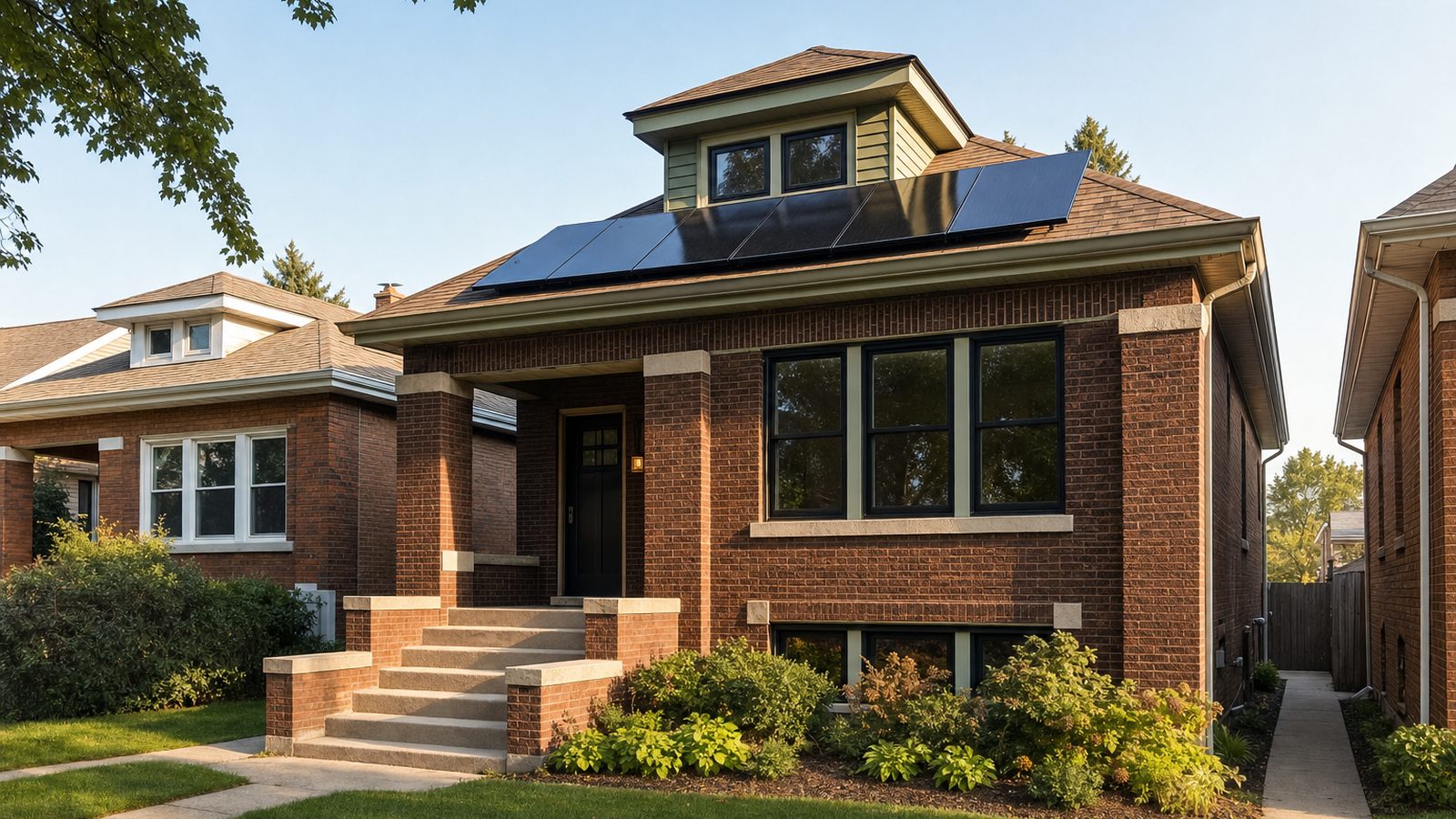
Illinois
Illinois solar in 2026
Illinois is where the incentive can move the project, not merely decorate the quote. Illinois Shines pays SREC value upfront for fifteen years, and the smaller-system block values run from $73.71 to $83.87 per REC in the cited block data. But new systems are on supply-only net metering. Delivery charges do not net out. That detail can outrun a flashy rebate.
For Illinois solar, the retail rate is not the export rate
A new system cannot assign the 23.85-cent retail figure to every exported kWh. Only supply charges net, while delivery charges remain. Illinois Shines can lower the upfront cost materially, so the calculation needs both program value and a properly reduced bill, not a blanket retail-rate multiplication.
| Energy source | Type | Average price | What that means |
|---|---|---|---|
| Illinois statewide blend | Electricity | 23.85¢ per kWh | Illinois residential composite from EIA, reported through May 2026. |
| Residential natural gas | Natural gas | $15.39 per Mcf | EIA's May 2026 Illinois household gas series, roughly 5.1 cents per thermal kWh. |
| Rooftop solar, owned | Electricity | ~9.0¢ per kWh | Twenty-five-year cost analysis using EnergySage state pricing and our PVGIS modeling. Energy delivered beyond the home can be worth less than self-consumed generation. |
Electricity uses EIA Table 5.6.A for May 2026. The corresponding Illinois residential gas reference is in EIA's gas-price data; one Mcf is about 304 kWh of thermal energy. The solar calculation uses the method on the methodology page.
Illinois production improves as you move south
This state has a north-to-south output gradient. Chicago is the cautious modeled case and Carbondale the high case. That difference should shape the forecast for a specific roof, not be used as an excuse for a generic production promise.
| Model location | Yearly kWh per installed kW | Annual output for 11.58 kW |
|---|---|---|
| Chicago | 1,218 | 14,102 kWh |
| Springfield | 1,385 | 16,035 kWh |
| Rockford | 1,333 | 15,440 kWh |
| Carbondale | 1,388 | 16,070 kWh |
Method: PVGIS v5.2 model runs by Solar Learning Lab on August 18, 2026, using the NSRDB radiation database. Assumptions: fixed roof mount, south facing, 30 degree tilt, 14 percent losses. Your roof will differ. The example matches the EnergySage Illinois average system of 11.58 kW.
Illinois has to be modeled as a bill rule plus a program payment
Full retail net metering ended for systems put into service on or after January 1, 2025. Later systems net the supply portion, leave delivery charges untouched, and roll credits forward. Any sales forecast using a retail savings figure must break those bill components apart.
For eligible residential and small commercial ComEd and Ameren customers, the distributed-generation rebate provides $300 for each kW of solar and $300 per kWh of storage. Accepting it permanently gives up full-retail net metering. Most newer projects already sit outside that older treatment, but the option should never be described casually. Illinois Shines requires work through an Approved Vendor or Designee.
Policy source: Illinois Shines FAQs.
Illinois Shines value is real, but access is limited
| Item | Value | Fine print |
|---|---|---|
| Illinois Shines, 0 to 10 kW | $73.71 Group A, $83.87 Group B per SREC | One payment covering fifteen years of SRECs. In the cited 2024/2025 cycle, the block for systems below 25 kW filled (block-rate summary) |
| Distributed generation rebate | $300 per kW solar, $300 per kWh storage | For qualifying ComEd and Ameren residential and small commercial customers; accepting it ends full-retail net-metering eligibility (Illinois Shines FAQs) |
| Federal 25D | Ended December 31, 2025 | A lease or PPA company can claim 48E and potentially reflect part of the benefit in pricing (CRS) |
The Illinois Shines block amounts can materially alter payback. Their availability is finite, and the cited smaller-system block filled in that cycle. Before assigning a dollar to the project, require an Approved Vendor to show current program availability.
Illinois requires two separate decisions, not one rebate calculation
First, measure the bill rule. Systems energized after January 1, 2025 receive supply-only netting. Supply charges are offset and credits roll over, but delivery charges do not disappear. That means the 23.85-cent statewide residential figure cannot serve as a shortcut for the value of all production. The installer should show supply savings, delivery charges, and the forecast for exported generation separately.
Second, test program access. Illinois Shines provides a single upfront payment for fifteen years of SRECs, but participation runs through an Approved Vendor or Designee and availability is limited by yearly blocks. In the cited 2024-2025 schedule, 0 to 10 kW projects were listed at $73.71 per SREC in Ameren and MidAmerican Group A and $83.87 in ComEd Group B. Blocks for systems under 25 kW filled in that cycle. A historical rate is not proof that a new reservation is open.
The distributed-generation rebate has its own consequence. For ComEd and Ameren residential customers it is $300 per kW of solar and $300 per kWh of storage, but accepting it irreversibly forfeits full retail net metering. Illinois Solar For All is a separate path for eligible single-family homeowners at or below 80% of Area Median Income, with no upfront cost and monthly payments capped at half the energy value produced. These are different programs with different gates. Do not merge them into one advertised discount.
The sharpest question to put to a vendor is not whether Illinois Shines is "included." Ask whether the project falls in Group A or Group B, which Approved Vendor or Designee will submit it, what block is available, and whether the number shown is an upfront payment for the stated fifteen-year SREC term. Then ask a different question about the bill: what part of a production kWh offsets supply and what part leaves delivery charges in place? Those answers describe two different pieces of the economics. A polished quote that combines them without labels is harder to audit and easier to misunderstand.
Program requirements: Illinois Shines FAQs. Block figures and Solar For All summary: Illinois incentive data. Net-metering context: Citizens Utility Board.
Use a two-part Illinois calculation before signing
Start with the calculator's bill-savings baseline. Then ask an Approved Vendor to combine the Illinois Shines payment and the applicable net-metering treatment in one written forecast.
Bounds use four Illinois PVGIS runs. Chicago is the low case while Carbondale is the high case.
Cash quotes in Illinois cluster near $2.99 per watt, against a $3.50 national 2024 median (LBNL). Use your quote.
Assumptions you can change
Use the rate on your actual lease or PPA quote. There is no published statewide average we trust enough to hardcode.
Cash purchase
$12,558 after state credit
- Year 1 benefit
- $111/mo
- Payback
- 9 years
- 20 year net position
- $19,796
Illinois Shines and the distributed-generation rebate are not percentage credits. Their eligibility and net-metering consequences must be quoted by an Approved Vendor.
Solar loan
$158/mo 15 yr payment
- Year 1 net
- -$47/mo
- Upfront
- $0
- 20 year net position
- $3,883
We price loans at $4.19 per watt: the EnergySage cash figure plus the $1.20 national loan-over-cash spread LBNL documents, since dealer fees get built into loan pricing.
Lease / PPA
$0 down you buy the power
- Year 1 net
- -$1/mo
- Upfront
- $0
- 20 year net position
- $1,361
A lease or PPA provider may still claim 48E. Illinois Shines participation requires an Approved Vendor or Designee.
Estimates, not quotes. Inputs use the Illinois average rate from EIA (Table 5.6.A, May 2026), our own PVGIS production runs, and EnergySage August 2026 cost data. Illinois Shines uses fifteen years of SRECs paid upfront; block rates depend on utility group and system size. We are a solar installer and we also partner with other solar companies. See our disclosures.
Illinois questions that prevent a misleading quote
- Require separate supply-savings and delivery-charge lines. New systems cannot net delivery charges.
- Determine Group A or Group B before borrowing a block figure from a neighbor's proposal.
- Use an Approved Vendor or Designee to confirm the live Illinois Shines block. A past opening is not proof of availability.
- The $300-per-kW rebate has permanent net-metering consequences. Get both sides of that choice in writing.
Illinois installer screening hinges on program handling
High-review installers operate around Chicago and across the state. The central screening issue is program handling: ask which Approved Vendor runs Illinois Shines, whose name appears on the submission, and what happens if a block fills.
Tron Solar
Vernon Hills, IL
4.8(1,055 Google reviews)
Kapital Electric
Bensenville, IL
4.8(740 Google reviews)
Certasun
Buffalo Grove, IL
4.7(321 Google reviews)
Greenlink Energy Solutions
Rockford, IL
4.9(211 Google reviews)
SunPower (Vernon Hills)
Vernon Hills, IL
4.0(457 Google reviews)
Google Maps ratings observed in August 2026 via the DataForSEO SERP feed. Zero companies paid us and none are endorsed by us. Verify contractor licensing and the local building-permit record before signing a contract.
Illinois city guides
Permits, utility export rules, and a city-specific PVGIS production model for each market we have researched so far.
Create an Illinois solar estimate
Four questions produce an Illinois-specific estimate using the page's EIA rate and PVGIS production data. We are a solar installer and we also partner with other solar companies. Details in our disclosures.
What does your monthly electric bill look like?
Illinois average is $110 per month (EIA, 2024).