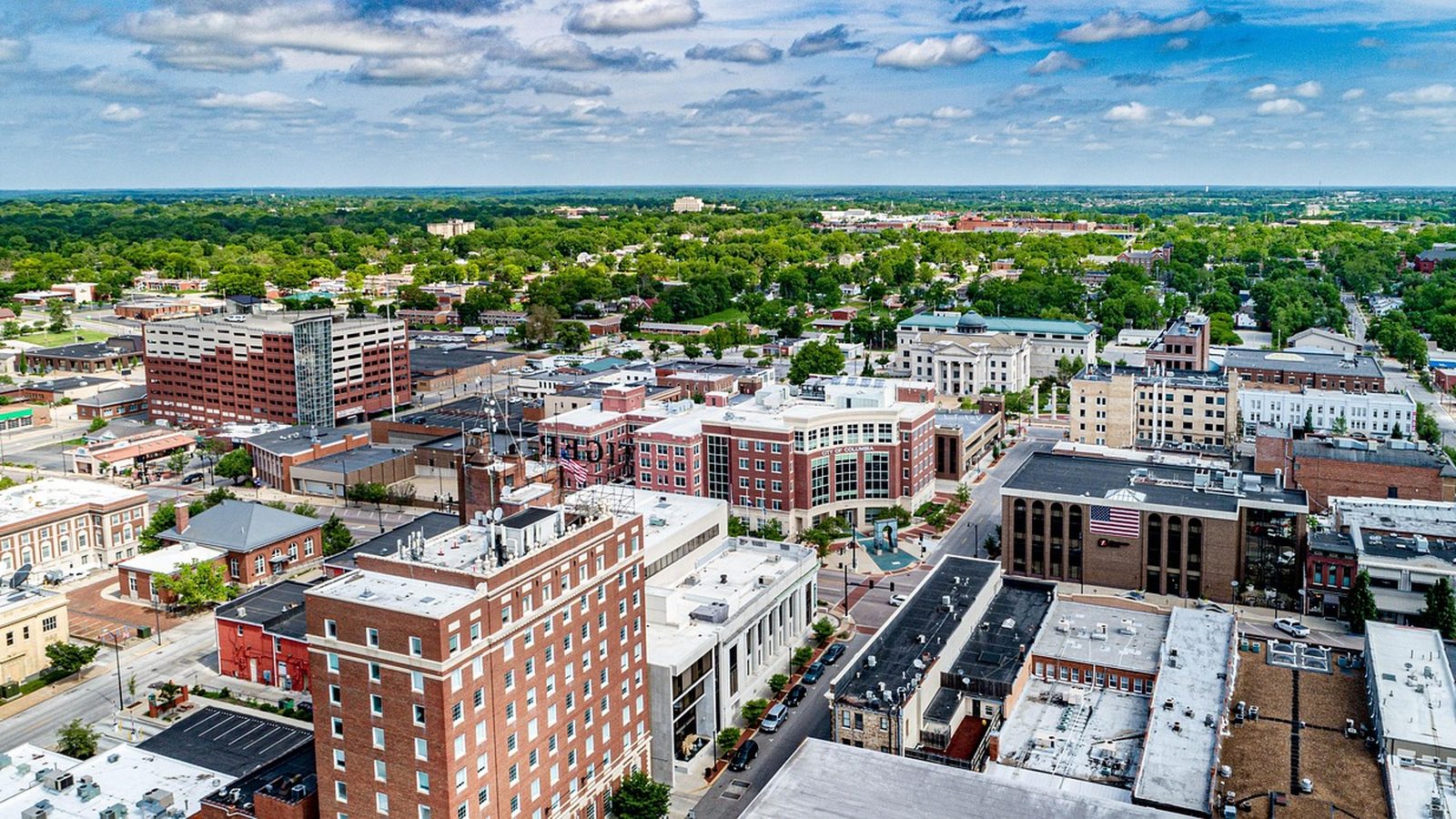
Photo: mgattorna on Pixabay
Missouri · Columbia
Solar in Columbia works if you respect the sequence
Written by the Solar Learning Lab research deskUpdated September 1, 202613 min read
Columbia owns its electric utility, and that single fact rearranges the whole solar conversation. Columbia Water and Light pays a rebate, lends its own money at 1 percent, and credits monthly net excess at retail. It also enforces an order of operations that forfeits the rebate if an installer bolts panels down before the paperwork clears. The program rewards people who read it.
$500
City rebate per kW of installed capacity
1387.4 kWh
Annual PVGIS output per kW installed
1%
City solar loan rate for terms up to 3 years
Price a Columbia system against the city program
Start from your bill, then walk the rebate and interconnection steps in the order the utility requires.
Get my Columbia estimateYour utility is the city, and the numbers are competitive
Columbia Water and Light is the City of Columbia's municipal electric utility. The solar program, the Interconnection and Net Metering Agreement, the rebate, and the final interconnection verification all run through City of Columbia Utilities at 573.441.5528. In 2024 the utility averaged 13.935042 cents per residential kWh across 45,651 customers, per EIA Table 6. Boone Electric Cooperative serves addresses around the city at a 2024 average of 13.402621 cents, and its members are not eligible for any of the city programs described here. So the first diligence step in this market is boring and essential: confirm the meter is a City of Columbia electric account. Getting started with solar, como.gov.
How much solar already sits on this grid? The utility's 2025 Renewable Energy Plan reports 2024 net metered purchases of 2,899 MWh out of an estimated 7,584 MWh generated by customer systems, about 0.62 percent of system energy, purchased at $39.99 per MWh. Customer solar is routine here, not exotic. The city's own permit reports even track Solar Photovoltaic System (Res) as its own residential work class. 2025 Renewable Energy Plan.
The sequence that protects the rebate
The city publishes the order and enforces it. Submit the Interconnection and Net Metering Agreement to City of Columbia Utilities first. Receive the approval letter, which reserves rebate funds. Then the contractor pulls the electrical permit from Building and Site Development, the installation happens, the city runs the final code inspection, and the utility performs interconnection verification. Projects not completed within six months of approval lose their place in the rebate queue. Paid invoices, the passed final inspection, and, for systems over 10 kW, an insurance certificate all come due at the end. como.gov solar steps.
The failure mode is obvious once you see the structure. A crew that installs first has not saved you time. It has spent your rebate. Any Columbia proposal should name the NMA submission date before it names an installation date.
What $500 per kW requires, and what quietly voids it
The rebate pays $500 per kW of installed capacity, plus a peak time premium for arrays designed to produce into hot summer afternoon and evening peaks, calculated from azimuth, tilt, and shading. The January 2023 guidelines add the fine print that matters: rebated capacity is capped at 110 percent of annual consumption, meter bases must sit on fixed foundations, and arrays tilted above 10 degrees facing azimuths from 0 to 110 degrees or 320 to 0 degrees, roughly north through east, can interconnect but earn no rebate. Solar rebates, como.gov and 2023 NMA guidelines.
One caution about the city's own website: the rebate page still describes a federal credit of 30 percent through 2032. That schedule predates P.L. 119-21 and is no longer accurate, as covered below. Trust como.gov on its own programs and the Congressional Research Service on federal law. CRS on the 25D termination.
Credits, RECs, and the March wipe
Columbia's export treatment is genuinely better than the Missouri statutory floor. Section 386.890 obligates every retail supplier, municipal utilities included, to offer net metering up to 100 kW with excess credited at least at avoided fuel cost. Columbia instead credits monthly net excess at the customer's current applicable electric rate, provided the utility retains the solar RECs. Keep the RECs yourself and the credit drops to the avoided average energy market price at the Columbia node, which ran $39.99 per MWh in 2024, about 4 cents against a retail average near 13.9. For most homeowners, assigning RECs to the utility is the plainly better trade. RSMo 386.890 and como.gov net metering.
Now the catch. Credits roll forward month to month, but any balance remaining after the March billing is removed without compensation. Pair that with the 110 percent rebate cap and the design rule writes itself: size to annual load, because everything beyond it is a donation with an annual deadline. Systems of 100 kW or less qualify, equipment must be IEEE and UL certified and installed per NEC Article 690 with an accessible manual disconnect next to the meter, and systems over 10 kW carry at least $100,000.00 of liability insurance. Net metering rules.
The 1 percent loan almost nobody talks about
The city lends its own money for solar: up to $15,000 residential at 1 percent interest for terms up to 3 years, 3 percent for 4 to 5 years, 5 percent for 6 to 10 years, with no prepayment penalty. A municipal loan on those terms is rare nationally. The screens are real, though. Borrowers must be city electric customers and property owners, secure the loan with a deed of trust, stay current on property taxes, and meet insulation minimums including an R-50 attic. Equipment standards apply too: panels need a 25 year warranty and inverters 10 years. City solar loans.
In practice the insulation prerequisite is a feature. A house that clears R-50 before sizing a system will size a smaller, cheaper one.
Permits at Building and Site Development
Building and Site Development, a division of Community Development at 573.874.7474, issues the electrical permit through the Citizen Self Service Portal, which runs 24 hours a day. The city builds under the 2018 International Codes package and the 2017 National Electrical Code, computes building permit fees through its online calculator with a $35.00 minimum, and prices trade permits separately. Loan and rebate paperwork can be dropped at 701 E. Broadway, 4th floor. None of this is the hard part of a Columbia project; the utility sequence is. But the electrical permit and final code inspection are the gate the rebate ultimately passes through. Building and Site Development and fee calculator.
Columbia's production shape
The downtown PVGIS run totals 1387.4 kWh per kW annually, peaking in July at 142.7 and bottoming in December at 74.8. The city's own planning figure says 1 kW of panels offsets about 1,500 kWh per year in Missouri, and it reports a 2024 average installed cost in Columbia of $3,100 per kW before rebates and incentives. Our model runs a little under the city's offset figure because it fixes tilt, orientation, and a 14 percent loss assumption. City system economics.
July peaks, which is exactly the window the city's peak time premium rebate is designed to reward.
PVGIS v5.2. PVGIS v5.2 NSRDB, run by Solar Learning Lab on August 31, 2026, 30 degree tilt, 14 percent losses, downtown coordinates. Your roof will differ.
Rates in context
| Energy source | Type | Average price | What that means |
|---|---|---|---|
| Missouri benchmark | Residential electricity | 13.68¢ calculator input | Table 5.6.A, May 2026 |
| Columbia Water and Light, 2024 average | Residential electricity | 13.9¢ per kWh | EIA Table 6, 2024 bundled retail sales, City of Columbia municipal, 13.935042 cents. |
| Export credit if you keep your RECs | Net excess | ~4¢ per kWh | Columbia node avoided market price; 2024 utility purchases ran $39.99 per MWh. Assign RECs to the utility for retail rate credit instead. |
Averages from EIA Table 6; credit mechanics from the city net metering page.
Renters and shaded roofs have a sanctioned alternative here: the city sells community solar in 1.5 kW blocks through 2044, and a February 2, 2026 KBIA report notes it is seeking more participants at a $24.77 monthly subscription. Community solar and KBIA.
Two tax claims to refuse in a Columbia sales pitch
First, property tax. Missouri's old exemption for solar energy systems not held for resale was held unconstitutional by the Supreme Court of Missouri in case SC99441, which found the legislature lacked constitutional power to create it. Any Columbia quote that lists a statutory property tax exemption as a benefit is citing dead law. SC99441.
Second, the federal credit. P.L. 119-21 terminated the 30 percent residential 25D credit for expenditures made after December 31, 2025, and the statute treats an expenditure as made when installation is completed. A system finished in 2026 does not qualify, whatever a brochure printed in 2024 says. Carryforward of pre 2026 credits is unchanged. The CRS notice does not address third party ownership, so this page makes no claim about lease or PPA federal credits. Congressional Research Service.
Local companies
Five companies show up in our Columbia snapshot, with review counts from 3 to 29. Whoever you interview, run them against this page: which date does the NMA go in, is the array orientation rebate eligible, who assigns the RECs, and does the sizing respect the 110 percent cap and the March expiration. A bidder who cannot answer those four has not done Columbia work, whatever the star rating says.
Ratings snapshot: Google Maps, August 2026, via the DataForSEO SERP feed. Zero companies paid us and none are endorsed by us.
Solar Sam
Columbia, MO
3.5(29 Google reviews)
Missouri Solar Solutions
Fulton, MO
5.0(25 Google reviews)

Green Leaf Solar
Columbia, MO
5.0(13 Google reviews)
Modern Power LLC
Columbia, MO
5.0(5 Google reviews)
Agilix Solutions
Columbia, MO
4.7(3 Google reviews)
Ratings and review counts are Google Maps ratings for Columbia local results, retrieved August 17, 2026 via the DataForSEO SERP API. We list the highest rated established companies we found. No company paid to appear here, and appearing here is not an endorsement. Check current reviews and licensing before you sign anything.
Test your bill against the model
The calculator values production at a retail benchmark, which matches Columbia's retail rate credit reasonably well for a right-sized system with utility-assigned RECs. It does not model the March wipe, so oversized designs will overstate savings here.
The upper input is the downtown Columbia PVGIS run at 1387.4 kWh per kW. The lower input is 85 percent of that, a planning floor for shade and off-south orientation rather than a site specific result.
Cash quotes in Columbia cluster near $2.52 per watt, against a $3.50 national 2024 median (LBNL). Use your quote.
Assumptions you can change
Use the rate on your actual lease or PPA quote. There is no published statewide average we trust enough to hardcode.
Cash purchase
$20,664 after state credit
- Year 1 benefit
- $130/mo
- Payback
- 12 years
- 20 year net position
- $17,104
Columbia Water and Light pays a $500 per kW rebate and credits monthly net excess at retail when the utility keeps the RECs, but any credit balance left after the March billing is removed. Sequence and sizing decide whether the incentives actually land.
Solar loan
$274/mo 15 yr payment
- Year 1 net
- -$144/mo
- Upfront
- $0
- 20 year net position
- -$11,584
Before pricing a commercial solar loan, check the city's own program: up to $15,000 residential at 1 percent for up to 3 years, with an R-50 attic insulation prerequisite and a deed of trust.
Lease / PPA
$0 down you buy the power
- Year 1 net
- -$98/mo
- Upfront
- $0
- 20 year net position
- -$25,307
The CRS notice on the 25D sunset does not address third party ownership, so no federal credit claim for lease or PPA providers appears here. Any third party contract still has to clear the city's interconnection approval sequence.
Estimates, not quotes. Inputs use the stated EIA benchmark rate, the Solar Learning Lab PVGIS run for Columbia, and state cost benchmarks. Rebate approval, the March credit expiration, REC assignment, permits, and roof condition are not modeled. We are a solar installer and we also partner with other solar companies. See our disclosures.
Columbia FAQ
How much is the Columbia solar rebate?
Can I install first and file the paperwork after?
What happens to unused net metering credits?
Should I keep my solar RECs?
Is Missouri solar exempt from property tax?
Does Ameren or Evergy serve Columbia?
Records behind this page
Program mechanics come from como.gov pages and the 2023 guidelines PDF, legal boundaries from Missouri statute and case law, prices from EIA Table 6, and production from our own PVGIS run. The city's residential rate sheet components were not verifiable this session, so the EIA average stands in as the benchmark.
- https://www.como.gov/community-development/building-site-development/
- https://www.como.gov/webapps/buildingfees/index.php
- https://www.como.gov/utilities/columbia-power-partners/solar/getting-started-with-solar/
- https://www.como.gov/utilities/columbia-power-partners/solar/solar-rebates/
- https://www.como.gov/utilities/columbia-power-partners/solar/net-metering/
- https://www.como.gov/utilities/columbia-power-partners/solar/solar-loans/
- https://www.como.gov/wp-content/uploads/2023/01/Solar-NMA-Guidelines-2023-Jan-1.pdf
- https://www.como.gov/utilities/columbia-power-partners/solar/community-solar/
- https://law.justia.com/codes/missouri/title-xxv/chapter-386/section-386-890/
- https://law.justia.com/cases/missouri/supreme-court/2022/sc99441.html
- https://bloximages.newyork1.vip.townnews.com/comobuz.com/content/tncms/assets/v3/editorial/5/81/581b7948-6bda-4f42-a7a2-d6716f822b3a/688781389e5c1.pdf.pdf
- https://www.kbia.org/kbia-news/2026-02-02/city-of-columbia-seeks-more-participants-in-solar-energy-program
- https://www.eia.gov/electricity/sales_revenue_price/xls/table_6.xlsx
- https://www.congress.gov/crs-product/IN12611
- https://en.wikipedia.org/wiki/Columbia,_Missouri
Get a Columbia review
Have a recent Columbia Water and Light bill and your attic insulation status handy; both change the recommendation. We are a solar installer and we also partner with other solar companies. Read our disclosures.
What does your monthly electric bill look like?
Missouri average is $167 per month (EIA, 2024).