New Jersey · Elizabeth
Solar in Elizabeth: a 23 cent kilowatt hour does the selling
Written by the Solar Learning Lab research deskUpdated September 1, 202612 min read
Add up the pieces of a PSE&G residential bill under Tariff B.P.U.N.J. No. 17 and each kilowatt hour costs 23.06 cents from October through May, before riders and tax. Summer usage above 600 kWh runs 27.36 cents on the same basis. That single arithmetic exercise is most of the case for solar in Elizabeth, because New Jersey law makes the utility credit your production against that full retail construction, and a state program pays another 77 dollars per megawatt hour in cash on top, for 15 years.
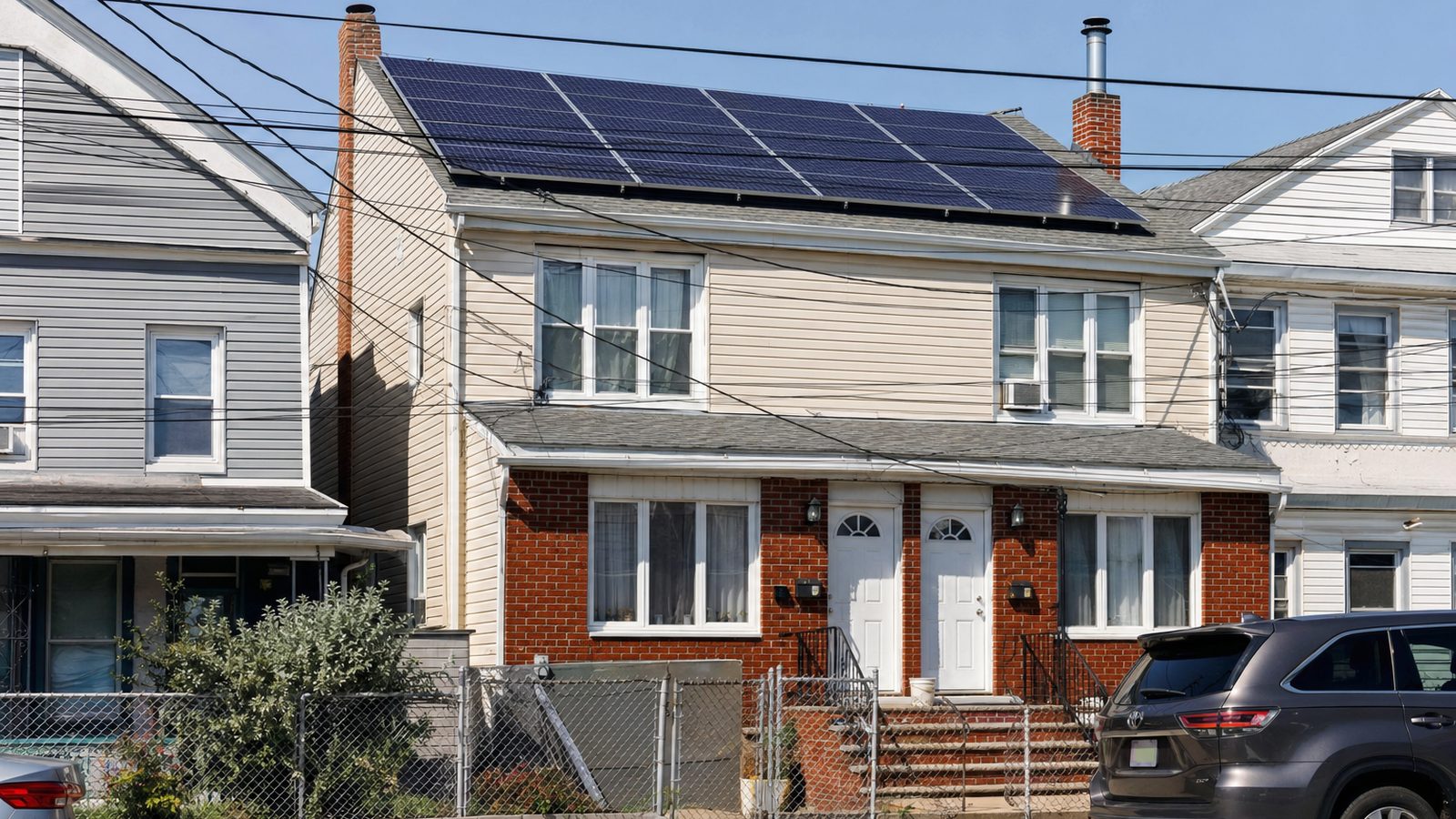
The honest counterweight: Elizabeth is a city of 45,932 households where only 25.4 percent own their homes and 18.8 percent of units are single family. The economics are among the best we have written up. The roof access is among the hardest. Both facts belong on the same page, so here they are, with every claim linked to its document.
Two revenue streams, one estimator
The calculator models the bill offset at PSE&G's documented average. SREC-II cash is deliberately left out, so real returns should beat what it shows.
Open the Elizabeth estimatorTariff No. 17, added up line by line
PSE&G's electric service roster lists the City of Elizabeth under Union County, one of thirteen counties in the company's electric footprint. Note the word electric: the city's own permit paperwork names Elizabethtown Gas as the gas utility, so everything on this page concerns the electric meter only. Across its 1,966,950 residential customers, PSE&G's 2024 EIA average came to 20.42 cents per kWh.
The consolidated Rate Schedule RS tariff shows where the money goes. A 5.63 dollar monthly service charge, 6.00 with sales and use tax. Distribution at 4.5007 cents per kWh from October through May, rising to 7.7470 cents for the first 600 kWh and 8.1291 above it from June through September. Basic Generation Service energy and capacity, effective June 1, 2026, at 12.1097 cents October through May, and BGS transmission at 6.4507 cents year round. Stack the October through May lines and a winter kilowatt hour costs 23.06 cents before riders and tax; the summer stack above 600 kWh reaches 27.36 cents. Every kWh your panels displace is worth that much.
| Energy source | Type | Average price | What that means |
|---|---|---|---|
| PSE&G RS | Service Charge | $5.63 per month | $6.00 including sales and use tax |
| PSE&G RS | Distribution, Oct to May | 4.5007¢ per kWh | Summer: 7.7470¢ first 600 kWh, 8.1291¢ above |
| PSE&G RS | BGS energy, from Jun 1, 2026 | 12.1097¢ per kWh, Oct to May | Plus BGS transmission at 6.4507¢ year round |
| PSE&G RS | Computed all in | 23.06¢ to 27.36¢ per kWh | Winter baseline to summer above 600 kWh, before riders and tax |
| Elizabeth | PVGIS output | 1,360.9 kWh per kW annually | Fixed south facing model; individual roofs differ. |
Tariff B.P.U.N.J. No. 17, transmission edition effective July 15, 2026, and EIA Table 6, 2024. The estimator further down runs on the EIA average.
The netting year, rule by rule
The legal spine is N.J.A.C. 14:8-4.3, which orders every electric distribution company and supplier to offer net metering to customers generating with class I renewables on their side of the meter, first come, first served, under a filed tariff. Three of its clauses decide your design. Sizing: generating capacity may not exceed the electricity you used over a historical 12 month period that you select, so your past bills literally set your ceiling. Carryover: monthly excess reduces the next month's bill, and credits accumulate through your annualized period. The true up: whatever excess remains at the end of that period is paid out at the avoided cost of wholesale power, a fraction of the 23 cents you were offsetting all year.
Read those rules together and the design brief writes itself. Size at or just under your own consumption, because kWh beyond it earn wholesale scraps. And since the netting runs annually, whether your panels produce at the moment you cook dinner barely matters; the year, not the hour, is the accounting unit.
Applying through PSE&G: an email address and two parts
PSE&G runs its interconnection intake by email. Level 1, systems under 10 kW, the track that fits the bulk of this city's one and two family housing, goes to CINETMETER@PSEG.com. Level 2 handles systems over 10 kW and Level 3 those over 10 kW needing special relaying or metering; both want a site plan, a line diagram, and an NREL PVWatts output with the application. The form itself has two parts, the second completed after construction, so interconnection is not finished when the racking goes up.
Before any of that, PSE&G asks applicants to run the address through its Solar Power Suitability Map to check circuit capacity. It takes minutes and it is the cheapest possible way to find out whether your block's infrastructure has room. An installer who has not done it by the second conversation is skipping steps.
77 dollars per megawatt hour, on a 15 year clock
New Jersey's second payment stream runs through the Administratively Determined Incentive program under the Successor Solar Incentive, covering net metered residential projects of 5 MW or less. Registrations are open, first come, first served, until the Energy Year 2027 residential block of 300 MW fills or June 1, 2027, whichever comes first. The current residential value is 77 dollars per SREC-II, applying to any registration that arrived on or after July 27, 2026 at 12:01 a.m. That number is fresh: a Board of Public Utilities order dated May 21, 2026 cut it from 85 dollars, a 9 percent decrease, applying to registrations submitted 60 days after the order took effect. Any Elizabeth quote still showing 85 dollars was drafted before midsummer and needs updating.
The duration is the part sales pitches undersell. Board staff state that past and present awards assume SREC-II payments hold for 15 years from award, and the order's own modeling uses that term. Scale it: a 7 kW system producing about 9,064 kWh a year generates roughly 9.06 MWh, worth about 698 dollars a year at 77 dollars per MWh, alongside roughly 2,090 dollars of retail bill value at the computed winter rate. Registration date, not installation date, sets your incentive value, which makes the registration filing a contract term worth negotiating, not an afterthought.
Two tax exemptions that work, one credit that died
The equipment arrives tax free: N.J.S.A. 54:32B-8.33 exempts sales of solar energy devices and systems, storage devices included, from New Jersey sales and use tax. Do not confuse it with Elizabeth's Urban Enterprise Zone, where eligible merchants charge a reduced 3.3125 percent rate against the statewide 6.625; the solar exemption is a separate, full exemption that follows the equipment, not the store.
The system's assessed value stays off your tax bill too. N.J.S.A. 54:4-3.113b exempts property certified as a renewable energy system, measured as the assessed value with the system minus the value without it, and the companion definitions route that certification through the municipal construction office. In Elizabeth that means the same Bureau of Construction that issues your permit, one more reason to keep that relationship tidy. What no longer exists anywhere in this stack: the federal 25D homeowner credit, which Public Law 119-21 terminated for expenditures after December 31, 2025. New Jersey's program strength is precisely why its market absorbs that loss better than most states.
One counter on Winfield Scott Plaza
Construction permitting in Elizabeth belongs to the Bureau of Construction within the Department of Planning and Community Development, which oversees all construction in the city under the State Uniform Construction Code, N.J.A.C. 5:23. The Bureau sits at 50 Winfield Scott Plaza, phone 908-820-4093, fax 908-820-4245, with Pedro L. Pons as Construction Official. The city directory splits the phone tree: 908-820-4093 for building permits and zone maps, 908-820-4026 for additions and their inspections.
Two gaps we could not close from official pages, flagged rather than papered over: no local permit fee table is publicly fetchable, and no online application portal is named anywhere on the city's construction pages. Budget a phone call to 908-820-4093 for current fees, and assume paper. For a city this size in 2026 that is genuinely unusual, and it makes an installer who already knows this counter worth something.
Who controls the roof decides who gets the 23 cents
Elizabeth grew 9.9 percent between 2010 and 2020 to 137,298 residents on 12.32 square miles of land, the largest city in Union County, with a 2025 estimate of 141,675. The ACS 2023 profile is blunt about tenure: of 45,932 households, just 25.4 percent are owner occupied, 18.8 percent of units are single family, the median household earns 63,874 dollars, and 8.9 percent heat with electricity. Three out of four households here answer to a landlord on roof questions.
We write that not to talk anyone out of solar but to aim the page correctly. If you hold the deed to a one or two family home here, you occupy one of the better solar positions in the Northeast and the sections above are your checklist. If you rent, the owner captures the incentives, and your leverage is showing them this math. Third party ownership deals are common in markets like this one; the questions that matter are in the calculator notes below.
The production curve the netting year absorbs
Our Elizabeth PVGIS run comes out at 1,360.9 kWh per installed kW over the year. July leads at 139.1 kWh per kW, December trails at 74.6, and the annual netting rules exist precisely so that gap becomes a bookkeeping detail instead of a December bill shock. Summer overproduction banks at retail value and drains through the dark months.
July models 139.1 kWh per kW against December's 74.6. Banked summer credit covers the winter under New Jersey's annualized netting.
PVGIS v5.2 model run by Solar Learning Lab on August 31, 2026, NSRDB radiation database. Fixed south facing mount, 30 degree tilt, 14 percent losses, downtown Elizabeth coordinates. Your roof will differ. Tool documentation at PVGIS.
Installers serving Union County
Our Elizabeth pull surfaced a bench that includes a firm headquartered in the city itself. Questions that separate serious proposals here: the exact date the ADI registration will be filed and at what incentive value, whether the SREC-II revenue stays with you or the company, whether the system size matches your trailing 12 months of usage, and whether the quote includes a confirmed Bureau of Construction fee or a placeholder.
Ratings snapshot: Google Maps, August 2026, via the DataForSEO SERP feed. Zero companies paid us and none are endorsed by us.


Walker Power
5.0(25 Google reviews)
Ceads Energy
5.0(21 Google reviews)
State Solar
5.0(7 Google reviews)
Ratings and review counts are Google Maps ratings for Elizabeth local results, retrieved August 17, 2026 via the DataForSEO SERP API. We list the highest rated established companies we found. No company paid to appear here, and appearing here is not an endorsement. Check current reviews and licensing before you sign anything.
Price the offset; the SREC-II rides on top
The estimator handles the retail offset at PSE&G's 20.42 cent 2024 average against our Elizabeth production run. It excludes SREC-II income on purpose. An estimate that undersells reality by a known margin is more useful than one tuned to impress.
The ceiling is our fixed south facing Elizabeth model, 1,360.9 kWh per kW. July models 139.1 kWh per kW and December 74.6, and New Jersey's annual netting cycle is built to absorb exactly that spread.
Cash quotes in Elizabeth cluster near $2.70 per watt, against a $3.50 national 2024 median (LBNL). Use your quote.
Assumptions you can change
Use the rate on your actual lease or PPA quote. There is no published statewide average we trust enough to hardcode.
Cash purchase
$14,850 after state credit
- Year 1 benefit
- $127/mo
- Payback
- 9 years
- 20 year net position
- $22,241
The calculator models the bill offset only. It excludes the SREC-II payment of 77 dollars per MWh that a registered Elizabeth system also earns for 15 years, and it excludes the sales tax exemption on the equipment. Real returns should land above what it shows.
Solar loan
$193/mo 15 yr payment
- Year 1 net
- -$65/mo
- Upfront
- $0
- 20 year net position
- $2,387
Loan pricing uses the New Jersey state configuration. SREC-II payments only begin after registration and commercial operation, so do not let a lender or salesperson count them against loan payments from day one.
Lease / PPA
$0 down you buy the power
- Year 1 net
- -$22/mo
- Upfront
- $0
- 20 year net position
- -$4,408
In a city where three quarters of households rent, third party ownership is common. If a company owns the system on your roof, get in writing who receives the SREC-II payments and how the annual net metering true up is settled.
Estimates, not quotes. Production is our Elizabeth PVGIS run and the rate is PSE&G's 2024 EIA average; SREC-II income and tariff riders are not modeled. We are a solar installer and we also partner with other solar companies. See our disclosures.
Elizabeth questions, answered from the documents
What is the current SREC-II value for a new Elizabeth system?
Does PSE&G credit solar at the full retail rate?
How large a system am I allowed to install?
Is there still a rush on the incentive block?
Do I pay sales tax on the equipment, or higher property taxes after?
Where do permits happen and what do they cost?
Records
Reviewed September 1, 2026. This is our second New Jersey city, researched and written independently of the Paterson coverage. Elizabeth's fee ordinance is hosted on a site that blocks automated readers, which is why no local fee figure appears above.
- Bureau of Construction, city directory, and the permit checklist naming the Bureau's address and officials
- PSE&G service territory, Tariff B.P.U.N.J. No. 17, and the interconnection application process
- N.J.A.C. 14:8-4.3, ADI program, and the May 21, 2026 Board order
- Sales tax exemption, property tax exemption, and its definitions section
- IRS on the 25D termination, EIA Table 6, Elizabeth background, and Census ACS 2023
Get an Elizabeth quote with the registration date in it
The 77 dollar value is set by when the paperwork lands, so make the ADI filing date and the SREC-II owner explicit contract terms. We are a solar installer and we also partner with other solar companies. Read our disclosures.
What does your monthly electric bill look like?
Elizabeth average is $167 per month (EIA, 2024).