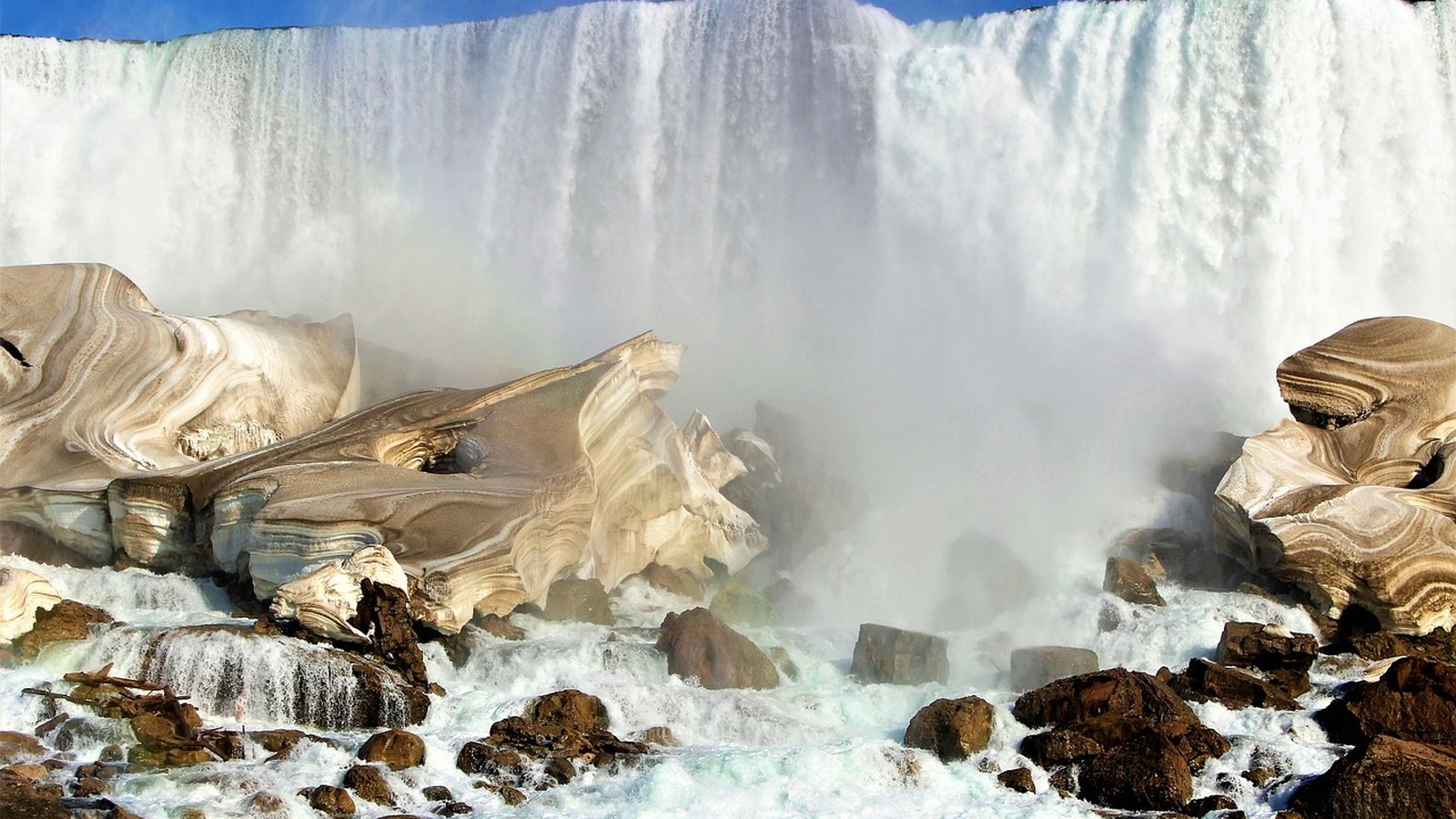
Photo: Chun-San, via Pixabay
New York · Buffalo
Solar in Buffalo: the snow is real, and so is the math
Written by the Solar Learning Lab research deskUpdated September 1, 202612 min read
Buffalo averages 95.4 inches of snow a year and sees 49 percent of possible sunshine. Nobody should sell you solar here without saying that out loud first. Our PVGIS model puts a Buffalo roof at 1,191.5 kWh per installed kW annually, and December contributes 42.9 of those kWh against 145.1 in July. That is the honest starting point, and it is workable, because National Grid credits carry summer surplus forward and New York still pays a 25 percent state tax credit on the system.
What has changed for 2026: the federal homeowner credit is gone, the NY-Sun upstate residential rebate blocks are fully allocated, and the New York City property tax abatement that national sites keep quoting has never applied here. What is left is a shorter list, but a real one, and this page walks it with the program documents attached.
Skip to the working numbers
The estimator uses Niagara Mohawk's documented 2024 average rate and our Buffalo production run, with the 25 percent state credit modeled.
Open the Buffalo estimatorDecember against July, in actual kilowatt hours
Write the winter off before it surprises you. January in Buffalo averages 26.7 inches of snow and December 25.3, lake effect bands off Lake Erie can bury a neighborhood while the next one stays clear, and a single November 2014 storm dropped over 66 inches. Fox Weather ranks Buffalo among the top five snowiest large cities in the country. Panels shed snow on their own eventually, but a mid winter week of covered modules is a normal Buffalo event, not a defect.
December models 42.9 kWh per kW, less than a third of July's 145.1. Summer credit banking is what makes the annual picture work.
PVGIS v5.2 model run by Solar Learning Lab on August 31, 2026, NSRDB radiation database. Fixed south facing mount, 30 degree tilt, 14 percent losses, downtown Buffalo coordinates. Your roof will differ. Tool documentation at PVGIS. The five months from May through September do most of the year's work, which is exactly why the billing structure in the next two sections matters more here than in an even climate.
The National Grid bill you are offsetting
Buffalo sits in National Grid's Load Zone A, Sub-Zone 1, the Frontier region. The company, operating upstate as Niagara Mohawk since acquiring it in 2000, serves about 1.7 million upstate electric customers across 25,000 square miles and plans full smart meter deployment by 2027. Residential service under rate SC-1 carries a 19.00 dollar monthly basic charge and a 10.013 cent per kWh delivery charge, with supply priced separately at a market rate that moves monthly. Across all of it, the 2024 EIA average for Niagara Mohawk residential service is 17.22 cents per kWh over 1,430,208 customers.
One boundary check before you quote anything: NYSEG serves 924,544 electric customers in 44 counties, more than 40 percent of upstate New York, including areas near Buffalo. The city itself is National Grid, but a suburban address might not be, and the two utilities carry different rates and different solar charges. Confirm from the bill, not the zip code.
| Energy source | Type | Average price | What that means |
|---|---|---|---|
| National Grid | 2024 residential average | 17.22¢ per kWh | EIA Table 6, Niagara Mohawk, 1,430,208 customers |
| National Grid SC-1 | Basic Service Charge | $19.00 per month | Fixed; solar does not reduce it |
| National Grid SC-1 | Delivery charge | 10.013¢ per kWh | Supply is a separate monthly market price |
| Buffalo | PVGIS output | 1,191.5 kWh per kW annually | Fixed south facing model; individual roofs differ. |
EIA Table 6, 2024 and National Grid upstate service rates. The estimator later on this page runs on the EIA figure.
How exports get credited, and the monthly charge nobody mentions
New York compensates rooftop solar under the Public Service Commission's Value of Distributed Energy Resources framework, which builds bill credits from energy, capacity, environmental, demand reduction, and locational values. The same April 18, 2019 order preserved eligibility for Phase One Net Metering, the simpler kWh for kWh arrangement most residential systems still take. Your installer files the interconnection; your job is to know which of the two structures the proposal assumes, because the credit math differs.
Either way, a new system pays something for the privilege. Niagara Mohawk's Statement No. 7, effective January 1, 2026, sets the Customer Benefit Contribution for SC-1 solar at 0.97 dollars per kW DC per month for Phase One net metered projects and 0.49 dollars for Value Stack projects. On a 7 kW DC roof under net metering that is 6.79 dollars a month. The charge applies to systems interconnected on or after January 1, 2022 and funds low income, efficiency, and clean energy programs; NYSERDA's 2026 statewide table confirms the National Grid values. Small money, but proposals that omit it are rounding in their own favor.
Three incentives that work here, and one that never did
Start with what is gone. Public Law 119-21 ended the Section 25D federal residential credit for expenditures after December 31, 2025, and a March 12, 2026 NYSERDA presentation confirms the NY-Sun upstate residential blocks, including Affordable Solar, are fully allocated. A 2026 Buffalo buyer gets no federal credit and no upfront state rebate. The same presentation notes Green Jobs Green New York financing remains open, which is the practical answer to the upfront money question.
Now the working trio. First, the New York solar equipment credit: 25 percent of qualified expenditures, capped at 5,000 dollars, claimed on Form IT-255, nonrefundable with a five year carryover. It is unusually flexible, covering purchased systems, leased systems, and power purchase agreements of at least ten years. Second, the 4 percent state sales tax exemption on residential solar sale and installation under Tax Bulletin ST-776, with local sales tax treatment varying by jurisdiction per Publication 718-S. Third, RPTL 487 exempts the value a solar system adds from property taxation for fifteen years, and the state opt out list shows neither the City of Buffalo nor the Buffalo City School District opted out. Erie County opt outs are limited to the towns of Boston, Clarence, Marilla, and Sardinia, the village of Angola, and several suburban school districts, so check that list if you are reading this from outside the city line.
The myth: the property tax abatement that pays 7.5 percent of installation cost yearly for four years exists under RPTL 499-bbbb, and its first eligibility condition is that the property must be located in New York City. Any Buffalo pitch that includes it is either careless or copied. Either way, keep your guard up for the rest of the document.
City Hall, Room 313, and the days that matter
Permits run through the Department of Permit and Inspection Services, 65 Niagara Square, Room 313 of City Hall, reachable at 716-851-4290 for permits, with electrical questions to Lance Chandler at 716-851-9696. Applications flow through the ePermits portal, with contractor registration handled in Room 301 or online. Since October 1, 2025, in person applications require appointments on Tuesdays and Thursdays, and walk ins run Monday, Wednesday, and Friday for those who arrive before 9:00 a.m. Plan the counter trip like a flight.
The electrical fee schedule is friendly to houses: a 50 dollar application fee on all electrical permits, and a flat 50 dollars covering permit and inspection for a one family dwelling when no plans are required, 75 for a two family. When plans are required, add 100 dollars of plan review plus an area based fee of at least 50 dollars and 25 dollars per meter. The schedule's 3.00 dollar per panel line applies to commercial solar only; no residential solar surcharge exists. Two Buffalo specific gates deserve respect: properties in historic districts or designated buildings need Preservation Board approval before a permit issues, and everything must comply with the Buffalo Green Code, the city's form based land use ordinance. In a city with this much pre war housing stock, the Preservation Board step is not a corner case.
Old houses, few driveways, and who actually owns the roof
Buffalo counted 278,349 residents in 2020, the second largest city in New York, with an estimated 274,613 in 2025. The ACS 2023 numbers describe the housing fabric solar has to fit: 119,548 households, owner occupancy at 42.7 percent, single family units at 39.5 percent, a median household income of 48,050 dollars, and electric heat in just 9.4 percent of homes. Around 30 percent of households were car free in 2015 against a national average of 8.7 percent, a tell for how old and dense this city's neighborhoods run.
The practical read: most Buffalo residents rent or share a structure, so the owner occupied doubles and singles that can go solar are a minority of the market, and the low electric heat share means winter bills here are mostly a gas story that solar will not touch. For the households that do control a roof, the IT-255 credit covering leases and long PPAs is the detail worth knowing, because third party ownership is how a 48,050 dollar median income market usually gets to yes.
Installers working Western New York
Our Buffalo pull returned a full bench, including firms headquartered in the city and the inner suburbs. Sorting questions that fit this market: does the proposal state Phase One net metering or Value Stack, does it include the 0.97 dollar per kW monthly CBC in the cash flow, does it model December honestly, and who files the Preservation Board paperwork if your block needs it.
Ratings snapshot: Google Maps, August 2026, via the DataForSEO SERP feed. Zero companies paid us and none are endorsed by us.

NOCO Residential: HVAC, Fuels, and Energy
Tonawanda, NY
4.8(532 Google reviews)
NextEra Energy Services, Formerly New Wave Energy
Buffalo, NY
4.0(447 Google reviews)
VSG Power
Buffalo, NY
5.0(29 Google reviews)
Ratings and review counts are Google Maps ratings for Buffalo local results, retrieved August 17, 2026 via the DataForSEO SERP API. We list the highest rated established companies we found. No company paid to appear here, and appearing here is not an endorsement. Check current reviews and licensing before you sign anything.
Estimate a Buffalo system
The estimator below runs Niagara Mohawk's 17.22 cent 2024 average against our Buffalo production model and applies the 25 percent state credit up to its 5,000 dollar cap. It does not subtract the monthly CBC charge or model snow beyond PVGIS's standard losses, so shade the output slightly downward in your head rather than upward.
The upper bound is our south facing Buffalo model, 1,191.5 kWh per kW. December models 42.9 kWh per kW against 145.1 in July, a swing of more than three to one, so annual credit banking matters more here than the annual total.
Cash quotes in Buffalo cluster near $2.76 per watt, against a $3.50 national 2024 median (LBNL). Use your quote.
Assumptions you can change
Use the rate on your actual lease or PPA quote. There is no published statewide average we trust enough to hardcode.
Cash purchase
$17,632 after state credit
- Year 1 benefit
- $140/mo
- Payback
- 10 years
- 20 year net position
- $23,196
The 25 percent New York credit, capped at 5,000 dollars, is modeled. Not modeled: the NY-Sun upstate residential rebate, because those blocks are fully allocated, and the Customer Benefit Contribution charge of 0.97 dollars per kW DC per month that new net metered systems pay National Grid.
Solar loan
$247/mo 15 yr payment
- Year 1 net
- -$107/mo
- Upfront
- $0
- 20 year net position
- -$3,619
Loan pricing uses the New York state configuration. Green Jobs Green New York financing remains open even with the upstate rebate blocks exhausted, so compare any dealer loan against it.
Lease / PPA
$0 down you buy the power
- Year 1 net
- -$55/mo
- Upfront
- $0
- 20 year net position
- -$13,341
New York's IT-255 credit is unusual: it covers leased systems and power purchase agreements of at least ten years, not just purchases. If a third party owns your Buffalo system, ask who claims the 25 percent credit before you sign.
Estimates, not quotes. Production is our Buffalo PVGIS run and the rate is Niagara Mohawk's 2024 EIA average. Snow losses beyond the model, the monthly CBC charge, and VDER credit values are not fully modeled. We are a solar installer and we also partner with other solar companies. See our disclosures.
Buffalo questions, answered from the documents
Does solar even make sense with Buffalo snow?
Can I still get a NY-Sun rebate in 2026?
What is the 25 percent state credit worth, and who qualifies?
Will solar raise my property taxes?
What is the Customer Benefit Contribution charge?
What about the property tax abatement I saw online?
Paper trail
First upstate New York city page on this site, reviewed September 1, 2026. Every figure above traces to one of these documents.
- Permit office, permit process, department overview, electrical permit application, electrical fee schedule, and ePermits portal
- National Grid load zones, SC-1 service rates, CBC Statement No. 7, NYSERDA utility profile, and NYSEG service area
- VDER framework, 2026 CBC rate table, NY-Sun block status, and upstate dashboard
- IT-255 credit, sales tax bulletin, RPTL 487, opt out list, RPTL 499-bbbb, and NYC program page
- IRS guidance on the 25D repeal, EIA Table 6, Buffalo background, and Census ACS 2023
Get a Buffalo quote that survives a Buffalo winter
Make the installer show December in the production table, name the CBC charge, and state which credit structure applies. We are a solar installer and we also partner with other solar companies. Read our disclosures.
What does your monthly electric bill look like?
Buffalo average is $167 per month (EIA, 2024).