Skip to content
Solar Learning Lab
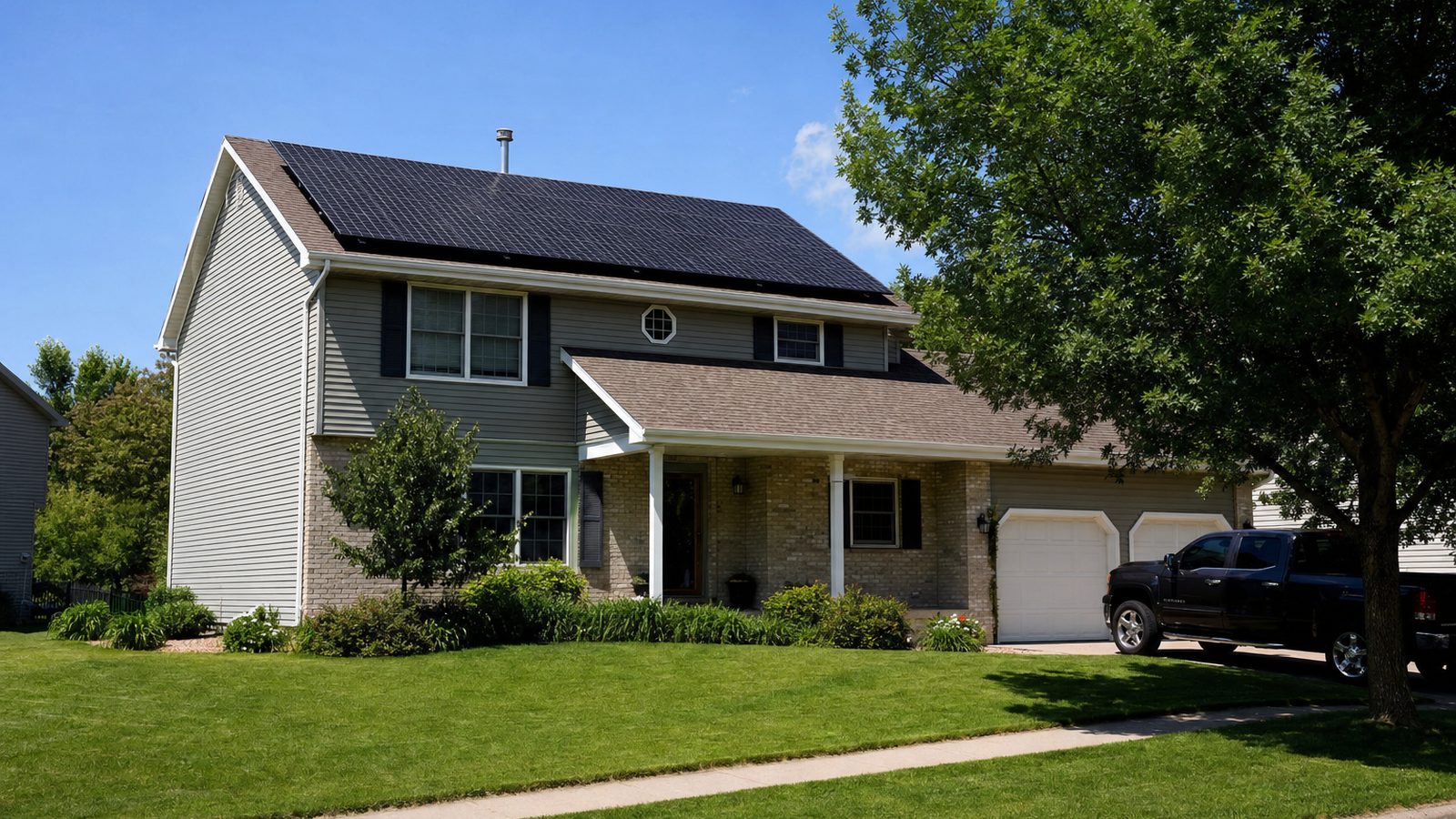
Rooftop solar panels on a single family home in Sioux Falls, South Dakota

south dakota / Sioux Falls

Sioux Falls solar runs on a different rulebook

Written by the Solar Learning Lab research deskUpdated September 1, 202612 min read

This is the first South Dakota city page on this site, and the state's market structure is the story. There is no net metering here. Exports earn Xcel's filed avoided cost, 3.16 cents per kWh on the occasional delivery schedule, so the winning design covers the household load and stops. PVGIS production source.

Model a load-matched Sioux Falls system

The calculator below values production at retail, which is only honest for the energy you consume yourself. Read the export sections first.

Go to the calculator

The PUC says it in plain words: no net metering

Start with the fact that reorders every other number on this page. The South Dakota PUC states that South Dakota does not compensate solar generation at a net metered rate. PUC regulated utilities must interconnect your system and purchase its output, but the minimum purchase rate is the utility's avoided cost, its incremental cost of energy and capacity, filed with the commission. And because SDCL 49-34A-42 assigns service territories, you cannot shop your way to a better deal from another provider. Whatever your serving utility filed is what an exported kilowatt hour earns. Most of the sales scripts written for net metering states quietly assume retail rate exports. In Sioux Falls that assumption is wrong on day one.

Sources: pucFaq

Sioux Falls is not one utility, check the address

The PUC's list of utilities serving each community puts Sioux Falls under both Sioux Falls Municipal Power and Light and the Xcel Energy, Sioux Valley Energy, and Southeastern Electric Cooperative entry, so the answer depends on where the house sits. Xcel dominates: it reported 92,204 South Dakota residential customers in 2024, which dwarfs the municipal system's roughly 2,900 customers plus about 23,000 streetlights, running on power purchased from WAPA supplemented by Heartland Energy. Cooperative territory rings the city, and Sioux Valley averaged 12.935621 cents per residential kWh in 2024. Export terms, metering charges, and interconnection rules differ by provider. Confirm who serves the meter before you believe anything in a quote, including this page's Xcel numbers.

Sources: serviceList, muni, eia

What Xcel actually pays for an exported kWh

Xcel's filed small qualifying facility schedules, Docket EL25-025, effective January 1, 2026, put dollar figures on the export question. Rate Code E50, the occasional delivery schedule, pays 3.16 cents per kWh, charges $3.75 per month for metering on single phase service, caps compensation at 2,000 kWh delivered per month with anything above that uncompensated, and carries a 12 month minimum contract term. Rate Code E52, the time of delivery option, pays 3.97 cents on peak and 2.72 cents off peak, adds a capacity payment of 0.82 cents per on peak kWh for firm power that passes a 65 percent on peak capacity factor test, and charges $4.75 per month for metering. Set those against Xcel's 2024 South Dakota residential average of 13.865791 cents per kWh and the design brief writes itself.

Sources: e50, e52, eia

Size to the load, then put the pencil down

A kilowatt hour you use behind the meter is worth retail, near 13.9 cents. A kilowatt hour you export earns 3.16 cents on E50, and past 2,000 kWh in a month it earns nothing at all. That ratio, better than four to one, is the whole design problem. The system that wins here matches daytime consumption, not roof area. Interconnection itself is not the obstacle: Xcel's South Dakota manual, built on PUC rule chapter 20:10:36, runs four tiers, and Tier 1 covers lab tested inverter systems of 10 kW AC or less with a $50 application fee. The paperwork is cheap. Oversizing is what gets expensive, one uncompensated kilowatt hour at a time.

Sources: e50, interconnection, eia

Permitting is the cheap line item

City of Sioux Falls Building Services works out of the first floor of City Center at 231 N. Dakota Avenue, Monday through Friday 8 a.m. to 5 p.m., main line 605-367-8670, with applications filed through the city's CSS online portal. Building permit fees start at $40 and scale with construction value; on the 2023 residential schedule a project valued near $25,000 prices out around $170.50. Work must begin, with an inspection requested, within 180 days of issuance. Residential electrical work requires a contractor holding a Class B Electrical License, and municipal code section 150.213 pulls a rooftop PV interconnection into the electrical permit requirement. One trap: zoning section 159.302 reads like a solar ordinance but governs commercial scale systems only. It has no residential rooftop provisions.

Sources: permits, feeSchedule, electricCode, zoning

The incentive that survives is a tax you will not pay

South Dakota offers no state solar rebate and no state tax credit anywhere in the record for this page; the PUC's solar FAQ describes only two things, the avoided cost purchase obligation and a property tax exemption. That exemption has teeth. SDCL 10-4-44 exempts the greater of the first $50,000 of assessed value or 70 percent of the assessed value of a renewable energy facility under 5 MW from real property tax, and SDCL 10-4-45 keeps such property out of discretionary assessment formulas. For a typical residential array that means effectively no property tax increase, in statute rather than in a brochure. On the federal side, the 25D homeowner credit was terminated by P.L. 119-21 for expenditures after December 31, 2025, and the CRS notice does not address third party ownership, so no lease credit claim appears here.

Sources: pucFaq, propertyTax, federal

Snow is real, the resource holds up anyway

Sioux Falls averages 45.3 inches of snow across roughly 32.8 snowy days, with 8.0 to 8.7 inches per month from December through February, and a January daily mean of 17.9 F. That is racking and tilt territory, and it is why December models at 72.1 kWh per kW while July models at 157.4. But the annual resource is better than the winters suggest: modeled in plane irradiation runs 1,907.79 kWh per square meter per year, higher than many Midwest peers. The city is also growing fast, from 66,283 housing units in 2010 to 83,504 in 2020, so a large share of local roofs are new construction with clean framing for an installer to work with.

Sources: profile
The monthly production curve

The downtown Sioux Falls PVGIS run totals 1413.1 kWh per kW annually. July leads at 157.4 kWh per kW and December trails at 72.1, a summer heavy shape that pairs well with air conditioning load and poorly with a strategy built on winter exports. Treat the curve as a location model, not a shade study.

Jan
Feb
Mar
Apr
May
Jun
Jul
Aug
Sep
Oct
Nov
Dec

July is the modeled peak. Snow cover pulls the December through February bars down, which the 14 percent loss assumption only partly captures.

PVGIS v5.2. PVGIS v5.2 NSRDB, run by Solar Learning Lab on August 31, 2026, 30 degree tilt, 14 percent losses, downtown coordinates. Your roof will differ.

Rate benchmark for the model

Energy sourceTypeAverage priceWhat that means
South Dakota benchmarkResidential electricity15.73¢ calculator inputTable 5.6.A, May 2026
Xcel Energy SD, 2024 averageResidential electricity13.9¢ per kWhEIA Table 6, 2024 bundled retail sales, 13.865791 cents. The prose above uses this as the retail reference.
Xcel E50 export rateExported solar3.16¢ per kWhFiled avoided cost, effective January 1, 2026, capped at 2,000 kWh per month.

Retail average from EIA Table 6; export rate from the filed E50 schedule. The gap between those two rows is the argument for sizing to load.

The short installer list

Our Sioux Falls snapshot surfaced exactly two companies, and each carries a single Google review, one at five stars and one at one star. A sample of one is noise, not a track record, so treat both cards as directory entries to investigate rather than rankings, and widen the interview list beyond them. Whoever bids, make them show you the E50 or E52 schedule their production model assumes and the interconnection tier they will file under.

Ratings snapshot: Google Maps, August 2026, via the DataForSEO SERP feed. Zero companies paid us and none are endorsed by us.

Christo Energy

5.0(1 Google reviews)

Peppermint Energy

Sioux Falls, SD

1.0(1 Google reviews)

Ratings and review counts are Google Maps ratings for Sioux Falls local results, retrieved August 17, 2026 via the DataForSEO SERP API. We list the highest rated established companies we found. No company paid to appear here, and appearing here is not an endorsement. Check current reviews and licensing before you sign anything.

Run the self consumption math

This model values every kilowatt hour at the benchmark retail rate. That is a fair approximation only for a system whose output the household actually consumes. Discount the result mentally for any design that exports heavily, because 3.16 cents is not 13.9.

$128
1,413

The upper input is the downtown Sioux Falls PVGIS run at 1413.1 kWh per kW. The lower input is 85 percent of that run, a planning floor for snow shading and imperfect roof geometry, not a site study.

$3.77

Cash quotes in Sioux Falls cluster near $3.77 per watt, against a $3.50 national 2024 median (LBNL). Use your quote.

Assumptions you can change
2.5%
7%
15
24c

Use the rate on your actual lease or PPA quote. There is no published statewide average we trust enough to hardcode.

2%
Estimated system: 6.9 kWAnnual usage: 9,765 kWhState credit: $0

Cash purchase

$26,013 after state credit

Year 1 benefit
$128/mo
Payback
15 years
20 year net position
$11,206

In Sioux Falls the calculator's retail rate treatment flatters exports. Xcel's filed E50 schedule pays 3.16 cents per exported kWh, so a system that leans on exports will land below this model.

Solar loan

$308/mo 15 yr payment

Year 1 net
-$180/mo
Upfront
$0
20 year net position
-$18,263

Financing uses the South Dakota cost inputs already in the state calculator, not a Sioux Falls specific lender offer. Dealer fees change financed pricing.

Lease / PPA

$0 down you buy the power

Year 1 net
-$67/mo
Upfront
$0
20 year net position
-$16,839

The CRS notice on the 25D sunset does not address third party ownership, so we make no claim about lease or PPA federal credits here. Read the contract's export and payment terms against Xcel's filed schedules.

Estimates, not quotes. Inputs use the stated EIA benchmark rate, the Solar Learning Lab PVGIS run for Sioux Falls, and state cost benchmarks. Avoided cost export treatment, the serving utility at your address, permits, and roof condition are not modeled. We are a solar installer and we also partner with other solar companies. See our disclosures.

Sioux Falls questions

Does South Dakota have net metering?
No. The PUC states that South Dakota does not compensate solar generation at a net metered rate. Utilities purchase exports at their filed avoided cost. SD PUC solar FAQ.
What does Xcel pay for exported solar in Sioux Falls?
Rate Code E50 pays 3.16 cents per kWh with a $3.75 monthly metering charge, a 2,000 kWh monthly compensation cap, and a 12 month minimum term. The E52 time of delivery option pays 3.97 cents on peak and 2.72 cents off peak. Filed E50 schedule.
Will panels raise my property taxes?
SDCL 10-4-44 exempts the greater of the first $50,000 of assessed value or 70 percent of assessed value for renewable systems under 5 MW, which for a house level array means effectively no increase. SDCL 10-4-44.
What does the city permit cost?
Building permit fees start at $40 and scale with valuation; a project valued near $25,000 prices out around $170.50 on the 2023 residential schedule. 2023 fee schedule.
Which utility serves my address?
It varies inside the city. The PUC's serving list shows Sioux Falls under the municipal system and under Xcel, Sioux Valley, and Southeastern territory. Most addresses are Xcel, but confirm before quoting terms. PUC serving list.

Federal status: the residential 25D credit was terminated for expenditures after December 31, 2025, and installation completion sets the expenditure date. Congressional Research Service.

Talk through a Sioux Falls project

Bring a year of bills so the sizing conversation starts from consumption. We are a solar installer and we also partner with other solar companies. Read our disclosures.

What does your monthly electric bill look like?

South Dakota average is $167 per month (EIA, 2024).