Skip to content
Solar Learning Lab
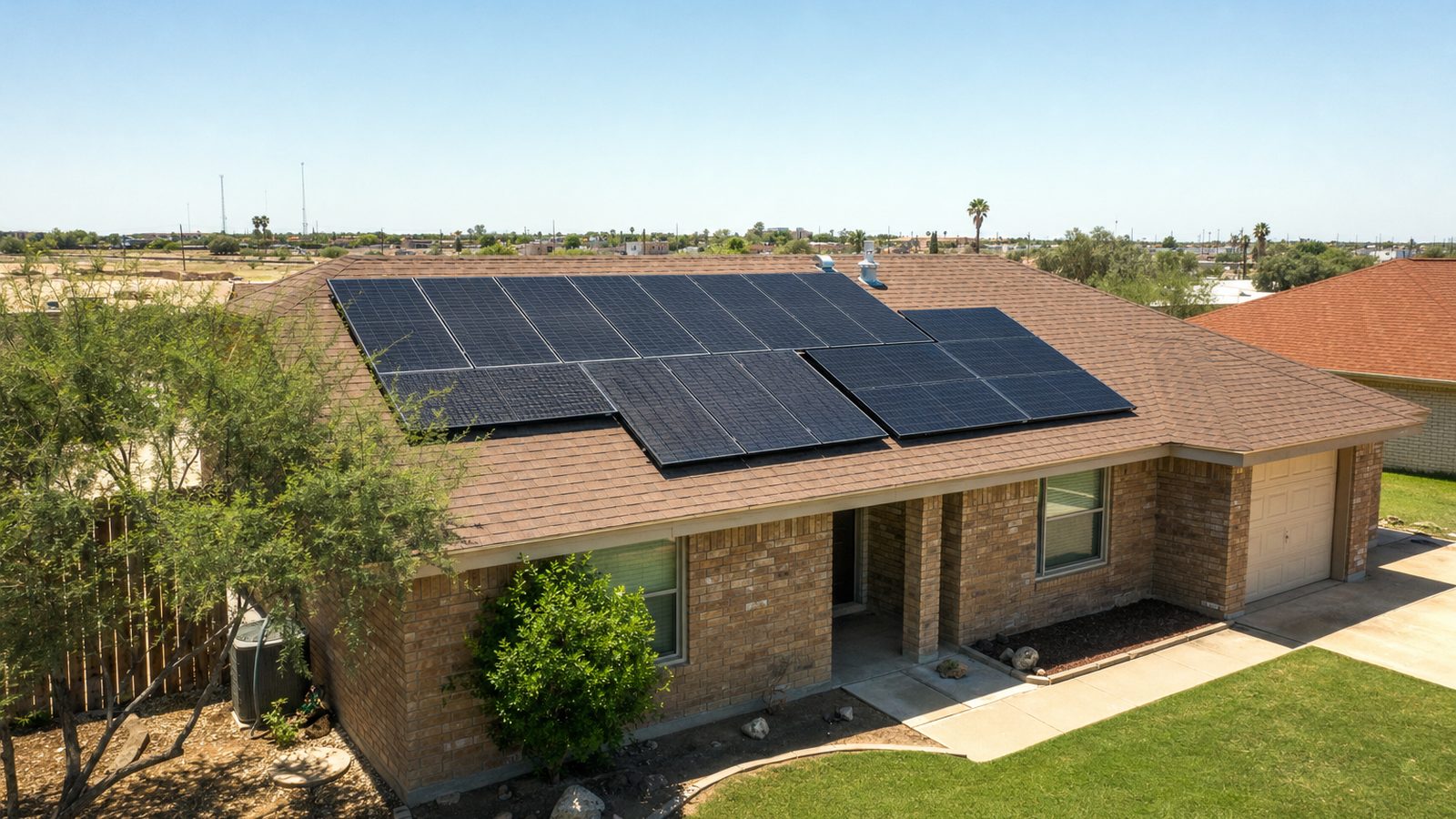
Residential rooftop with solar panels in bright southern sunlight

texas / Laredo

Laredo solar: a $200 permit and a buyback you shop for

Written by the Solar Learning Lab research deskUpdated August 30, 202612 min read

Laredo runs on deregulated ERCOT retail: AEP Texas owns the wires, a retail provider of your choosing sells the energy, and in October 2024 the city council gave rooftop solar its own $200 permit. Getting all three pieces sequenced correctly is most of the job. PVGIS production source.

Two approval tracks, one calendar

City permit and AEP Texas interconnection run in parallel. See how the numbers land before either clock starts.

Try the estimator

October 2024 gave solar its own fee

Most Texas cities bury rooftop solar inside their electrical permit schedules. Laredo went the other way. On October 28, 2024, the council approved Ordinance 2024-O-247, establishing a dedicated $200.00 non-refundable solar panel permit fee for commercial and residential construction, per the Legistar record and the Building Development Services requirements page. A Solar Panel permit is required for all installations or alterations of electrical equipment before work starts, and the department references a Solar Permitting Checklist alongside it.

Two readings of that fee, both fair. It costs more than the token permits some cities charge. It also means the counter staff at 1413 Houston St. have a defined lane for solar rather than improvising from the general electrical rules, and a defined lane is worth something when your installer is trying to predict a timeline. Applications flow through the Click2Gov Building Permits portal, with Avolve electronic plan review for projects touching two or more departments. New projects follow the 2021 Building Code, residential work under the International Residential Code. Permit questions: (956) 794-1625, option 3.

Who delivers versus who bills

Laredo sits inside AEP Texas territory, a regulated delivery company covering 97,000 square miles of south and west Texas with more than one million meters, headquartered regionally in Corpus Christi, per the company profile. AEP Texas moves the electricity and maintains the lines. It sells you nothing. The bill comes from a competitive retail electric provider you pick, and that split is not cosmetic: EIA's 2024 Table 6 has no bundled residential rate row for AEP Texas Central at all, because a wires-only utility has no retail sales to report, per EIA.

For market context only, the biggest statewide retail providers in that table cluster around 17.4 to 18.8 cents per kWh: TXU at 18.7, Reliant at 17.4, Ambit at 18.8, Green Mountain at 17.5, Gexa at 18.1. None of those figures is a Laredo price. Your price is whatever offer you signed, which is exactly why a solar proposal here should open with your current plan documents, not a state average. On the hardware side, one detail simplifies life: solar customers keep a single advanced meter, reprogrammed to record both draw and surplus, per the AEP Texas solar page. No second meter to schedule.

Surplus power has no guaranteed buyer

Say it before the contract stage, because afterward it hurts: nothing in Laredo obligates anyone to pay for the kWh your roof exports. AEP Texas puts the warning on its own solar page, noting providers compensate excess energy differently and a customer may not be compensated at all if the provider offers no buyback program. Utilities Code 39.916 says the same in statute, a provider is not required in all circumstances to purchase surplus electricity, per the code.

So treat buyback as a shopping task with a deadline before the design is final. If your chosen plan pays for exports, oversizing modestly can make sense. If it pays nothing, the design should chase self-consumption instead, and in this city self-consumption is easy to find: 83.9 percent of Laredo households run electric heat per the 2023 ACS estimates, and the air conditioning season stretches most of the year. A house that consumes its own solar at 3 p.m. in August does not need a generous export rate to justify the array. It needs an honest load profile.

City track, utility track, one project

Two clocks run at once here, and both must finish before exports earn anything. Track one is the city: Solar Panel permit before work starts, checklist, licensed electrical work, city inspection, all through Building Development Services, open weekdays 8:00 a.m. to 5:00 p.m. Track two is AEP Texas: interconnection application submitted before installation, approval, install, inspection, then the signed interconnection agreement.

The utility publishes its own tempo, and it is worth writing into the contract. Interconnection agreement and permission to operate within 30 days of receiving the application. Meter reprogramming within 15 days of permission to operate. Load profile updates so surplus data reaches your retail provider within 30 to 60 days, per the AEP Texas process page. The quick start guide adds the operational details: 90 to 95 percent of completed applications clear first review, a 35 day approval target, a required AC disconnect switch, post-installation field verification, and a distributed generation line at 361-881-5333. An installer who cannot recite this sequence has not done many AEP Texas jobs.

The homestead permit carve-out

Laredo's rules include a wrinkle Lubbock and most big Texas cities lack: a homeowner may act as their own contractor and pull their own permit for their homestead, per the requirements page. Before anyone plans a weekend self-install, read the other half of the same page. Electrical permits require a licensed professional, and a rooftop PV system is electrical work from the first conductor. The realistic use of the carve-out is a homeowner managing their own project while hiring a licensed electrician for the wiring scope, which can trim cost for the hands-on minority but adds coordination risk. For everyone else, the carve-out is trivia and the licensed route is the path.

74 triple-digit afternoons

Laredo averages 74.2 afternoons per year at or above 100 F, with an August daily mean of 89.1 F and an all-time record of 115 F, most recently hit June 19, 2023, per the city climate record. Freezing mornings average 4.6 a year. Translation for solar economics: the consumption side of the ledger is enormous and concentrated in exactly the hours a south facing array produces. That alignment is Laredo's quiet advantage over milder markets where midday generation and evening consumption miss each other. It also means heat-tolerant equipment specs and attic-side ventilation deserve a line in the bid review, since panel output tapers as cell temperature climbs, and this border city supplies more hot cells than almost anywhere in the state.

Measured yield on the border

Heat is not irradiance. Our PVGIS run puts Laredo at 1609.7 kWh per installed kW annually, with August the strongest month at 151.6 kWh per kW and December the floor at 112.3. Set that against the 1789.9 our identical model produces for Lubbock: south Texas humidity and cloud cover cost real output despite the higher temperatures. Any pitch quoting West Texas production numbers for a Webb County roof is inflating the model before the shade study even starts.

Jan
Feb
Mar
Apr
May
Jun
Jul
Aug
Sep
Oct
Nov
Dec

August peaks here, unlike the spring peak further north. Humid gulf air flattens the spring shoulder.

PVGIS v5.2. PVGIS v5.2 model run by Solar Learning Lab on August 30, 2026, NSRDB radiation database. Fixed south facing mount, 30 degree tilt, 14 percent losses, downtown Laredo coordinates. Your roof will differ.

What August 2025 taught about outages

On August 13, 2025, wind gusts near 60 mph knocked out power to roughly 24,000 AEP Texas customers in the Laredo District at the peak, with about 3,700 still dark the next morning as crews from the AEP Texas Laredo District worked restoration, per the company's news release. The outage line, for the record, is (866) 223-8508.

Relevant here because a grid-tied array without storage shuts down in an outage right alongside the neighborhood. Households weighing battery storage should weigh it on backup value in events like that one, not on export arbitrage, since export economics in this market already depend on the retail plan. No AEP Texas or Laredo-specific battery rebate was confirmed in our research, so price storage as resilience, unsubsidized.

Appraisals, HOAs, and the ended credit

The durable financial protections are state statutes. Tax Code 11.27, amended by SB 63 effective September 1, 2021, exempts the appraised value a solar device adds from property taxation when the device primarily serves on-site use, and extends the exemption to the device owner regardless of who owns the real property beneath it, per the tax code. Property Code 202.010 voids HOA prohibitions on solar devices, subject to exceptions covering roofline height, designated placement areas unless relocating costs more than 10 percent of estimated annual production per an NREL tool, roof slope conformity, hardware colors limited to silver, bronze, or black, fence-height limits for ground mounts, and prior approval requirements, per the property code.

What is gone: the federal Section 25D homeowner credit. P.L. 119-21, enacted July 4, 2025, repealed the 30 percent credit for expenditures after December 31, 2025, and the completion date of the installation controls, per the CRS analysis. Texas never had a state solar income tax credit to fall back on. A 2026 Laredo system stands on avoided consumption, the appraisal exemption, and whatever buyback plan the household secures.

Framing the rate inputs

Energy sourceTypeAverage priceWhat that means
texasResidential electricity16.44¢ calculator benchmarkTable 5.6.A, May 2026
LaredoPVGIS output1609.7 kWh per kW annuallyDowntown coordinates; gulf humidity trims yield versus West Texas.

AEP Texas publishes no bundled residential rate because it sells no energy. Replace the benchmark with your actual retail offer before drawing conclusions.

Checking Laredo firms

A shortlist is a starting point. The filter that matters locally: ask each firm for the $200 permit as a line item, the AEP Texas application date on their sample timeline, and the specific retail plan behind their savings projection. Bilingual proposal documents are a reasonable ask too, in a city where 95.15 percent of residents identified as Hispanic or Latino in 2020.

Ratings snapshot: Google Maps, August 2026, via the DataForSEO SERP feed. Zero companies paid us and none are endorsed by us.

PEG Energy

Laredo, TX

4.5(291 Google reviews)

Read the graded profile

People’s Choice Solutions

Laredo, TX

4.7(133 Google reviews)

Vilu Energy logo

Vilu Energy

Laredo, TX

4.5(23 Google reviews)

Home UpGr8 logo

Home UpGr8

Laredo, TX

5.0(5 Google reviews)

Smart Energy Management LLC

Laredo, TX

3.0(2 Google reviews)

Ratings and review counts are Google Maps ratings for Laredo local results, retrieved August 17, 2026 via the DataForSEO SERP API. We list the highest rated established companies we found. No company paid to appear here, and appearing here is not an endorsement. Check current reviews and licensing before you sign anything.

Estimate your system

$164
1,610

The top figure is our downtown Laredo PVGIS run at 1609.7 kWh per kW. The floor is 85 percent of it. Humidity and cloud cover keep south Texas below West Texas yields despite the heat.

$2.21

Cash quotes in Laredo cluster near $2.21 per watt, against a $3.50 national 2024 median (LBNL). Use your quote.

Assumptions you can change
2.5%
7%
15
24c

Use the rate on your actual lease or PPA quote. There is no published statewide average we trust enough to hardcode.

2%
Estimated system: 7.4 kWAnnual usage: 11,971 kWhState credit: $0

Cash purchase

$16,354 after state credit

Year 1 benefit
$163/mo
Payback
8 years
20 year net position
$31,168

Budget Laredo's $200 non-refundable solar permit fee into any cash purchase, then remember the bigger variable: your retail provider decides what exported energy earns, and AEP Texas warns it can earn nothing.

Solar loan

$227/mo 15 yr payment

Year 1 net
-$64/mo
Upfront
$0
20 year net position
$6,696

Financed figures lean on the standard Texas cost inputs. A Laredo lender scenario should assume zero export revenue until you hold a signed plan that actually pays for surplus.

Lease / PPA

$0 down you buy the power

Year 1 net
-$75/mo
Upfront
$0
20 year net position
-$18,519

Third-party deals in AEP Texas Central territory still hinge on interconnection approval and on the household's retail plan. Ask who files with AEP Texas and how the contract handles surplus the provider will not buy.

Estimates, not quotes. Production reflects our Laredo PVGIS run; costs use Texas benchmarks and no specific retail offer. AEP Texas delivers but does not price your energy, and buyback depends entirely on the plan you choose. We are a solar installer and we also partner with other solar companies. See our disclosures.

Asked in Laredo

How much is the solar permit in Laredo?
$200.00, non-refundable, for commercial and residential solar panel installations. The fee was created by Ordinance 2024-O-247, approved October 28, 2024, per the council record. Older cost guides that fold solar into generic electrical fees are out of date for this city.
Will AEP Texas pay me for extra solar energy?
No. AEP Texas is the delivery company. Compensation for excess energy comes from your retail electric provider, providers handle it differently, and AEP Texas states you may not be compensated at all if your provider has no buyback program, per its solar page.
When should the interconnection application go in?
Before installation. AEP Texas asks for the application first, approves 90 to 95 percent of completed applications on first review, and targets approval within 35 days, per its quick start guide. Installing first risks rework at field verification.
Does Laredo's heat make panels outperform the rest of Texas?
No. Our PVGIS runs model Laredo at 1609.7 kWh per kW annually versus 1789.9 for Lubbock under identical assumptions. South Texas humidity and cloud cover offset the heat, so production claims recycled from West Texas overstate a Laredo roof.
What happens to my appraisal after panels go up?
Tax Code 11.27 exempts the appraised value arising from a solar device used primarily for on-site energy from property taxation, and under (a-1) the device owner gets the exemption regardless of who owns the underlying property, per the statute.
Can I pull my own solar permit as a homeowner?
Partly. The city lets a homeowner act as their own contractor and pull a permit for their homestead, but electrical permits require a licensed professional, per the department's requirements page. In practice a licensed electrician stays in the project.

Start a Laredo estimate with the fee priced in

We are a solar installer and we also partner with other solar companies. Read our disclosures.

What does your monthly electric bill look like?

texas average is $167 per month (EIA, 2024).