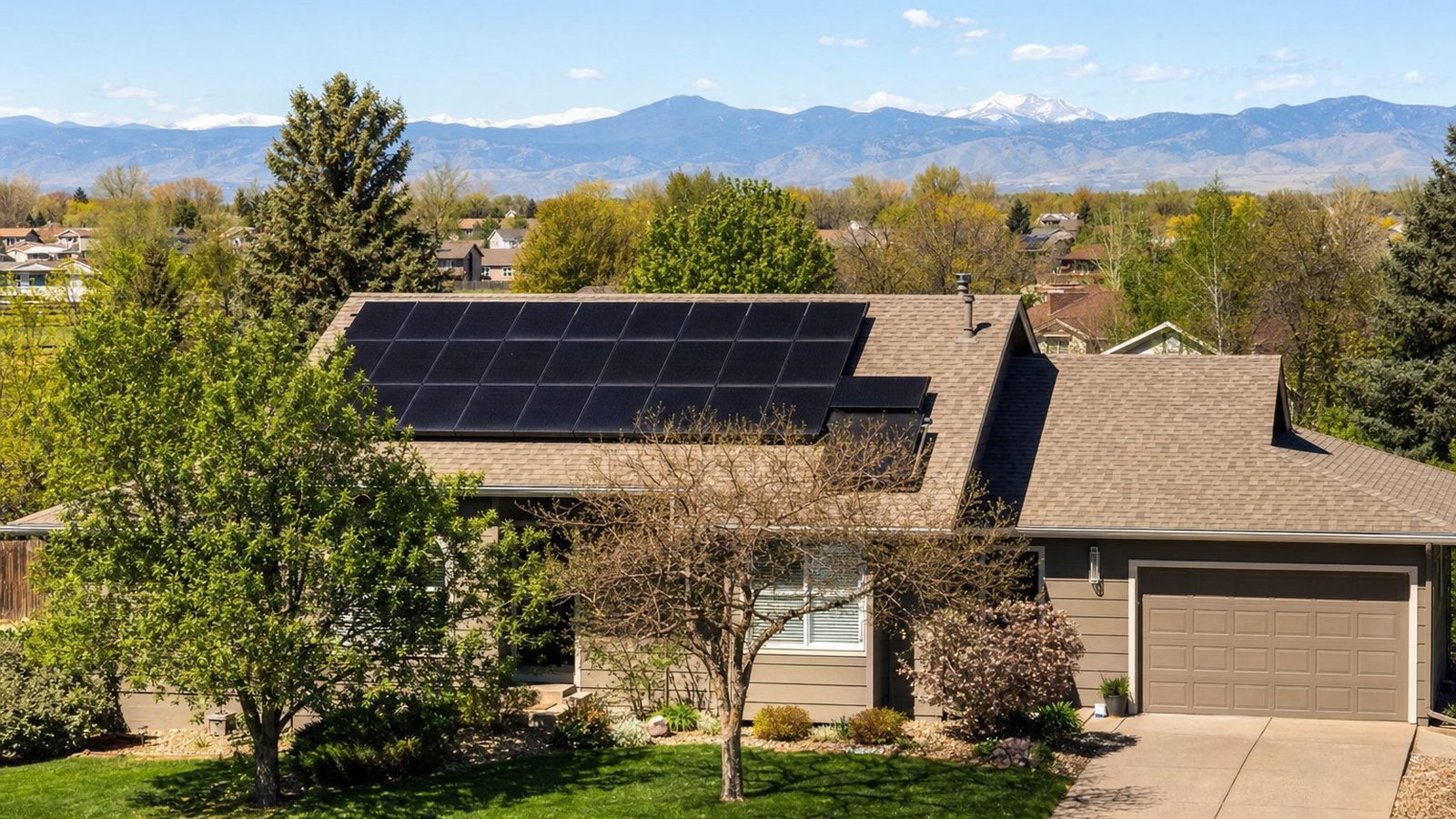
Colorado · Westminster
Westminster made the solar permit boring. That is the compliment.
Written by the Solar Learning Lab research deskUpdated August 30, 202612 min read
Most cities make you dig through valuation tables to guess what a solar permit will cost and how long it will sit in review. Westminster publishes both answers on one page: the permit is a flat $300, small system PV reviews take three days at the longest, and inspections happen within five business days of the request, per the city's own Solar Resources page. Behind those numbers sits Ordinance Number 4071, the Solar-By-Right ordinance, which allows accessory rooftop PV by right in all major zones. The zoning fight other suburbs still have was settled here by council vote.
The harder homework in Westminster is on the utility side. Xcel serves the city, and the paperwork choice buried in Xcel's solar onboarding, the Solar Bank election, quietly determines what your excess generation is worth for as long as you own the home. We cover the fast part and the fine print part below.
Three days for the city, one evening for you
Screen your roof economics before any sales appointment. The permit will not be your bottleneck here.
Run a Westminster estimateA permit desk that publishes its own stopwatch
The mechanics, all from city pages. Applications go through eTRAKiT, which Westminster describes as a one stop platform where contractors pay fees, apply, and schedule or cancel inspections; the process is fully paperless, and the city notes applications cannot be completed on a phone or tablet and recommends Chrome, per the permit application page and Building Division. The division sits at 4800 W 92nd Avenue, front office open 8 a.m. to 5 p.m. weekdays, with residential walk through reviews Tuesdays 1 to 4:30 p.m. and Thursdays 9 a.m. to noon.
Compare the $300 flat solar fee to what non-solar work pays under the fee schedule effective January 1, 2026: valuation based fees with plan review at 4.25 percent of half the total valuation plus 15 percent trade fees. A flat number you can budget before the first site visit is a small thing that signals a bigger one. This city decided rooftop PV should move through the queue like a water heater, not like a custom addition. Contractors price that predictability, and homeowners collect it.
Solar-By-Right means the zoning argument is already over
Ordinance Number 4071 explicitly allows accessory use of solar PV by right in all major zones, per the city's solar page. What that removes from your project is the discretionary layer: no special use hearing, no case-by-case zoning judgment on whether panels belong on your roof. HOA covenants and building code still apply, and applicants are told to read the Building Division's electronic file submittal requirements and the city's solar permitting checklist before filing. But the threshold question, may this house have solar at all, was answered by ordinance rather than left to whoever reviews your file that week. Fewer discretionary steps means fewer places for a project to stall, and stalled projects are where soft costs breed.
Two counties, one desk
Westminster straddles a county line: 71,240 residents on the Adams County side and 45,077 in Jefferson County as of the 2020 census, per the city profile. For most home projects that split creates a moment of confusion about where paperwork goes. For rooftop solar it does not matter at all. The city's own Building Division handles permitting for every Westminster address regardless of county, one desk, one fee, one timeline. If a bid sheet routes your permit through a county office, the contractor is thinking of somewhere else.
The Solar Bank form is the decision Xcel will not chase you about
Colorado's net metering statute, C.R.S. 40-2-124, carries monthly excess forward indefinitely and lets a customer whose annual generation beats consumption make a written election: take payment at average hourly incremental cost for that calendar year, a wholesale-style figure, or donate leftover credits to low income energy assistance. How that plays out on an actual Xcel bill depends on a form: the Solar Bank Election. Per Xcel's Colorado net metering and billing FAQ, customers who never make an election default to the Waive Decision path, and the Continuous Rollover option converts excess at the prevailing total energy rate into a dollar credit that offsets every line on the bill besides the Service and Facilities charge, rolling month to month.
Read the constraints on Continuous Rollover twice. It is permanent. The bank cannot be cashed out. And it does not transfer if you move. For a household planning to sell within a few years, that combination should shape both the election and the system size. Separately, Solar*Rewards adds a production-metered REC payment on top of net metering billing: Xcel's worked example pays $20 on 4,000 kWh of production, which is half a cent per kWh, over a 10 year payment period inside a 20 year contract for the small customer owned category. Real money, but small money. Nobody should buy a system for it.
The battery tax credit has sixteen months of life left
Colorado's Residential Energy Storage Credit pays 10 percent of a battery's purchase price, counting equipment, sales taxes, and freight but excluding installation and permit fees, per the legislature's tax expenditure memo. The statute repeals January 1, 2027, and SB 25-026 extended it only through tax years 2025 and 2026, so this is the final full year to plan around it. The refund mechanics reward reading: claimed on your own return the credit is nonrefundable with no carryforward, but assigned to the seller at purchase it becomes refundable, passed through as a price discount with form DR 1307 filed within 30 days. Batteries also get their own exemption from the state's 2.9 percent sales tax under Section 39-26-733, which matters because the solar equipment exemption in C.R.S. 39-26-724 expressly excludes storage devices.
The rest of the Colorado tax picture, briefly: qualifying PV equipment is exempt from state sales tax, residential renewable property serving the home is exempt from property taxation per the Division of Property Taxation, and there is no Colorado income tax credit for the panels themselves. Federally, the Section 25D homeowner credit is gone for anything completed in 2026: P.L. 119-21 cut it off for expenditures made after December 31, 2025, and the code dates an expenditure to when installation finishes, per the Congressional Research Service. Carryforwards from pre-2026 spending survive.
Pricing a roof investment inside hail alley
NOAA's National Severe Storms Laboratory names Nebraska, Colorado, and Wyoming as the states that usually see the most hailstorms, and the region where they meet, hail alley, averages seven to nine hail days a year, per NSSL. Westminster sits squarely in that geography, so two questions belong in every bid review here. First, what impact rating does the proposed module carry, in writing. Second, what does your homeowner's insurer say about covering the array before installation, since a post-storm surprise is the expensive way to learn your policy's answer. Panels often shrug off hail that totals asphalt shingles, but often is not a warranty. The document is.
Free help the city already pays for
Three Westminster programs cost residents nothing and most sales reps never mention them. The city partners with Solar United Neighbors on Switch Together, a group purchase program covering solar, batteries, EV chargers, and heat pumps, built on free registration, a contractor auction, and a personal proposal. That auction structure is a useful price check against any private quote even if you never buy through it. Second, Westminster addresses qualify for a free Home Energy Squad Plus visit, normally $150, code WESTY2026, phone 303-446-7910, including blower door testing and infrared imaging. Third, the co-op track record is real: the city ran a 2021 Westminster Solar Co-Op, and the 2022 Adams Solar Co-op with Adams County, Northglenn, and Solar United Neighbors hit its 200 member goal, per the city's renewable energy page. Co-ops are free to join with no obligation to install.
What a roof produces at 5,325 feet
Our downtown Westminster PVGIS run models 1586.8 kWh per year per installed kW. June leads at 153.0 kWh per kW, December bottoms at 98.8, and the shoulder months hold up unusually well: March models 148.2, within four percent of the June peak. Thin, clear air at elevation is doing what humidity-free skies do.
June models 153.0 kWh per kW. Note the strong March shoulder at 148.2, a Front Range altitude signature that flatter, more humid markets do not show.
PVGIS v5.2 model run by Solar Learning Lab on August 30, 2026, NSRDB radiation database. Fixed south facing mount, 30 degree tilt, 14 percent losses, downtown Westminster coordinates. Your roof will differ. Full methodology at PVGIS. The city's own Energy Action Plan gives a sense of the demand side: residential premises are 90.9 percent of all premises and 59 percent of total community energy consumption, with residential electricity at 335 million kWh in the 2014 baseline, per the plan.
The Xcel price backdrop, with date stamps
Public Service Company of Colorado averaged 15.05 cents per kWh across residential customers in 2024, per EIA Table 6. Xcel's fetchable residential brochure carries rates in effect May 1, 2024, while the rate books page posts summaries as recent as July 1, 2026, so treat any specific cents-per-kWh figure as dated the moment it is quoted and verify against the current rate book before signing.
| Energy source | Type | Average price | What that means |
|---|---|---|---|
| Xcel Energy Colorado | 2024 residential average | 15.05¢ per kWh | EIA Table 6, 2024 Utility Bundled Retail Sales, Residential. |
| Xcel Schedule R | Summer energy charge, brochure dated May 1, 2024 | 10.380¢ per kWh | Winter at 8.570 cents. Service and Facility charge $7.10 monthly, production meter $2.55 if applicable. |
| Xcel Schedule RE-TOU | Summer on peak, brochure dated May 1, 2024 | 20.915¢ per kWh | Shoulder 14.332, off peak 7.749. Current values live at Sheet 33B of the Electric Rate Book. |
| Westminster rooftop | PVGIS modeled output | 1586.8 kWh per kW annually | Fixed south facing model at 30 degree tilt. Individual roofs differ. |
Brochure figures from the dated May 2024 residential brochure; confirm current tariffs at the rate books page.
Who installs here, and the one question to ask them
The bench serving Westminster includes a firm headquartered in the city itself alongside established Denver and Broomfield shops. Our screening question for this market: which Solar Bank election are you recommending for my situation, and why. An installer with a reasoned answer has read the same FAQ you now have. One who says the billing sorts itself out has not.
Ratings snapshot: Google Maps, August 2026, via the DataForSEO SERP feed. Zero companies paid us and none are endorsed by us.





Solar RNR
Denver, CO
5.0(306 Google reviews)
Ratings and review counts are Google Maps ratings for Westminster local results, retrieved August 17, 2026 via the DataForSEO SERP API. We list the highest rated established companies we found. No company paid to appear here, and appearing here is not an endorsement. Check current reviews and licensing before you sign anything.
Test the numbers before anyone tests your patience
The tool below uses the 15.05 cent PSCo average and our Westminster production run. It cannot model TOU pricing or Solar Bank mechanics, so use it to size the decision, then push any bidder for tariff-specific math.
Slider top is our downtown Westminster PVGIS run, 1,586.8 kWh per kW at 5,325 feet of elevation. Slider bottom trims 15 percent for shade and orientation.
Cash quotes in Westminster cluster near $2.66 per watt, against a $3.50 national 2024 median (LBNL). Use your quote.
Assumptions you can change
Use the rate on your actual lease or PPA quote. There is no published statewide average we trust enough to hardcode.
Cash purchase
$13,566 after state credit
- Year 1 benefit
- $101/mo
- Payback
- 11 years
- 20 year net position
- $15,990
A Westminster cash buyer gets a $300 flat permit, a sales tax exemption on qualifying solar equipment, property tax exemption on the system, and a possible Solar*Rewards REC payment. None of that requires a loan to capture.
Solar loan
$177/mo 15 yr payment
- Year 1 net
- -$75/mo
- Upfront
- $0
- 20 year net position
- -$2,294
Financing uses the Colorado cost benchmarks. Before signing dealer paper, check whether a Switch Together group purchase round is open, since the city runs one with Solar United Neighbors.
Lease / PPA
$0 down you buy the power
- Year 1 net
- -$60/mo
- Upfront
- $0
- 20 year net position
- -$15,311
The 25D homeowner credit ended December 31, 2025. Evaluate any Westminster lease on its escalator and on who controls the Xcel Solar Bank election, because that choice is permanent.
Estimates, not quotes. Inputs use the PSCo 2024 residential average from EIA, our downtown Westminster PVGIS run, and EnergySage Colorado cost data. Xcel TOU pricing, Solar Bank elections, and REC payments are not modeled. We are a solar installer and we also partner with other solar companies. See our disclosures.
We are a solar installer and we also partner with other solar companies.
Westminster solar, asked plainly
What does a Westminster solar permit cost and how long does review take?
Can my zoning block rooftop solar here?
I live on the Jefferson County side. Where does my permit go?
What happens to power I export to Xcel?
Is the Colorado battery credit still available?
Does Westminster offer anything free before I buy?
The file drawer
Everything above traces to these documents, reviewed August 30, 2026. Where a figure carries a date, that date travels with it.
- https://www.westminsterco.gov/737/Solar-Resources
- https://www.westminsterco.gov/621/Building
- https://www.westminsterco.gov/617/Apply-for-a-Permit-Project
- https://www.westminsterco.gov/DocumentCenter/View/6284/Fee-Schedule-V3-2026
- https://www.westminsterco.gov/352/Energy-Efficiency-Electrification
- https://www.westminsterco.gov/Residents/CityServices/Sustainability/RenewableEnergy
- https://devwww.westminsterco.gov/Portals/1/Documents/Residents%20-%20Documents/City%20Services/WestminsterEnergyActionPlanFINAL.pdf
- https://www.westminstereconomicdevelopment.org/wp-content/uploads/2024/01/2024-FINAL-Digital-ED-Profile.pdf
- https://www.eia.gov/electricity/sales_revenue_price/xls/table_6.xlsx
- https://www.xcelenergy.com/company/rates_and_regulations/rates/rate_books
- https://www.xcelenergy.com/staticfiles/xe-responsive/Company/Rates%20&%20Regulations/CO-Residential-Rates-Brochure.pdf
- https://www.xcelenergy.com/staticfiles/xe-responsive/Programs%20and%20Rebates/Residential/CO-Solar-Rewards-FAQ.pdf
- https://www.xcelenergy.com/staticfiles/xe-responsive/Programs%20and%20Rebates/Residential/CO-SR-Existing-Customer-FAQ.pdf
- https://law.justia.com/codes/colorado/title-40/public-utilities/general-and-administrative/article-2/part-1/section-40-2-124/
- https://law.justia.com/codes/colorado/2023/title-39/specific-taxes/sales-and-use-tax/article-26/part-7/section-39-26-724-d-1/
- https://dpt.colorado.gov/renewable-energy
- https://content.leg.colorado.gov/sites/default/files/2025-TE15_residential_energy_storage_system_tax_expenditures.pdf
- https://tax.colorado.gov/DR1307
- https://www.congress.gov/crs-product/IN12611
- https://www.nssl.noaa.gov/education/svrwx101/hail/
- https://en.wikipedia.org/wiki/Westminster,_Colorado
Get a Westminster quote with the elections spelled out
Ask us or any bidder to name the Solar Bank election, the module impact rating, and the battery credit path on page one of the proposal. Everything else follows from those three.
What does your monthly electric bill look like?
Westminster average is $167 per month (EIA, 2024).