Skip to content
Solar Learning Lab
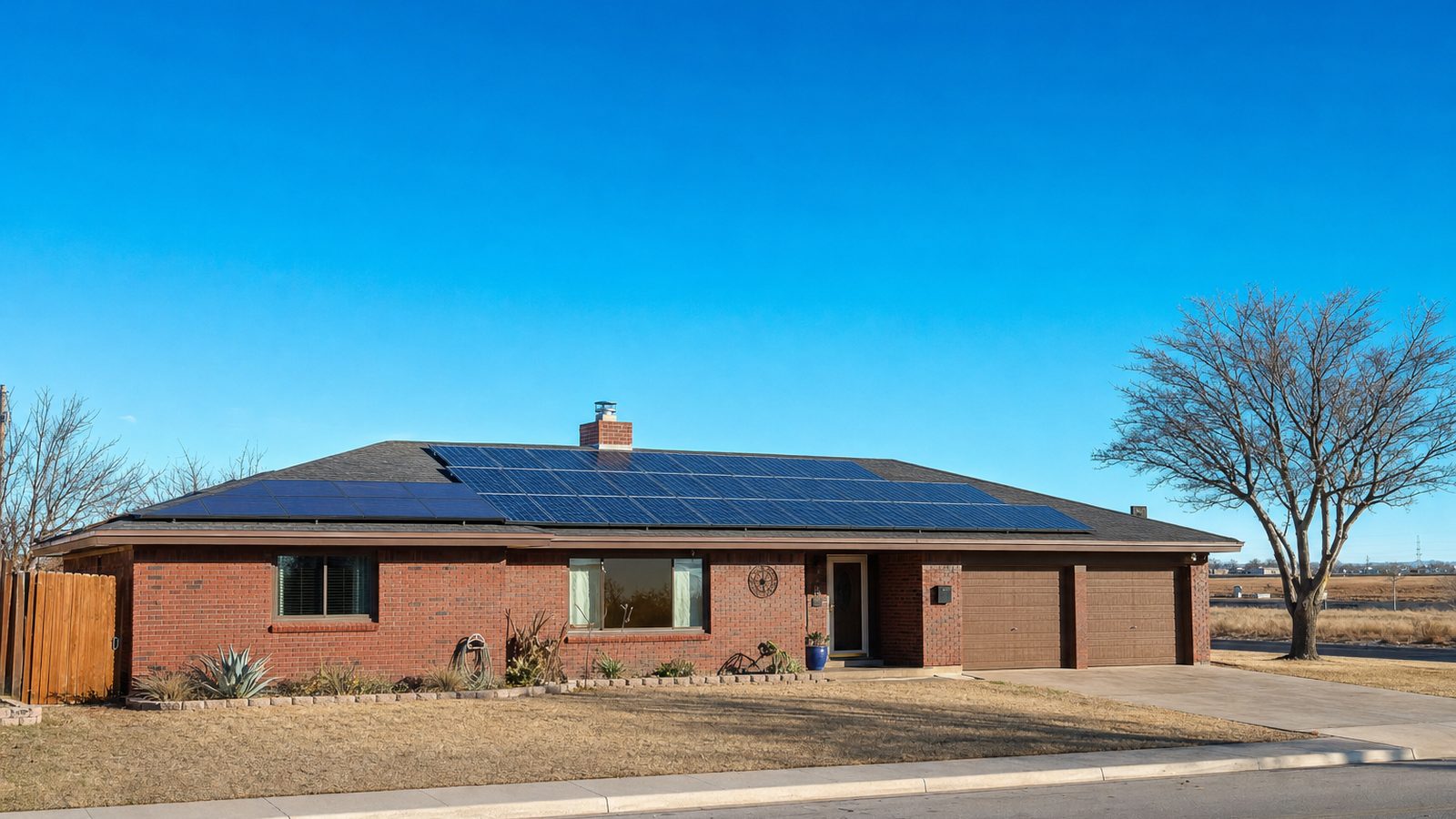
Solar panels mounted on a home roof beneath a wide open sky

texas / Lubbock

Lubbock solar since the 2024 switch: shop the plan first

Written by the Solar Learning Lab research deskUpdated August 30, 202612 min read

Between March 4 and April 1, 2024, retail electric service for 109,577 Lubbock premises moved from LP&L to competitive providers. LP&L now runs poles, wires, and meters. Nobody owes you a buyback rate, which makes plan selection the single biggest lever on solar payback here. PVGIS production source.

Sun is not the bottleneck in Lubbock

At 1789.9 modeled kWh per kW, production is generous. The contract you sign for exports is where the math gets won or lost.

Start with the numbers

March 2024 rewired everything

If your mental model of Lubbock electricity was formed before 2024, throw it out. The transition ran in stages: the PUCT approved LP&L's ERCOT move in March 2018, 83,000 customers shifted onto the ERCOT grid in May 2021, the remaining 19,000 left the Southwest Power Pool in December 2023, and the council vote for full deregulation came February 22, 2022, per the local transition history. The shopping window opened January 5, 2024. Meters flipped March 4. ERCOT's market notice records 109,577 premises transferred to competitive providers by April 1, 2024, with reconciliation done April 5.

What remains of LP&L is the wires business. Its shopping guide puts it plainly: retail providers sell the power, LP&L maintains the infrastructure it owns and manages delivery no matter which company you choose. The city utility still publishes a Tariff for Competitive Retailer Access, effective November 1, 2025, with a residential delivery schedule and a distributed generation interconnection process, per the filed tariff. Households that never picked a provider during the window were defaulted to Reliant, TXU, or Octopus Energy. Any solar pitch that quotes an LP&L retail rate or promises LP&L net metering payments is describing a utility that no longer exists in that form.

Export pay is a plan feature

Here is the rule that governs every kWh your roof sends out. You must sell excess power to the same company you buy electricity from, and that company is not required to purchase it. Some tie buyback to one specific retail offer. That language comes straight from LP&L's published guide, which points customers to PowertoChoose.org to find plans that pay for exports. Texas Utilities Code 39.916 backs this up at the state level: a retail provider is not required in all circumstances to purchase surplus electricity, per the statute.

The mistake we see in this market is sequencing. People price the hardware, sign the install contract, then go looking for a buyback plan and discover their current provider pays nothing for exports until the contract term ends. Reverse it. Compare buyback plans on PowertoChoose.org before sizing the system, because a plan that pays for surplus can justify a bigger array, while a plan that pays nothing argues for sizing tight to daytime consumption. There is a small consolation in a mediocre buyback market: 53.3 percent of Lubbock households heat with electricity per the 2023 ACS estimates, and heavy self-consumption blunts the export problem.

A $75 permit with one catch

City permitting is refreshingly cheap. Lubbock issues an Alternative Energy Source permit for $75.00, covering the required inspection, and the permit must be in hand before installation starts, per the Residential Permitting page. Plans and the application go in electronically as PDFs through the Citizen Self Service portal. Codes are current: the 2021 International Codes and 2020 National Electrical Code were adopted March 26, 2024 and enforced from June 3, 2024, per Building Safety.

The catch sits in the fine print of the application itself: only licensed electrical contractors may obtain this permit. A DIY array cannot be legally permitted here, whatever the video tutorials suggest. And every permit in LP&L's electrical service area must include the approved interconnect agreement between the customer and LP&L, which brings us to the ordering problem below. Residential questions go to a Residential Plans Examiner at 806-775-2087, weekdays 8 a.m. to 5 p.m., at 1314 Avenue K.

The paperwork chain, in order

Lubbock's process has a strict sequence, and skipping a link stalls everything behind it. First, complete LP&L's Interconnection Agreement and return it to 1314 Ave K, by mail, or to customerrelations@lpandl.com. LP&L then issues an Authorization Letter. Second, inside city limits, take that letter to obtain the city permit. Third, install, then request final inspection from Building Safety. Fourth, LP&L contacts you within 7 to 14 business days to install the meter and establish the Distributed Generation Delivery System Service Rate on the account, and it may charge interconnection costs, per the tariff.

One terminology snag worth flagging: the city's permitting page still says the utility will establish "the Net Metering Rate" on the account. The tariff itself calls it the Distributed Generation Delivery System Service Rate, and actual export compensation now comes from your retail provider, not from that delivery rate. Trust the tariff wording. Since September 1, 2025, S.B. 1202 also allows third party review and inspection for home backup power on one and two family dwellings at 600 volts or less, though it does not touch a municipally owned utility's authority over interconnection, per the city's page.

LP&L or SPEC? Check first

A Lubbock street address does not automatically mean LP&L wires. The city's own permitting page names two utilities requiring interconnect agreements inside city limits: LP&L and South Plains Electric Cooperative. SPEC territory plays by cooperative rules, and its 2024 EIA numbers show an average residential price of 10.3 cents per kWh across 56,173 customers, a different economic baseline than the competitive retail market LP&L customers now shop in. Ten minutes confirming your wires company, before any proposal is drafted, prevents an installer from quoting the wrong interconnection process entirely.

Old rate tables lie here

EIA's 2024 Table 6 shows a City of Lubbock row at 13.69 cents per kWh, and it is a trap. That row covers just 4,825 residential customers, the tail end of bundled LP&L service in a transition year where 109,577 premises actually moved to competitive providers, per EIA read against the ERCOT notice. Nobody in Lubbock pays that today.

Better context comes from the big retail providers in the same table: TXU Energy at 18.7 cents across 1,446,391 residential customers statewide, Reliant at 17.4 cents across 1,548,250. Those are statewide averages, not Lubbock offers, but they frame the market a Lubbock household actually shops in. When a proposal's savings column assumes a 13 cent rate, the payback stretches years past the sales pitch. Demand the quote name the plan and rate it modeled.

South Plains production, charted

The resource is the easy part. Lubbock logs 3,196.6 mean annual sunshine hours, 72 percent of possible, at 3,202 feet on the Llano Estacado, per the city's climate record. Our PVGIS run models 1789.9 kWh per installed kW annually, with April the top month at 167.3 kWh per kW and even December holding 121.7. Cooling demand backs it up: an average of 92 afternoons a year hit 90 F or better, 13.3 reach 100 F.

Jan
Feb
Mar
Apr
May
Jun
Jul
Aug
Sep
Oct
Nov
Dec

Spring, not midsummer, is the modeled peak. Semi-arid air and altitude keep shoulder months productive.

PVGIS v5.2. PVGIS v5.2 model run by Solar Learning Lab on August 30, 2026, NSRDB radiation database. Fixed south facing mount, 30 degree tilt, 14 percent losses, downtown Lubbock coordinates. Your roof will differ.

The 12.4 mph question for racking

Lubbock ranks 10th windiest city in the United States at an average 12.4 mph, and the Weather Channel named it Toughest Weather City in America in 2013, per the climate record. That constant load is a design input, not trivia. Attachment count, rail spec, and fastener engineering deserve a direct question in every bid review: what wind speed is this racking rated for, and show me the attachment layout. A panel warranty means little if the mounting hardware was specced for a calmer market. The 2020 NEC and 2021 codes the city enforces give inspectors teeth here, which is one more reason the licensed-contractor rule works in the buyer's favor.

What state law locks in

Three statutes do real work for a Lubbock owner. Utilities Code 39.916 guarantees interconnection of distributed renewable generation up to 2,000 kW on the customer side of the meter and bars added liability insurance requirements, per the code. Tax Code 11.27 keeps the appraised value a solar device adds off the property tax rolls for on-site use, per the exemption statute. And Property Code 202.010 voids HOA bans on solar devices, with exceptions: panels can be required to stay within the roofline, conform to roof slope with the top edge parallel to the roofline, and use silver, bronze, or black hardware, per the property code.

What the law does not give: a state income tax credit (Texas has none), a statewide buyback mandate, or, any longer, the federal homeowner credit. P.L. 119-21 ended the 30 percent Section 25D credit for expenditures after December 31, 2025, with completion date controlling, per the Congressional Research Service. Price 2026 systems on avoided kWh and the property tax shield, nothing else.

Inputs behind the estimate

Energy sourceTypeAverage priceWhat that means
texasResidential electricity16.44¢ calculator benchmarkTable 5.6.A, May 2026
LubbockPVGIS output1789.9 kWh per kW annuallyDowntown model run; individual roofs and racking choices differ.

The benchmark is a state average. Your actual rate is whatever retail plan you signed, so pull a bill before trusting any payback claim.

Local crews, then hard questions

Use ratings to build a shortlist, then test each firm on three Lubbock specifics: which wires company serves the address, where the LP&L Authorization Letter sits in their project timeline, and which retail plan their savings model assumes for exports. Firms that work this market weekly answer without checking notes.

Ratings snapshot: Google Maps, August 2026, via the DataForSEO SERP feed. Zero companies paid us and none are endorsed by us.

Pure Energy

Lubbock, TX

4.5(104 Google reviews)

Read the graded profile

Freedom Forever

Lubbock, TX

4.1(79 Google reviews)

Read the graded profile

Harvest Energy Solutions

5.0(23 Google reviews)

Semper Fi Solar logo

Semper Fi Solar

5.0(16 Google reviews)

Gallagher Solar

Lubbock, TX

5.0(7 Google reviews)

Ratings and review counts are Google Maps ratings for Lubbock local results, retrieved August 17, 2026 via the DataForSEO SERP API. We list the highest rated established companies we found. No company paid to appear here, and appearing here is not an endorsement. Check current reviews and licensing before you sign anything.

Model your bill

$164
1,790

High end is our downtown Lubbock PVGIS run at 1789.9 kWh per kW, among the strongest we have modeled in Texas. Low end takes 85 percent of that for tougher roofs.

$2.21

Cash quotes in Lubbock cluster near $2.21 per watt, against a $3.50 national 2024 median (LBNL). Use your quote.

Assumptions you can change
2.5%
7%
15
24c

Use the rate on your actual lease or PPA quote. There is no published statewide average we trust enough to hardcode.

2%
Estimated system: 6.7 kWAnnual usage: 11,971 kWhState credit: $0

Cash purchase

$14,807 after state credit

Year 1 benefit
$164/mo
Payback
8 years
20 year net position
$33,037

Lubbock left the LP&L retail monopoly in spring 2024, so an owned system's return depends on which competitive provider you sign with and whether that plan buys exports. No provider is obligated to.

Solar loan

$205/mo 15 yr payment

Year 1 net
-$41/mo
Upfront
$0
20 year net position
$10,880

Loan pricing uses the Texas benchmarks baked into the state calculator. On the South Plains, verify that the financed quote also covers wind-rated racking and attachment hardware, not panels alone.

Lease / PPA

$0 down you buy the power

Year 1 net
-$76/mo
Upfront
$0
20 year net position
-$18,644

Any third-party contract in Lubbock still leaves you shopping retail plans for the house's grid usage. Read how the agreement treats exported kWh under whichever provider you pick, because the provider sets buyback, not LP&L.

Estimates, not quotes. Production comes from our Lubbock PVGIS run; rates and costs use state benchmarks, not any specific retail plan. Export value in Lubbock is set plan by plan and can be zero. We are a solar installer and we also partner with other solar companies. See our disclosures.

Lubbock answers

Will LP&L buy my excess solar power?
No. LP&L stopped selling electricity when retail service moved to competitive providers in spring 2024. Excess power must be sold to whichever company you buy electricity from, and that company is not required to purchase it, per LP&L's own shopping guide.
Can I pull the solar permit myself?
Not in Lubbock. Only licensed electrical contractors may obtain the Alternative Energy Source permit, per the city's application, so a homeowner self-install cannot be permitted through this path.
How soon after final inspection does the meter get swapped?
LP&L contacts the customer within 7 to 14 business days of final inspection to install the meter and establish the Distributed Generation Delivery System Service Rate on the account, per the LP&L tariff.
Which building codes apply to a Lubbock install?
Building Safety adopted the 2021 International Codes and the 2020 National Electrical Code on March 26, 2024, with enforcement from June 3, 2024, per the department's page.
Is every Lubbock address in LP&L territory?
No. The city's permitting page names both LP&L and South Plains Electric Cooperative as utilities requiring interconnect agreements inside city limits, so confirm which wires company serves your address before anyone drafts paperwork.
Does Texas give me any tax break on the system?
Tax Code 11.27 exempts the appraised value a solar device adds from property taxation when the device primarily serves on-site use, per the statute. There is no Texas state solar income tax credit, and the federal 25D homeowner credit ended for installations completed after December 31, 2025.

Get a Lubbock estimate built on your plan

We are a solar installer and we also partner with other solar companies. Read our disclosures.

What does your monthly electric bill look like?

texas average is $167 per month (EIA, 2024).