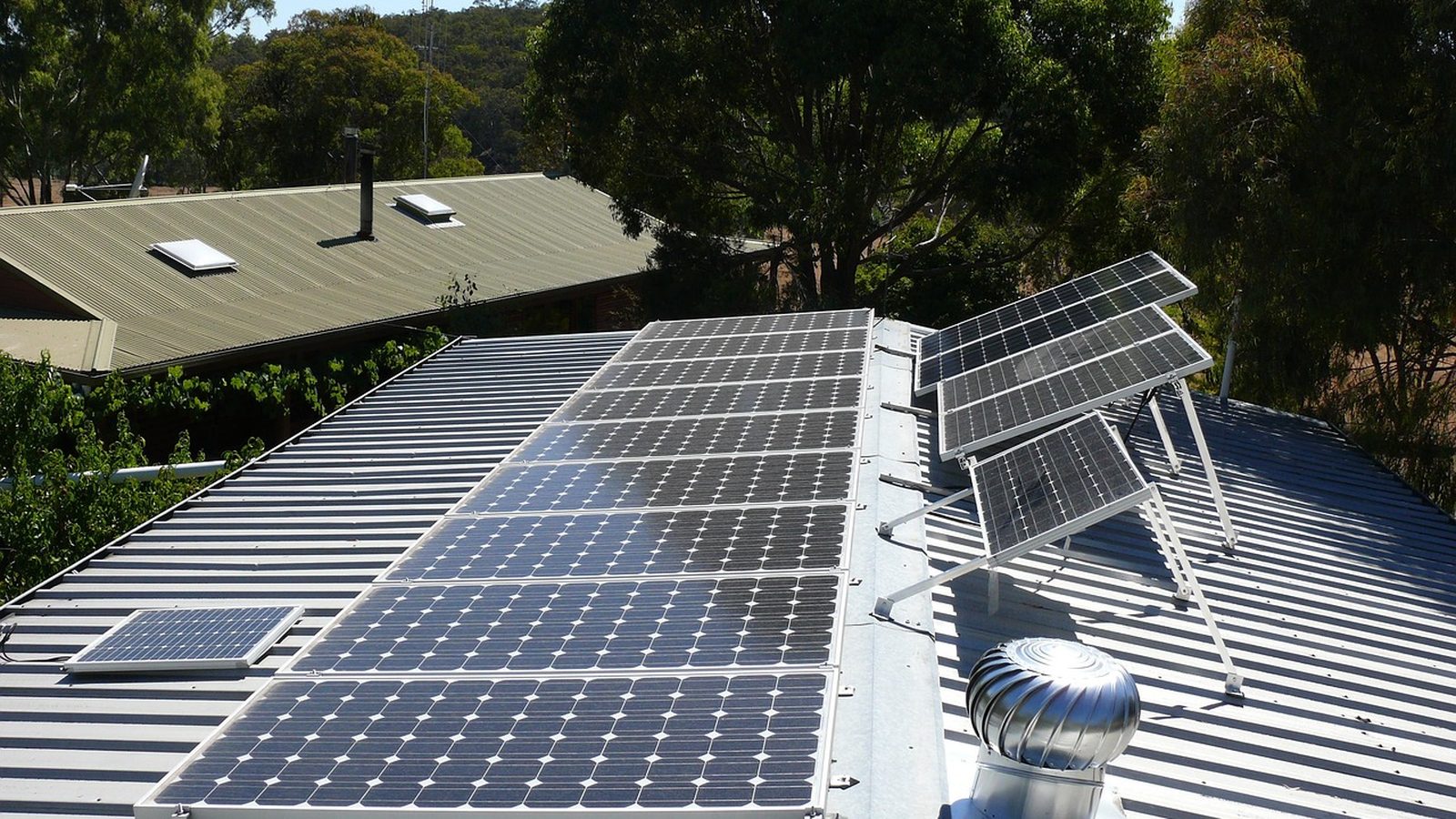
Photo: RosiePosie, via Pixabay
Arizona · Glendale
Glendale solar starts at the utility border
Written by the Solar Learning Lab research deskUpdated August 22, 202611 min read
Glendale is not one solar market. The city says APS and SRP both serve it and tells people in the border area to verify directly which company supplies power. That answer changes export compensation, plan choice and the way a proposal should be sized. A Glendale roof can be excellent. A Glendale quote that does not name the utility is unfinished.
Published base residential PV permit total
Published total when electrical clearance applies
PVGIS annual output per installed kW
Ask the bill-first question
Get a local estimate only after the installer identifies APS or SRP, the applicable plan and the permit assumptions.
Request a Glendale reviewA city with two electric maps
Glendale's roadway-lighting guidance does not hedge: APS supplies one service area and SRP supplies another, and the city says border locations need direct utility verification. Its inspection menu reinforces the split with separate clearance codes, 681 for SRP and 682 for APS. There is no fetched city or utility source that divides Glendale households between the two companies. A sales rep who claims to know from a neighborhood name is filling in a map the public record does not provide. Read the city guidance.
That border is financial, not ceremonial. EIA's 2024 utility table shows average residential prices of 16.45 cents per kWh for APS and 13.46 cents for SRP. Those are not promised Glendale bills, but they explain why a state-average model cannot be the final word. The installer needs the account's actual provider and price plan, then needs to show how much solar is used on site versus sent away. See the EIA table.
| Energy source | Type | Average price | What that means |
|---|---|---|---|
| APS | Utilitywide residential average | 16.45¢ per kWh | EIA 2024 benchmark, not a Glendale tariff. |
| SRP | Utilitywide residential average | 13.46¢ per kWh | EIA 2024 benchmark, not a Glendale tariff. |
| Glendale solar | Export value | address and plan dependent per kWh | Confirm the provider before sizing. |
Glendale electric-service boundary guidance · Glendale residential PV requirements and fee items · Glendale electronic solar plan submission · Glendale inspection scheduling · Arizona Corporation Commission APS case update · ACC resource-comparison framework · August 2026 APS export-rate coverage · SRP solar-plan comparison · SRP customer-generation detail · SRP time-of-use export page · SRP rooftop-solar information · SRP residential rebate terms · SRP renewable-energy-credit program · SRP residential-change overview · EIA Arizona utility price workbook · Glendale Census QuickFacts · NOAA regional climate normals · Arizona solar device credit form · Arizona solar credit statute · Arizona solar property-tax treatment · Arizona solar retail-sales exemption · Arizona municipal solar-permit statute · Congressional federal-credit update · PVGIS modeling tool
Glendale publishes a permit ledger, so use it
The city's base stack is unusually explicit: $29.79 electrical base permit, $38.64 sub-panel, $114.35 inspection and $122.88 plan review, for $305.66. Electrical clearance adds another $114.35, producing $420.01. Glendale adjusts fees by CPI each July 1. Do not accept a proposal with an unexplained permit allowance when the city has already itemized the published pieces. Ask which items the contractor expects at this address and which are provisional. View the requirements and fee list.
Glendale does not offer an instant-permit promise in the city pages reviewed. The published route is an electronic review of one complete PDF plan set. The required record reaches beyond module data: it includes electrical diagrams, disconnect locations, roof material and slope, anchoring, flashing, cut sheets and, when a main breaker is derated, a load-calculation worksheet. That is why a roof visit and an electrical check matter before a lender application. See the electronic review process.
A.R.S. 9-468 caps municipal solar permit fees at the cost of issuing the permit and allows cities to use a qualifying automated platform. It does not require Glendale to do so. The right conclusion is narrower than an instant-permitting claim: Glendale has a documented electronic plan-review workflow and a published fee structure. The review timeline is n.a. in the material fetched, so schedule promises should come from the current project queue, not this page. Read the statute.
The SRP side needs a plan decision, not a generic net-metering label
SRP lists six plans for solar customers. Customer Generation and Average Demand use net metering. Conserve and Save, Manage Demand and Save, Time-of-Use Export, and Electric Vehicle Export use an export credit. Customer Generation has service-charge tiers and a demand charge tied to on-peak thirty-minute intervals. Time-of-Use Export has no monthly demand charge, but imports and exports are metered instantaneously. A Glendale SRP proposal should name the selected plan and show the household's expected timing, especially summer cooling hours. Compare SRP solar plans.
There is a live documentation problem worth keeping visible. SRP's plan-comparison and Time-of-Use Export pages say the fixed export credit is 3.45 cents per kWh. The SRP rooftop-solar page says $0.0187 per kWh for the same export-plan group. Both statements are linked here because both were published in the reviewed source set. Do not average them. Do not choose the more favorable one. Ask the bidder for the current ratebook and model the project with the exact rate and date they are relying on. Read the Time-of-Use Export page and the rooftop page.
SRP itself says solar customers still rely on the utility for about two-thirds of their electricity. That is a useful antidote to the idea that more panels automatically mean more value. On this side of Glendale, the practical prize is matching production to consumption, not building an array that assumes daytime surplus has a retail value. See SRP's customer context.
On the APS side, exported power is the weak link
Arizona Corporation Commission coverage reports that the August 12, 2026 action reduced the APS and UNS solar export rate by 10 percent to 5.5 cents per kWh for new solar customers. The Resource Comparison Proxy year runs September 1 through August 31. That makes daytime self-use central to a Glendale APS design. The current APS residential plan-level charges were not verified in this research set, and the APS rate case remains open, so this page does not invent a tariff to complete the chart. Read the August 2026 APS coverage.
The APS question is not whether a panel makes electricity. It is whether that electricity arrives while the house needs it. A proposal should include monthly use, on-site solar use, exports, the export assumption and the effective date for that assumption. If those five figures do not appear, the quoted savings are not yet auditable. Read the ACC export-rate framework.
Glendale sunshine is plentiful. Geometry still wins.
May is the high point in this fixed south-facing model.
Method: PVGIS v5.2. PVGIS v5.2 model run by Solar Learning Lab on August 22, 2026, NSRDB radiation database. Fixed south facing mount, 30 degree tilt, 14 percent losses, downtown Glendale coordinates. Your roof will differ.
Our downtown Glendale run estimates 1,803.5 kWh per installed kW each year, with May at 173.7 kWh per kW. It assumes a fixed south-facing array, 30 degree tilt and 14 percent losses. That is a reliable comparator, not a roof design. Glendale's plan requirements themselves call attention to roof slope, existing roofing material, attachments and flashing. A design that cannot explain how it departs from a city-coordinate model has skipped the part that makes the number local. Review Glendale's roof-plan requirements.
The tax credit is modest. The financing choice is not.
Arizona's residential solar energy-device credit is 25 percent of qualifying cost, capped at $1,000 in aggregate for the residence, with unused credit carried forward up to five years. Arizona also has the cited retail sales exemption for solar energy devices and statutory property-tax treatment. Those rules are worth documenting with a tax adviser, but none replaces a fair cash price. The federal homeowner 25D credit ended December 31, 2025. A lease or PPA provider may claim 48E, which is provider treatment rather than a homeowner credit. Read the Arizona credit statute and the federal credit update.
Glendale's 57.2 percent owner-occupancy rate, $73,530 median household income and $387,500 median owner-occupied value describe a mixed market. Monthly payment claims need more scrutiny here than a generic system-size pitch. Compare cash price, financed price, lender term, dealer fee disclosure, roof work and utility plan on one sheet. A lower monthly payment can still be the more expensive system. Read Glendale's housing context.
Five local names, one Glendale-specific test
These Google Maps results are not endorsements. In Glendale, the differentiator is whether a company can cleanly separate an APS design from an SRP design before asking for a signature. Ask every bidder to state the serving utility, selected plan, export source, permit ledger and whether electrical clearance is included. The same roof can generate similar energy under both utilities. It does not generate the same bill result.
Ratings snapshot: Google Maps, August 2026, via the DataForSEO SERP feed. Zero companies paid us and none are endorsed by us.




These are Phoenix-area Google Maps results retrieved August 17, 2026 through the DataForSEO SERP API. They are shown to give a Glendale buyer real companies to question about the APS and SRP boundary, not to crown a best installer. No placement was purchased and this page does not recommend a company. Validate current reviews, contractor licensing and the utility-specific price model before choosing.
Use Glendale production, then replace the rate with the bill
Glendale's top slider value is the fixed south-facing city run. The roof plane, attachment layout, shading, equipment placement and the household's daytime demand can move a real installation away from that model.
Cash quotes in Glendale cluster near $2.20 per watt, against a $3.50 national 2024 median (LBNL). Use your quote.
Assumptions you can change
Use the rate on your actual lease or PPA quote. There is no published statewide average we trust enough to hardcode.
Cash purchase
$14,400 after state credit
- Year 1 benefit
- $160/mo
- Payback
- 8 years
- 20 year net position
- $32,259
Arizona limits the residential device credit to a $1,000 lifetime cap, even though the statute describes it as 25 percent of qualifying cost. The federal homeowner credit ended in 2025. In Glendale, identify the serving utility before treating any savings range as useful.
Solar loan
$205/mo 15 yr payment
- Year 1 net
- -$45/mo
- Upfront
- $0
- 20 year net position
- $9,771
For a Glendale loan, put the cash equipment price beside the financed price, then run the payment against the correct APS or SRP bill model. A low payment with no utility assumption is not a complete comparison.
Lease / PPA
$0 down you buy the power
- Year 1 net
- -$92/mo
- Upfront
- $0
- 20 year net position
- -$23,334
A Glendale lease or PPA can leave federal 48E with the provider. Request the escalation schedule, transfer rules, contract length and the utility-plan assumption used to support the offer.
Estimates, not quotes. This Glendale range combines the Arizona EIA baseline, EnergySage Arizona cost data and our PVGIS production run. APS and SRP meet inside the city, so the actual account provider must replace the generic rate before a proposal is decision-ready. We are a solar installer and we also partner with other solar companies. See our disclosures.
Glendale solar questions
Does Glendale have APS or SRP?
What is the published permit fee?
Does Glendale offer instant solar permits?
What SRP export credit should a quote use?
Is the federal homeowner credit still available?
Glendale source ledger
Glendale electric-service boundary guidance · Glendale residential PV requirements and fee items · Glendale electronic solar plan submission · Glendale inspection scheduling · Arizona Corporation Commission APS case update · ACC resource-comparison framework · August 2026 APS export-rate coverage · SRP solar-plan comparison · SRP customer-generation detail · SRP time-of-use export page · SRP rooftop-solar information · SRP residential rebate terms · SRP renewable-energy-credit program · SRP residential-change overview · EIA Arizona utility price workbook · Glendale Census QuickFacts · NOAA regional climate normals · Arizona solar device credit form · Arizona solar credit statute · Arizona solar property-tax treatment · Arizona solar retail-sales exemption · Arizona municipal solar-permit statute · Congressional federal-credit update · PVGIS modeling tool
Request a Glendale bill and roof review
We are a solar installer and we also partner with other solar companies. Bring the electric bill, roof information and any planned panel work. Glendale is a two-utility city. The estimate should prove that it knows which side of the line applies.
What does your monthly electric bill look like?
Arizona average is $167 per month (EIA, 2024).